
Overview: The Federation of Indian Micro and Small & Medium Enterprises (FISME) has urged the government to commission market-specific studies covering 10 priority sectors and strengthen India’s export testing infrastructure. The proposals aim to help MSMEs understand tariffs, origin rules, product standards and certification costs while improving overseas acceptance of Indian test reports.
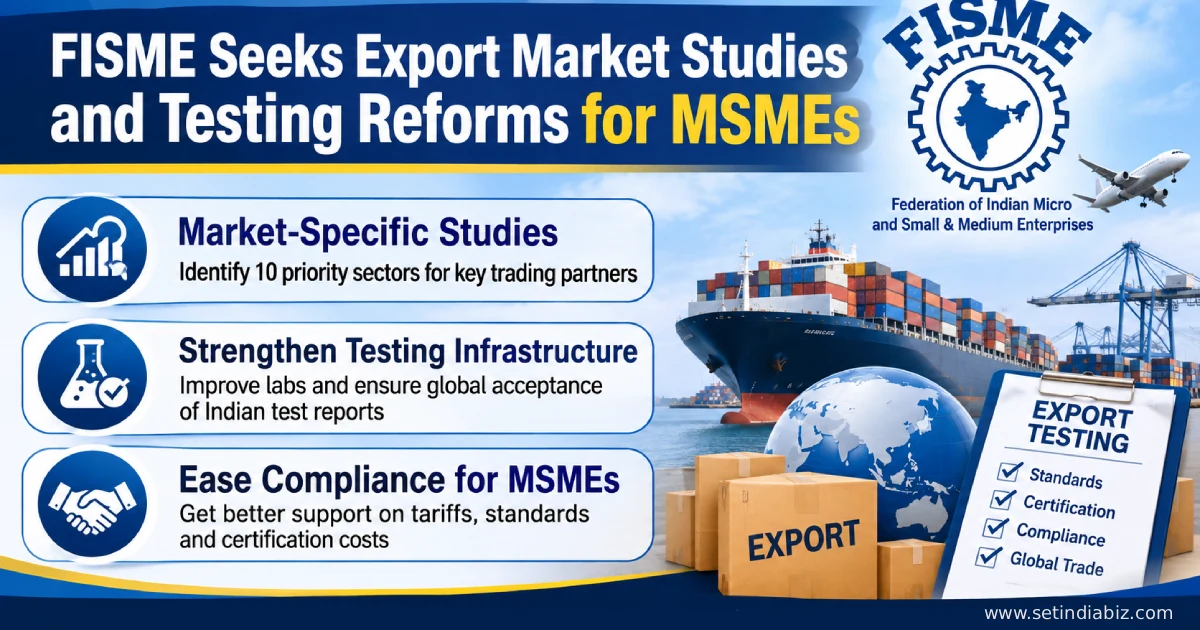
The Federation of Indian Micro and Small & Medium Enterprises (FISME) has urged the government to commission market-specific export studies and strengthen India’s testing infrastructure to help MSMEs overcome barriers in overseas markets.
In a memorandum submitted to Commerce and Industry Minister Piyush Goyal, the industry body called for better information on tariffs, product standards and certification costs, along with greater overseas acceptance of Indian test reports.
Preferential tariffs do not automatically make an export order profitable. Testing, certification, labelling and other compliance costs can reduce the savings, particularly for smaller consignments. FISME has asked the government to address these barriers through better market information and stronger testing infrastructure.
FISME Proposal
In a memorandum submitted to Commerce and Industry Minister Piyush Goyal on 9th November, 2026, FISME have made the following proposals:
- Market-specific studies: Identify 10 priority sectors separately for each major trading partner, considering overseas demand, tariff benefits, domestic supply capacity and MSME participation.
- Product-level information: Map preferential tariffs, rules of origin, mandatory quality and safety standards, registration, labelling and compliance costs.
- A national testing directory: List testing laboratories, certification agencies and technical institutions, including their capabilities, accreditation, fees, turnaround times and acceptance of test reports in overseas markets.
- Testing infrastructure review: Establish a Department of Commerce-led mechanism involving the Ministry of MSME, sectoral ministries and relevant standards bodies to upgrade existing laboratories, expand testing capabilities and explore mutual recognition arrangements with trading partners.
FISME has also suggested transparent testing fees, pooled procurement of testing services and financial assistance through compliance vouchers. Its indicative sectors include textiles, leather, agriculture, processed foods, chemicals, engineering, auto components, electronics and pharmaceuticals.
Support Through DGFT’s TRACE Intervention
Separately, eligible MSME exporters holding an active Importer-Exporter Code (IEC) and valid Udyam registration can seek partial reimbursement under DGFT’s Trade Regulations, Accreditation and Compliance Enablement (TRACE) intervention.
The scheme covers eligible testing, inspection, certification and other regulatory compliance expenses, subject to its prescribed list of certificates and conditions. Exporters must submit an Intent-to-Claim before seeking reimbursement.
Assistance is released in two equal installments: the first against the certificate or test report, invoice and proof of payment, and the second against evidence of exports and realisation of export proceeds.
This existing assistance is separate from FISME’s proposed compliance vouchers.
Why Testing Matters for FTA Benefits
Preferential customs duties under a Free Trade Agreement (FTA) depend on the agreement being in force, the product qualifying under its tariff schedule and compliance with product-specific rules of origin. Exporters must also follow the prescribed proof-of-origin process, which may require a Certificate of Origin or an approved declaration.
The markets discussed in the FTA context are at different stages. India-Australia ECTA is in force. India-EU FTA negotiations have concluded, but the agreement is not yet in force. India and the US have announced a framework for an interim trade agreement, but negotiations on its first tranche are continuing. India-Canada CEPA negotiations are also ongoing.
Overseas markets may separately require product testing, safety certification, labelling and registration. Accreditation of an Indian laboratory does not automatically guarantee acceptance of its reports by foreign regulators.
For more on tariff eligibility and export documentation, see our FTA opportunity guide for exporters and MSMEs.
How MSMEs Can Prepare
Exporters should:
- Check the product’s HS code, applicable tariff and rules of origin.
- Maintain sourcing and production records and verify destination-market testing, certification and labelling requirements.
- Include testing, certification, sample transportation and renewal costs in export pricing, particularly for smaller consignments.
Government Response
The minister has reportedly viewed the proposals positively and directed officials to initiate the process. However, the proposed studies and compliance vouchers are not yet approved government measures.
Setindiabiz Support
Setindiabiz assists businesses with registrations and tax formalities linked to exports. Its services include IEC registration and DGFT profile updates, annual GST LUT filing for eligible exporters and Udyam registration for eligible MSMEs. These services support export-related regulatory readiness but do not replace product testing, overseas certification or proof-of-origin requirements.
FAQs
No. Preferential rates depend on the applicable agreement, product eligibility and compliance with rules of origin and documentation requirements.
No. FISME has proposed selecting 10 sectors separately for each market. Its sector list is indicative.
No. Thesy are recommendations to the government. Eligible MSMEs can separately explore reimbursement under the existing DGFT TRACE intervention.
