
Overview: The Employees’ State Insurance Corporation (ESIC) has extended the New Amnesty Scheme 2025 until 31st December, 2026. The extension gives eligible employers and insured persons more time to seek settlement or withdrawal of specified ESI court cases. Relief depends on the type of dispute, payment of contributions and interest, supporting records and applicable procedural requirements. Employers with older ESI disputes should review their case files before the extended deadline.
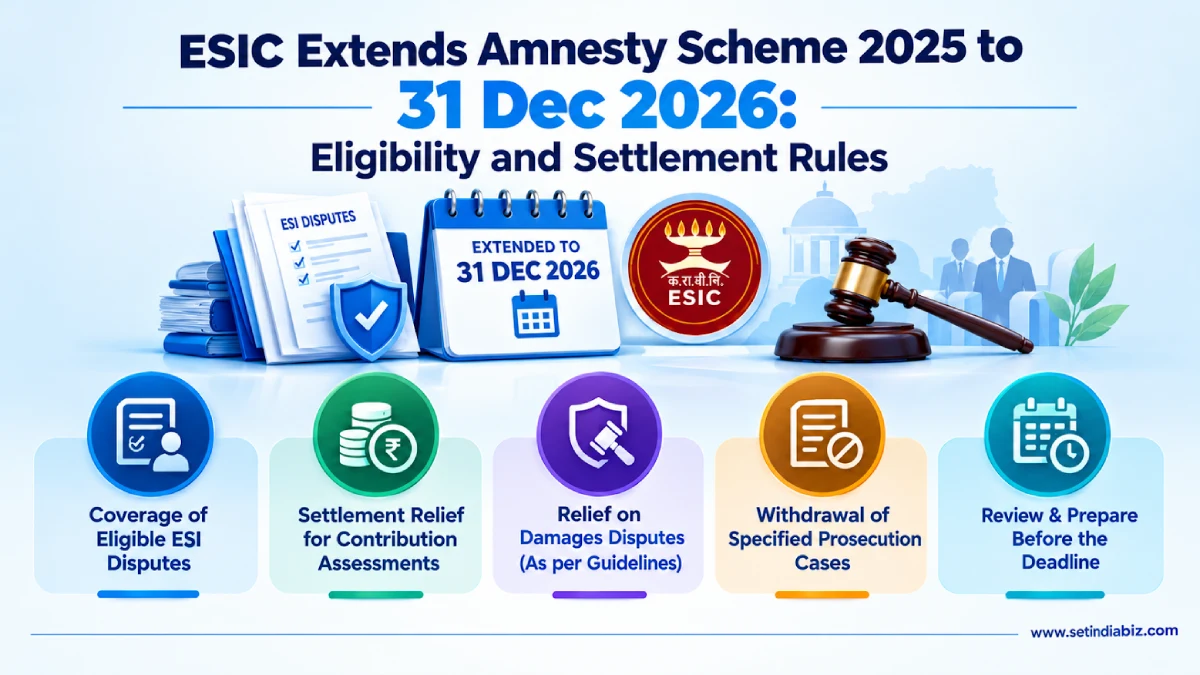
Businesses with pending Employees’ State Insurance (ESI) disputes have received another three months to seek relief under the New Amnesty Scheme 2025. ESIC has announced the extension, extending the original deadline of 30th September, 2026, to 31st December, 2026.
The extension gives employers additional time to examine disputed assessments, damages and prosecution cases. However, the scheme does not waive every outstanding ESI liability. The available relief depends on the type of case and the conditions set out in ESIC’s guidelines.
ESIC Amnesty Scheme 2025 Extension
The New Amnesty Scheme 2025 originally ran from 1st October, 2025, to 30th September, 2026. ESIC has now extended the scheme from 1st October to 31st December, 2026, on the existing terms and conditions.
The scheme aims to reduce pending litigation by allowing specified ESI disputes to be settled and certain prosecution cases to be withdrawn. It covers qualifying court cases filed up to 31st March, 2025, subject to the relevant category-specific requirements.
The extension does not create a fresh waiver or change the original settlement terms. Employers must establish whether their case falls within the scheme and complete the applicable process. The official ESIC Amnesty Scheme 2025 guidelines set out the conditions for different categories of cases.
Eligibility and Settlement Conditions
The scheme provides different forms of relief for coverage disputes, contribution assessments, damages disputes and specified prosecution cases. The payment requirements vary by category.
| No. | Dispute category | Settlement or relief terms | Key condition |
|---|---|---|---|
| 1 | Coverage disputes | Eligible cases involving closed or running units may be settled or withdrawn under the scheme, with relief from damages where the relevant conditions are met. | The employer must meet the requirements applicable to the unit and produce supporting records or other permitted evidence. Special exclusions apply. |
| 2 | Ad hoc contribution assessments under Section 45A | Eligible contribution disputes may be settled without damages. | The employer must establish the contribution liability using available records or evidence permitted under the guidelines, pay the applicable contribution and interest, and complete the required procedure. Where prescribed records are unavailable, the guidelines provide a separate basis for determining the amount payable. |
| 3 | Disputes over damages | A qualifying case may be withdrawn on payment of 10% of the damages determined by ESIC. | The principal contribution and applicable interest must already have been paid. The condition applies to the relevant damages-dispute category, not every case under the scheme. |
| 4 | Prosecution for not submitting contribution returns | Specified prosecution cases may be withdrawn after the required compliance is completed. | The conditions differ for closed and running units and include payment of the contribution and interest for the relevant period, where applicable. |
| 5 | Other specified prosecution cases | Certain cases involving non-submission of records, delayed compliance or other covered offences may qualify for withdrawal. | The offence, case history and compliance position must meet the specific requirements. Withdrawal remains subject to the prescribed approval and court procedure. |
The 10% damages condition is not a universal settlement rate. It applies to the specified category of damages disputes where the contribution and applicable interest have already been paid. Other categories have different payment and evidence requirements, including provisions that address missing records.
The scheme also covers certain cases involving insured persons, subject to separate conditions. Cases involving allegations such as criminal conspiracy or forgery are not automatically covered merely because an ESI proceeding is pending.
Section 45A Assessment and ESI Damages
Section 45A of the Employees’ State Insurance Act, 1948, allows ESIC to determine contributions in specified circumstances, including where required records are not produced or cooperation is lacking. An employer disputing such an assessment should review the order, the period covered and the records used to calculate the contribution.
Before applying under the amnesty scheme, the employer should:
- Review the assessment order: Identify the contribution period, the basis of assessment and whether the dispute falls within the scheme’s coverage.
- Reconcile ESI challans: Match contribution payments against payroll records and the periods referred to in the assessment.
- Check wage and employee records: Gather wage registers, employee details, attendance records and other documents relevant to the disputed period.
- Locate earlier submissions: Retain copies of replies to ESIC notices, assessment representations, appeals and court filings.
- Verify the outstanding amount: Separate principal contributions, applicable interest and damages. Do not calculate the settlement amount by applying the 10% condition to the entire outstanding liability.
- Confirm the procedure: Check the prescribed application, supporting evidence, undertaking and court-permission requirements for the particular case.
Form 5 or Form 6 records, C-18 assessment documents and other historical records should be checked where relevant to the employer’s case. The precise documents required will depend on the nature of the proceedings and the evidence accepted under the scheme.
Withdrawal of Prosecution Cases Under the ESI Act
The scheme also provides for withdrawal of certain prosecution cases filed against employers and insured persons. These provisions do not mean that every prosecution can be withdrawn simply by paying outstanding contributions.
For example, specified cases concerning non-submission of contribution returns may qualify for withdrawal once the required compliance and payments have been completed. Other categories have separate conditions relating to the nature of the offence, the age of the case, the unit’s status and the settlement of related liabilities.
Where court proceedings are pending, the employer must follow the applicable application and permission process. The relevant ESIC authority must also approve withdrawal under the scheme. Employers should therefore examine the actual complaint, the sections invoked and the latest court order before deciding on their next steps.
Setindiabiz Support
An old ESI dispute can require more than locating a single assessment order. Employers may need to reconstruct payroll records, reconcile challans, establish which contributions were paid and organise documents covering the disputed period. Gaps in these records can also affect the handling of future assessments.
Setindiabiz supports businesses with employer-side ESI and EPF compliance, payroll-related records and statutory filing processes. For employers reviewing an old ESI matter, relevant compliance support may include organising available wage and employee records, reconciling ESI challans against payroll data, and checking the consistency of contribution records and filings.
Businesses can also use our payroll and statutory compliance support to maintain monthly records, track contribution obligations and keep filing documentation organised. This helps establish a clearer compliance trail when records are needed for an assessment or inspection; it does not guarantee that ESIC will refrain from raising a demand.
Employers with pending ESI cases should review their litigation and assessment files before 31 December 2026. Our experts support the employer-side compliance and documentation review. The applicability of the amnesty scheme, settlement approval and court proceedings remain subject to ESIC’s guidelines and the competent authorities.
FAQs
ESIC has extended the scheme until 31st December, 2026. The extension is subject to the existing terms and conditions.
Specified contribution disputes involving Section 45A assessments may qualify, subject to the scheme’s eligibility rules, evidence requirements, payment conditions and prescribed procedure.
Not in every case. The 10% condition applies to the specified category of damages disputes where the principal contribution and applicable interest have already been paid. It is not a general reduction of all ESI dues to 10%.
Certain prosecution cases may be withdrawn if the offence and case meet the scheme’s conditions and the required compliance is completed. The prescribed approval and court procedure must also be followed.
No. The scheme provides category-specific relief. Contributions and applicable interest may still be payable, and employers must meet the conditions for the particular case.
