
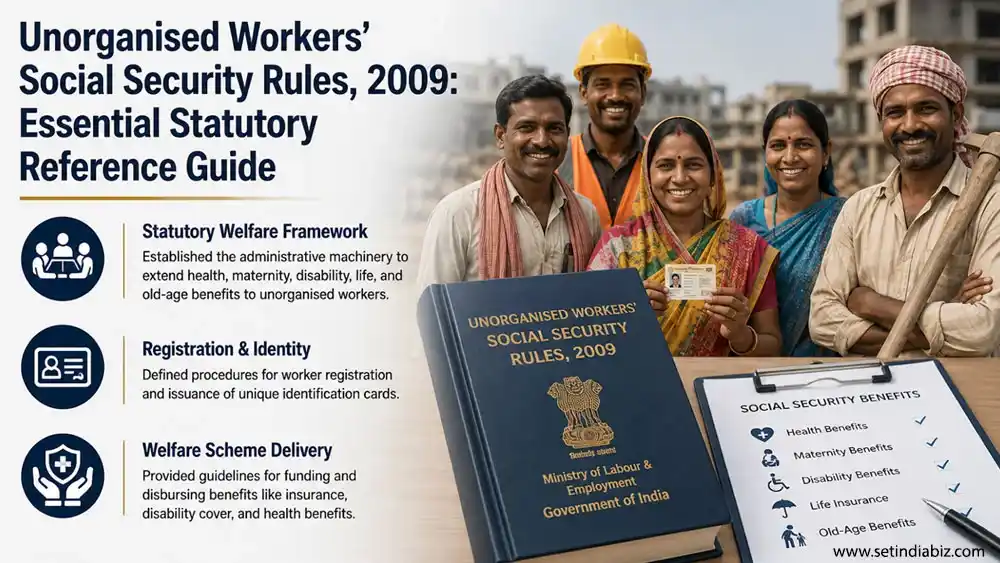
Overview: The Unorganised Workers’ Social Security Rules, 2009, framed under the Unorganised Workers’ Social Security Act, 2008, established the administrative machinery necessary to extend essential statutory protections—including health, maternity, life, disability, and old-age benefits—to India’s vast informal workforce. By defining standard operating procedures for worker registration, identity card issuance, benefit distribution, and the constitution of National and State Social Security Boards, these rules laid the structural groundwork for modern labour welfare systems.
The Unorganised Workers’ Social Security Rules, 2009, framed under the Unorganised Workers’ Social Security Act, 2008, established the administrative framework for extending vital welfare protections to India’s vast informal sector. By structuring statutory governance around health, maternity, disability, and old-age benefits, these rules provided a structured mechanism for supporting self-employed, casual, and home-based workers.
Today, these rules serve as a critical statutory baseline for legal professionals, HR specialists, and business leaders tracking the evolution of Indian employment laws as the nation transitions toward the consolidated Code on Social Security.
Understanding this landmark subordinate legislation offers valuable insights into the evolution of Indian labour policy, statutory welfare administration, and compliance benchmarks.
Key Highlights of the 2009 Rules
- National & State Advisory Boards: Outlined the constitution, powers, and term lengths of social security boards designed to monitor and recommend welfare schemes.
- Worker Registration Mechanics: Set clear procedures for identifying unorganised workers and issuing unique identification cards.
- Welfare Scheme Delivery: Provided guidelines for funding, administering, and disbursing benefits related to life insurance, disability cover, and health benefits.
- Administrative Operations: Defined quorum, meeting protocols, and financial record-keeping standards for statutory bodies.
Frequently Asked Questions (FAQs)
What was the primary purpose of the Unorganised Workers’ Social Security Rules, 2009?
Who qualifies as an unorganised worker under this framework?
Are the 2009 Rules still relevant under the new Labour Codes?
SetIndiaBiz Assistance for Labour & Corporate Compliance
Navigating India’s intricate statutory landscape—from historical rules to modern Labour Codes—requires dedicated legal and administrative oversight. SetIndiaBiz acts as an end-to-end compliance partner, helping businesses, startups, and foreign subsidiaries maintain 100% regulatory alignment through expert secretarial retainership, labour law registrations (including EPF, ESIC, Professional Tax, and Shops & Establishment), payroll management, and ROC filings.
In This Article
Author Bio

Setindiabiz Editorial Team is a multidisciplinary collective of Chartered Accountants, Company Secretaries, and Advocates offering authoritative insights on India’s regulatory and business landscape. With decades of experience in compliance, taxation, and advisory, they empower entrepreneurs and enterprises to make informed decisions.
