

Company Name Approval in India
Reserve a legally safe company name with the MCA: Get your proposed company name reserved with the Registrar through SPICe+ Part A or RUN under Section 4 of the Companies Act, 2013. Setindiabiz process experts run MCA, LLP and trademark searches first, so your name clears the CRC in the very first attempt.


Trusted By Leading Brands






























🗹 Key Information of Company Name Approval |
||
|---|---|---|
| 1 | Statutory basis | Section 4, Companies Act, 2013, read with Rules 8, 8A, 8B, 9 and 9A of the Companies (Incorporation) Rules, 2014. |
| 2 | Application route | SPICe+ Part A web service on MCA V3 for a new company; RUN for the name change of an existing company (Rule 9). |
| 3 | Approving authority | Central Registration Centre (CRC), Manesar — pan-India jurisdiction under Section 396, Companies Act, 2013. |
| 4 | Government fee | ₹1,000 per application (Companies (Registration Offices and Fees) Rules, 2014); extension fees of ₹1,000–₹3,000 under Rule 9A. |
| 5 | Names per application | Two proposed names in a standalone SPICe+ Part A or RUN; only one name when Part A is filed together with Part B (incorporation). |
| 6 | Resubmission | One resubmission allowed, to be filed within 15 days of the CRC marking the application “Resubmission Required”. |
| 7 | Validity of approved name | 20 days from approval for a new company; 60 days for an existing company’s name change — Section 4(5)(i). |
| 8 | Extension | Up to 40 or 60 days from approval on payment under Rule 9A; no extension beyond 60 days. |
| 9 | Processing time | Typically, 2–3 working days at the CRC for a clean application. |
Name Approval Letter
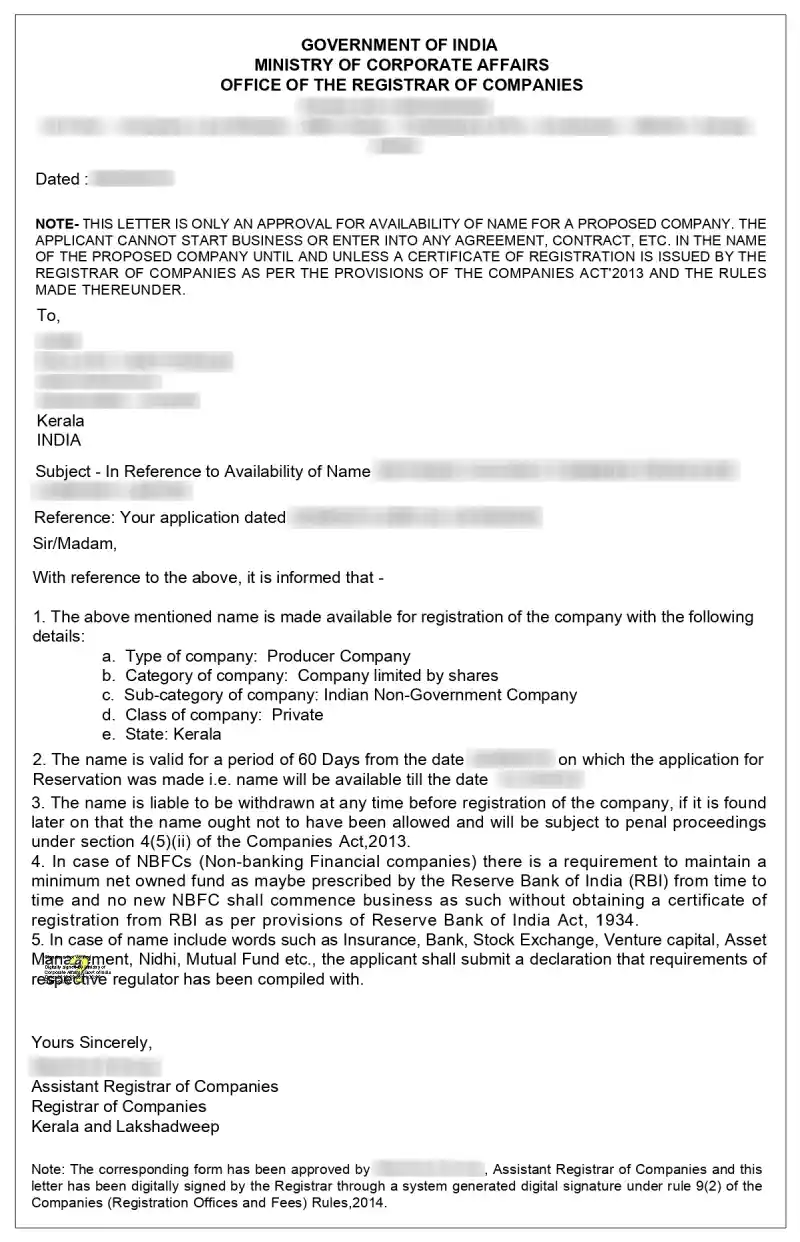
What is Company Name Approval?
Company name approval is the reservation of your proposed company name by the Registrar of Companies before incorporation or a name change. The proposed new name must not be identical with or too similar to an existing company’s name, nor be undesirable under the Companies (Incorporation) Rules, 2014. All applications across India are examined centrally by the Central Registration Centre (CRC) set up under Section 396.
Setindiabiz process experts make the approval first-attempt-ready: we search the MCA company and LLP registers, the reserved-names pool and the trademark registry, test your name against Rules 8, 8A and 8B, and then file SPICe+ Part A (new company) or RUN (name change) with a well-reasoned application, tracking it until the CRC issues the name reservation letter.

Pradeep Vallat
Founder "Autonomo""Setindiabiz’s knowledgeable, disciplined, and organized team made our company registration, tax, and IPR filings smooth, hassle-free, and worry-free."
Two Routes to Reserve a Company Name
Name approval routes are mutually exclusive based on whether you are forming a new company or renaming an existing one. Since February 23, 2020, new companies must use SPICe+ Part A on MCA V3, while the RUN service is reserved strictly for existing companies seeking a name change. Confirm your scenario before paying the ₹1,000 fee to avoid wasting government funds.
🧭 Route 1: SPICe+ Part A (new company)
SPICe+ Part A is the integrated name-reservation part of the SPICe+ incorporation suite on MCA V3. You may file Part A standalone with up to two proposed names, or together with Part B — in which case only one name is allowed, but the entire incorporation moves as a single filing.
Key Points:
- Submit up to two names (Spice Part A)
- ROC Fee ₹1,000
- Validity of Reserved Name: 20 days
- Name reservation can be extended
🧭 Route 2: RUN (name change of company)
RUN is the web service an already-incorporated company uses to reserve its proposed new name before passing the special resolution under Section 13 and filing for the fresh certificate of incorporation.
Key Points:
- Two proposed names allowed
- ROC Fee: ₹1,000.
- Board resolution mandatory
- Approved name valid for 60 days
- No extension possible
Note: MCA name approval protects the corporate name only; it is not brand or trademark protection. To stop others from using your brand in trade, register it as a trademark under Section 18 of the Trade Marks Act, 1999; our trademark registration team handles this in parallel.
MCA Rules for Company Name Approval – Rule 8 Guidelines Explained
To ensure your proposed company name gets approved swiftly by the Ministry of Corporate Affairs (MCA), it must comply with strict regulatory guidelines, primarily those detailed in Section 4 of the Companies Act, 2013 and Rule 8 of the Companies (Incorporation) Rules, 2014. These rules, which are also applied equivalently to Limited Liability Partnerships (LLPs), mandate that your proposed name must satisfy the following essential criteria:

Unique & Simple Name
Your proposed name must be unique and distinct from existing companies or LLPs registered with the MCA. Avoid phonetic similarities, plural variations or minor spelling changes entirely.

Indicates Business Activity
The company name should clearly reflect your principal business objectives as stated in the MOA. For example, 'ABC Technologies' indicates IT services meeting incorporation requirements.

No Undesirable Words
Avoid any offensive language or words prohibited under Rule 8A of the Companies (Incorporation) Rules, 2014. Name must respect all communities and cultural sensitivities across India.

Avoid Government Connection
Words like National, Union, Central, Federal or Bharat require special government approval under Section 4(1)(ii) as they imply government patronage or official connection status.

Suffix Compliance
Every company must end with a proper legal suffix: 'Private Limited' for private companies, 'Limited' for public companies, or 'OPC' for One Person Companies per the Companies Act 2013.
No Trademark Infringement
Ensure no existing trademark conflicts exist. If similar to registered trademarks, obtain an NOC from the owner first to avoid legal disputes under the Trademarks Act, 1999.
Timeline for Company Name Approval
Search & vetting
MCA, LLP, reserved-name and trademark searches; Rule 8/8A/8B testing of both proposed names; drafting of the significance note.
ROC Filing
SPICe+ Part A (or RUN) submitted on MCA V3 with the ₹1,000 fee; SRN generated (pay within 7 days or the SRN lapses).
CRC examination
The Central Registration Centre approves the name or marks it "Resubmission Required" with reasons.
Approval/resubmission
Name reservation letter issued, or one resubmission filed within the 15-day window, followed by final approval or rejection.
Process of Company Name Approval
The process below is calibrated to the fullest scenario — a standalone SPICe+ Part A with a trademark-sensitive name; a RUN filing for a name change follows the same spine with the board resolution added, and filing Part A together with Part B collapses Steps 4 and 7 into the incorporation filing itself. At each stage, the test is the same: will this name clear Section 4(2) of the Companies Act, 2013 and Rules 8, 8A and 8B at the CRC without a query?
Step 01: Shortlist and test the names
You share your preferred names and business activity; we test each against the Rule 8 resemblance standard, the Rule 8A undesirability list and the Rule 8B approval-required words, and search the MCA company/LLP registers and reserved-name pool.
🕒 Turnaround: Same working day.Step 02: Trademark and brand screening
We search the trademark registry for identical or deceptively similar marks in your activity class, because under Rule 8A(1)(b), a name containing another’s registered mark fails without the owner’s consent — and even an approved name can be attacked later under Section 16.
🕒 Turnaround: Same working day.Step 03: Finalise two names and the significance note
We lock the two strongest names in preference order and draft the name-significance and object-consistency note that accompanies the application, which materially reduces resubmission risk for coined or abbreviated names.
🕒 Turnaround: 1 working day.Step 04: File SPICe+ Part A / RUN on MCA V3
We file the web form under Rule 9, Companies (Incorporation) Rules, 2014, with the correct company type, class and industrial activity code, attach any NOC or approval, and pay the ₹1,000 government fee against the generated SRN.
🕒 Turnaround: 1 working day.Step 05: CRC examination and tracking
The Central Registration Centre examines the application centrally for all of India under Section 396, Companies Act, 2013; we track the SRN daily and brief you the moment a status change appears.
🕒 Turnaround: 2–3 working days at the CRC.Step 06: Resubmission, if marked
If the CRC marks “Resubmission Required”, we analyse the remark, modify the names or strengthen the justification, and refile within the 15-day window — only one resubmission is allowed, so this response is drafted with care.
🕒 Turnaround: 1–2 working days from the CRC remark.Step 07: Name reservation letter and next steps On approval
The CRC issues the name reservation letter; the name is held for 20 days (new company) or 60 days (name change) under Section 4(5)(i), and we immediately plan the incorporation filing or the Section 13 resolution so the window is never missed.
🕒 Turnaround: Same day as approval.ROC Fee for Name reservation of Company
The government fee for making a name reservation is ₹1,000 per SPICe+ Part A or RUN application, payable to the MCA under the Companies (Registration Offices and Fees) Rules, 2014. Rule 9A extension fees (₹1,000 / ₹2,000 / ₹3,000) apply only if you extend the reservation.
| No | Government Fee Item | Amount | Legal basis |
|---|---|---|---|
| 1 | Name Reservation Fee | ₹1,000 | Rule 9, Companies (Incorporation) Rules, 2014, read with the Companies (Registration Offices and Fees) Rules, 2014. |
| 2 | First Extension to 40 days from the original approval date | ₹1,000 | Rule 9A(a): Apply with additional ROC fee before expiry of the original 20 days. |
| 3 | Second extension of 60 days from the original approval date | ₹2,000 | Rule 9A(b): Apply with additional ROC fee before expiry of the 40th day. |
| 4 | Direct extension to 60 days | ₹3,000 | Rule 9A(c): Apply with additional ROC fee before expiry of the original 20 days. |
| Note: Government fees are payable on actuals and are non-refundable even if the name is rejected after one resubmission. A fresh application with a fresh ₹1,000 fee is needed if the reservation lapses. Setindiabiz is a private firm; the reservation itself is granted only by the CRC/Registrar of Companies. | |||
Name Availability Rules under Rule 8, 8A and 8B
Most name rejections happen because the proposed name fails one of three legal tests, all rewritten with illustrations by the Companies (Incorporation) Fifth Amendment Rules, 2019, notified on 10 May 2019. Rule 8 sets the “too nearly resembles” test against existing companies, Rule 8A lists what makes a name undesirable, and Rule 8B lists the words that need previous Central Government approval under Section 4(3)(b) of the Companies Act, 2013. Testing your name against all three before filing is the single best way to avoid losing time to a resubmission or rejection.
Rule 8 (Resemblance Test)
Names are compared to existing entities after ignoring suffixes, plurals, case, spacing, punctuation, and word order. Applications fail if the names remain identical after these disregards.
Rule 8A (Undesirable Names)
A name is undesirable if it violates the Emblems and Names Act, infringes on registered trademarks without consent, is offensive, or mimics an existing LLP. Names that are vague or use financial terms (like “Investment”) without matching the primary business are also prohibited.
Rule 8B (Government Approval)
Terms suggesting official patronage—such as National, Central, Republic, Board, or Commission—require prior Central Government approval before use in a company name.
Prohibited Names: Understanding Rule 8 of Companies (Incorporation) Rules, 2014
Under Section 4(2) of the Companies Act, 2013, read with Rule 8 of the Companies (Incorporation) Rules, 2014, a company name is prohibited if it is identical to or too closely resembles an existing company or LLP name. The law aims to prevent public confusion and to protect existing businesses from unfair competition arising from name similarity. Even minor variations in spelling, punctuation, or form are insufficient to create a distinct identity, and the Registrar will reject such names. This strict approach ensures each company maintains a unique market presence.
Categories of Prohibited Similarities
| No | Category | Description |
|---|---|---|
| 1 | Plural/Singular Variations |
|
| 2 | Spacing & Punctuation Differences |
|
| 3 | Tense Modifications |
|
| 4 | Phonetic Similarities |
|
| 5 | Common Word Additions |
|
| 6 | Language Translations |
|
| 7 | Type Case Variations |
|
Undesirable Names: Understanding Rule 8A
Rule 8A of the Companies (Incorporation) Rules, 2014, empowers the Central Government to prohibit names that are considered undesirable in public interest, as per Section 4(3) of the Companies Act, 2013. This rule categorises six distinct types of names that are inherently unsuitable for company registration, regardless of their uniqueness. These prohibitions protect public sentiment, prevent misrepresentation, and ensure companies operate under appropriate identities. The Registrar must reject any name falling within these categories, even if no similar company exists.
Six Categories of Undesirable Names
| No | Category | Description |
|---|---|---|
| 1 | Offensive or Objectionable Names |
|
| 2 | Government Association Without Approval |
|
| 3 | Regulated Sector Names (Without NOC) |
|
| 4 | Generic or Vague Names |
|
| 5 | Struck-off Company Names |
|
| 6 | Misleading Names |
|
| Important Registrar Discretion: The Registrar also reserves the authority to reject names that fall outside specific guidelines if they are deemed likely to cause public confusion, imply illegal operations, or contravene public policy. Therefore, thorough verification is a crucial step before applying. | ||
Company Name vs. Trademark: Know the Difference
Company names and trademarks are often confused, but they serve different purposes under various laws. Receiving approval from the MCA (Ministry of Corporate Affairs) for a company name does not automatically grant trademark rights. It’s essential to understand this distinction for adequate brand protection. MCA approval does not equate to trademark protection. To protect your brand identity, always register your trademark separately.
| No | Aspect | MCA Name Approval | Trademark Registration |
|---|---|---|---|
| 1 | Governing law | Section 4, Companies Act, 2013 | Section 18, Trade Marks Act, 1999 |
| 2 | What it protects | The corporate name on the register of companies | The brand in trade, for the registered class of goods/services |
| 3 | Authority | Central Registration Centre / ROC | Registrar of Trade Marks, IP India |
| 4 | Stops others from | Registering an identical/too-similar company name | Using a deceptively similar brand in commerce |
| 5 | Validity | Until the company exists (reservation itself: 20/60 days) | 10 years, renewable indefinitely |
| 6 | Enforcement right | None against brand misuse | Infringement action under Section 29, Trade Marks Act, 1999 |
Related Reading
Frequently Asked Questions
It is the reservation of your proposed company name by the Registrar of Companies before incorporation or a name change, under Section 4(4) of the Companies Act, 2013. Once approved, the name is held exclusively for you for the statutory window — 20 days for a new company, 60 days for a name change.
The Central Registration Centre (CRC) at Manesar, established under Section 396 of the Companies Act, 2013, examines and disposes of all name applications across India. There is no state-wise discretion — one central office applies one standard.
No. Name approval secures the corporate name on the MCA register; a trademark registered under the Trade Marks Act, 1999, protects the brand in trade. An MCA-approved name can still be challenged by a trademark owner under Section 16 of the Companies Act, 2013, within 3 years.
Yes — a company cannot be incorporated without a reserved or simultaneously approved name. You may either reserve the name first through a standalone SPICe+ Part A or propose it within the combined Part A + Part B incorporation filing.
SPICe+ Part A reserves a name for a new company on MCA V3 and is the only route for fresh incorporation since 23 February 2020 (Rule 9). RUN reserves a new name for an existing company that is changing its name. Both carry a ₹1,000 government fee.
Two names in order of preference in a standalone SPICe+ Part A or a RUN application. If you file Part A together with Part B (the full incorporation), only one name can be proposed — so the standalone route gives you a second shot.
₹1,000 per application under the Companies (Registration Offices and Fees) Rules, 2014. It is non-refundable even on rejection. Extension of the reservation costs ₹1,000, ₹2,000 or ₹3,000, depending on the Rule 9A option you choose.
No. A standalone SPICe+ Part A or RUN is a web-form filing that needs only a registered MCA V3 login. DSCs become necessary at the incorporation stage (SPICe+ Part B) — see our digital signature service.
The SRN generated on submission must be paid within 7 days, failing which it is cancelled and the application is treated as never filed. The reservation clock starts only from the CRC’s approval, not from filing.
The commonest reasons are resemblance to an existing company or LLP after the Rule 8 disregards (suffixes, spacing, plural forms, word order), an unconsented registered trademark in the name (Rule 8A(1)(b)), purely descriptive or vague names, and Rule 8B words used without Central Government approval.
Only with the previous approval of the Central Government under Section 4(3)(b) read with Rule 8B. Without that approval, the CRC must reject the name regardless of how distinctive the rest of it is.
Only with the written consent of the trademark owner where the mark is registered in the same class as your activity (Rule 8A(1)(b), save Section 35 of the Trade Marks Act, 1999). Without consent, the name is undesirable and will be refused.
If the CRC finds a curable defect, it marks the application “Resubmission Required” with reasons. You get one resubmission, to be filed within 15 days of the marking — you may modify the proposed names or strengthen the justification. After that, the application is finally approved or rejected.
No. Rule 8 expressly disregards internet-related suffixes, the addition of place names in many situations, punctuation, spacing and word order when comparing names, so cosmetic tweaks to an existing name will still fail the resemblance test.
Words such as Investment, Loan, Finance or Chit Fund may be used only where that is genuinely the main business (Rule 8A); conversely, an actual financing business should carry an indicative word. NBFC-type names also attract the RBI’s regulatory expectations before incorporation.
20 days from the date of approval for a new company and 60 days for an existing company’s name change, under Section 4(5)(i) of the Companies Act, 2013. Incorporation (or the name-change filing) must be completed within this window.
Yes, under Rule 9A, to 40 days on ₹1,000 paid before the 20th day, then to 60 days on ₹2,000 paid before the 40th day, or directly to 60 days on ₹3,000 paid within the first 20 days. Nothing extends the reservation beyond 60 days.
The name returns to the open pool, and you must file a fresh application with a fresh ₹1,000 fee — with no guarantee of approval the second time, since another applicant may reserve it first. Plan the incorporation filing before you reserve.
Yes, on two fronts. Under Section 4(5)(ii), a reservation obtained on wrong or incorrect information can be cancelled with a penalty up to ₹1 lakh. And under Section 16, a registered trademark owner can apply within 3 years of incorporation; on a direction, the company must rename within 3 months by ordinary resolution, failing which an “ORDNC”-series name is imposed by the Registrar.
LLP names are reserved through RUN-LLP or within the FiLLiP incorporation form under the LLP Act, 2008 — a parallel but separate system. The Rule 8 resemblance logic, however, also tests company names against existing LLP names, and vice versa. See LLP registration.
Move straight to SPICe+ Part B with the e-MoA and e-AoA for incorporation — or, for a name change, convene the EGM for the Section 13 special resolution — well inside the validity window, and consider filing a trademark application for the brand the same week.
