
Overview: India’s technology ambitions are expanding beyond IT services to indigenous products, artificial intelligence, cybersecurity, electronics and semiconductors. This shift could open opportunities for technology ventures and businesses supplying supporting infrastructure. However, founders entering these areas must also consider their legal structure, startup recognition, intellectual property, data protection obligations and foreign investment compliance.
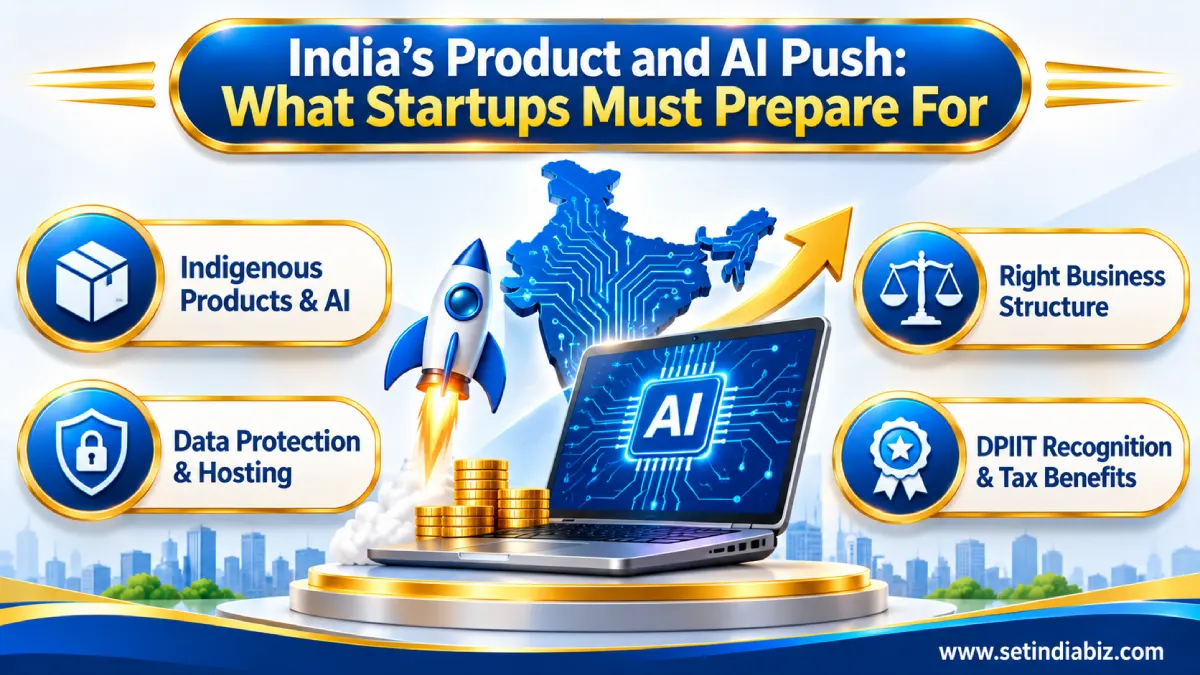
Shift Towards Indigenous Products and AI
India’s technology sector may be entering a phase in which building and owning products becomes as important as providing technology services. In an interview with The Financial Express, Bharti Enterprises Chairman Sunil Bharti Mittal identified cybersecurity, mapping, search engines and artificial intelligence as areas where Indian businesses could develop indigenous products.
He also discussed a 10-15-year investment horizon for electronics, semiconductors and related technologies. These comments reflect the industry’s long-term outlook, not a guarantee of investment or business opportunities for every venture.
Government initiatives, including the Production Linked Incentive (PLI) schemes and semiconductor programmes, are intended to strengthen domestic manufacturing. However, these schemes have specific eligibility conditions. A company developing AI software or a digital product does not automatically qualify for manufacturing incentives.
Opportunities in AI Infrastructure and Digital Services
The expansion of AI also requires supporting infrastructure, including data centres, computing capacity, cloud services, connectivity and cybersecurity.
Mittal discussed Airtel’s work on AI data centres for global technology companies and its plans to enter the compute business. Such investments could create opportunities for Indian technology firms supplying software, security, cloud and related services.
Smaller businesses seeking to enter these supply chains will need to demonstrate technical capability, reliable service delivery and sound business documentation. Commercial contracts should clearly address confidentiality, data security, service responsibilities and ownership of software and other intellectual property.
Data Protection and Hosting Requirements
Businesses developing AI products or handling customer information must understand the data protection rules applicable to their activities.
The Digital Personal Data Protection (DPDP) Act, 2023, and the DPDP Rules, 2025, have staggered commencement dates. The main provisions governing personal data processing, including Section 16, are scheduled to commence on 13th May, 2027. Section 16 allows the Central Government to restrict transfers of personal data to specified countries or territories. It does not require every business to store all personal data in India.
Separate obligations may apply to particular sectors. For instance, the Reserve Bank of India’s payment-system data-storage directions require payment system data to be stored in India. The MeitY Cloud Selection Framework, issued on 20th March, 2026, provides guidance to Central Government ministries and departments on cloud selection. It is not a general data-localisation mandate for private companies.
Businesses should identify the information they collect, the rules applicable to their sector, where data is stored and who can access it. These decisions should also be reflected in customer contracts and vendor arrangements.
Choosing the Right Business Structure
The choice between a private limited company and a Limited Liability Partnership (LLP) depends on the business model and funding plans.
A private limited company is generally more suitable where founders expect equity investment, institutional funding or employee stock options. An LLP may suit businesses with a different ownership and management model, but foreign investment in LLPs is subject to separate entry-route and sectoral conditions.
Founders should document ownership, roles, decision-making powers and investor rights from the beginning. Shareholder agreements, founder arrangements and employment or contractor contracts should also address confidentiality and ownership of work created for the business.
DPIIT Recognition and Startup Tax Benefits
Eligible businesses can apply for recognition under the Startup India initiative. Under DPIIT Notification G.S.R. 108(E) of 4th February, 2026, eligible entities include private limited companies, registered partnership firms, LLPs and specified cooperative societies.
The general recognition period is up to 10 years from incorporation or registration, with a turnover ceiling of ₹200 crore. Eligible Deep Tech ventures may receive recognition for up to 20 years, subject to a turnover ceiling of ₹300 crore. Applicants must meet the prescribed innovation or scalability conditions and must not have been formed by splitting up or reconstructing an existing business. A technology-based business does not automatically qualify as Deep Tech.
Tax benefits have separate eligibility conditions. Section 140 of the Income-tax Act 2025 provides a 100% deduction of profits and gains from an eligible business for three consecutive tax years within the first ten years from incorporation. The eligible entity must be a company or LLP, hold the required Inter-Ministerial Board of Certification certificate and meet the statutory turnover ceiling of ₹300 crore in the relevant tax year. The prescribed audit report must also be furnished in Form 32.
The ten-year tax deduction window remains separate from the extended 20-year recognition period available to qualifying Deep Tech ventures. DPIIT recognition alone does not automatically secure the deduction.
Protecting IP and Managing Foreign Investment
Founders should establish ownership of their technology, software, brand names and other intellectual property before bringing in investors or commercial partners. Employment agreements and contracts with developers should clearly assign relevant intellectual property rights to the business.
Section 3(k) of the Patents Act, 1970 excludes mathematical methods, business methods, algorithms and computer programmes per se from patentability. A software-related invention must be assessed on its technical contribution and other patentability requirements. Eligible DPIIT-recognised startups can also claim an 80% rebate on patent filing fees and a 50% rebate on trademark filing fees, but conditions apply.
Where foreign investment is involved, the business must examine the applicable FEMA entry route, sectoral conditions, pricing and reporting obligations. Depending on the transaction, reporting may involve forms such as FC-GPR or FC-TRS for companies and LLP-I or LLP-II for relevant LLP transactions.
Setindiabiz Support
Setindiabiz provides incorporation and business compliance services for founders setting up technology ventures in India. Our services cover private limited company and LLP registration, DPIIT recognition support, corporate documentation, shareholder agreements, intellectual property registration and FEMA-related documentation and reporting. This gives founders access to support across business formation, investment documentation and ongoing statutory compliance.
FAQs
No. DPIIT recognition and the tax deduction under Section 140 of the Income-tax Act, 2025 are separate. The business must satisfy the tax provision’s eligibility conditions, including the turnover ceiling and Inter-Ministerial Board certification.
No. The DPDP Act does not impose a blanket data-localisation requirement on all businesses. Specific sectoral rules, such as RBI directions for payment-system data, may impose separate obligations.
Not merely because it uses an algorithm or computer programme. Section 3(k) excludes computer programmes per se and certain other categories. Patentability depends on the invention’s technical contribution and the other applicable requirements.
