
Overview: Finance Minister Nirmala Sitharaman has highlighted the Government’s ongoing review of procurement rules and tender conditions to make public procurement more transparent and business-friendly. The development brings renewed attention to opportunities available to Micro and Small Enterprises (MSEs). Eligible businesses can claim benefits such as EMD exemption, free tender documents and purchase preference, subject to applicable conditions.
Union Finance Minister Nirmala Sitharaman, at the FE Leadership Awards 2026, has said that the Department of Expenditure periodically reviews government procurement rules and tender conditions to improve transparency, simplify procedures and make participation more industry-friendly. She also referred to changes in project execution requirements and provisions relating to bank and individual guarantees.
This review is relevant to businesses seeking government contracts, particularly Micro and Small Enterprises (MSEs), which already enjoy specific procurement preferences under the Government’s public procurement policy.
The Finance Minister’s remarks do not announce new concessions, but they provide a timely reason for businesses to understand the existing benefits, eligibility requirements and compliance conditions before participating in government tenders.
How Does Government Procurement Benefit MSEs?
Central Government Ministries, Departments and Central Public Sector Enterprises (CPSEs) have an annual procurement target of at least 25% from MSEs. Within this, 4% is earmarked for MSEs owned by Scheduled Caste or Scheduled Tribe entrepreneurs and 3% for women-owned MSEs. These sub-targets are part of the overall 25%.
This is an annual obligation on covered Government buyers, not a guaranteed order for an individual MSE. The policy covers goods produced and services provided by eligible MSEs; works contracts are excluded. State Government departments follow their own procurement policies.
What Benefits Can an MSE Claim?
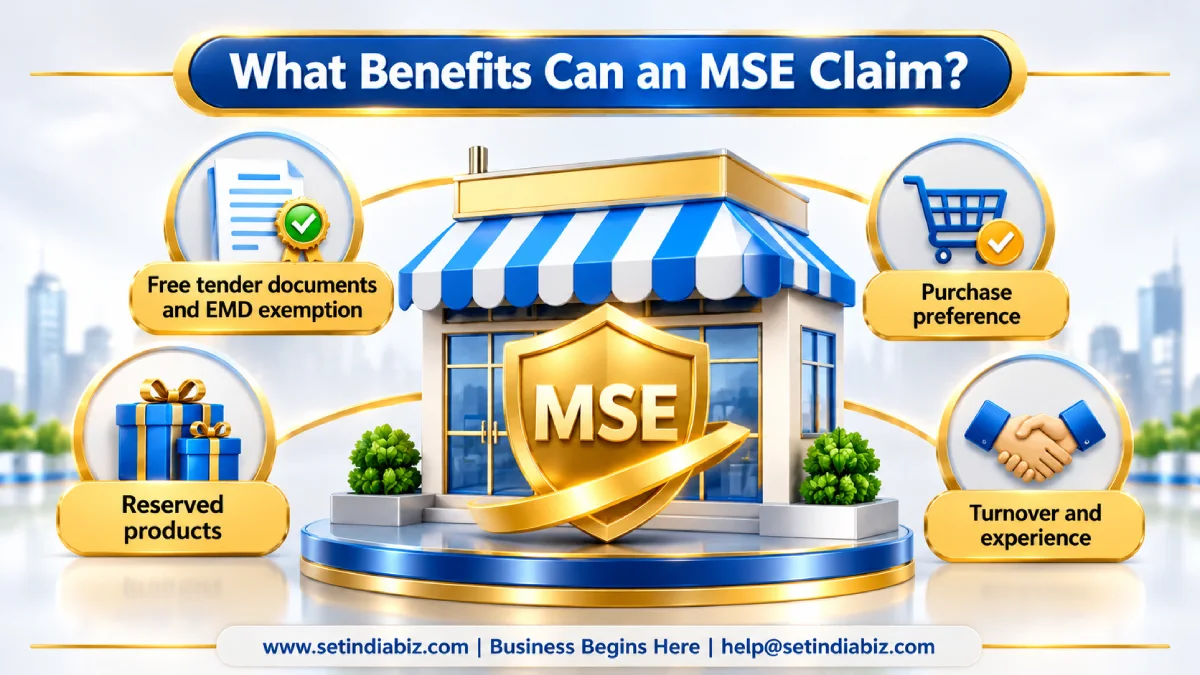
Eligible MSEs can claim these benefits, subject to the tender conditions:
- Free tender documents and EMD exemption: Eligible MSEs can obtain tender documents free of charge and are exempt from Earnest Money Deposit (EMD). Performance security and security deposits are not automatically waived. A procuring entity may require a Bid Securing Declaration instead of bid security; check the tender document.
- Purchase preference: If L1 (lowest bidder) is not an MSE, an eligible MSE quoting within the L1+15% price band can be invited to match L1 and receive up to 25% of the total tendered quantity. If several MSEs match L1, the quantity is shared proportionately. If the item cannot be divided, an eligible MSE may be awarded the full supply under the applicable procedure.
- Reserved products: 358 items are reserved for exclusive procurement from MSEs. Manufacturers should check the reserved list.
- Turnover and experience: Central Ministries, Departments and CPSEs may relax prior turnover and experience requirements for MSEs that meet technical and quality standards. This is not an automatic exemption in every tender.
MSE preferences do not remove the need to meet technical specifications and delivery requirements.
Who Can Claim These Benefits?
The preferences apply to eligible Micro and Small Enterprises, not Medium Enterprises. Udyam registration is required to establish MSE status.
Retail and wholesale traders can register on Udyam, but their registration benefits are restricted to Priority Sector Lending. They cannot claim MSE procurement preferences. The policy also excludes traders, distributors and sole agents; works contracts are outside its scope.
Udyam registration is separate from seller registration on the Government e-Marketplace (GeM), which provides an online platform for Government purchases.
What Should a Business Check Before Bidding?
Before submitting a tender, check that:
- Udyam details and MSE classification are correct;
- the goods or services are covered by the policy;
- technical, financial and delivery requirements can be met;
- required licences, certifications and declarations are available; and
- financial statements, GST returns, income-tax records and work credentials are up to date.
Companies and LLPs should also keep corporate records and statutory filings current.
What If the Buyer Delays Payment?
Under the MSMED Act, a buyer must pay an eligible MSE within the period agreed in writing, which cannot exceed 45 days from acceptance or deemed acceptance. Where there is no written agreement, payment is due before the statutory appointed day.
For delay beyond the permitted period, the buyer must pay compound interest with monthly rests at three times the RBI Bank Rate. The supplier can approach the Micro and Small Enterprises Facilitation Council under Section 18 or file an application through the MSME Samadhaan portal.
Keep purchase orders, invoices, delivery acknowledgements and payment correspondence. Udyam registration should be in place before contracting and supplying; later registration does not automatically give retrospective protection.
Setindiabiz Support
Navigating government procurement requirements demands absolute precision and compliance. Setindiabiz offers comprehensive, end-to-end advisory and registration services – including Private Limited and LLP incorporation, Udyam registration, GST compliance, and corporate statutory filings – to ensure your business seamlessly meets every tender eligibility benchmark. Our experts position your enterprise compliant and ready for high success in securing high-value government procurement contracts.
FAQs
No. The business must still meet tender conditions, technical specifications and other eligibility requirements.
Yes. Eligible suppliers can claim statutory compound interest under Section 16 of the MSMED Act.
Not automatically. EMD exemption does not mean exemption from performance security or other post-award obligations. Businesses should check the specific tender conditions.
MSEs can search for Government procurement opportunities on the Government e-Marketplace (GeM) and the relevant Central or State Government e-procurement portals. Seller registration and compliance with tender requirements are necessary to participate.
Government procurement offers opportunities for small businesses. Understanding eligibility, using available preferences and keeping statutory records in order can help an enterprise participate with confidence.
