
Overview: The Indian Government has notified changes to GST registration, e-invoicing and rates for selected goods. From 1st November, 2026, eligible online sellers can use an e-commerce operator’s warehouse as their principal place of business in another State or Union Territory, subject to prescribed conditions. E-invoicing will cover additional reverse-charge transactions and imports of services from 1st January, 2027. Separate changes reduce GST on retreaded tractor tyres and clarify the classification of specified seaweed-based bio-stimulants.
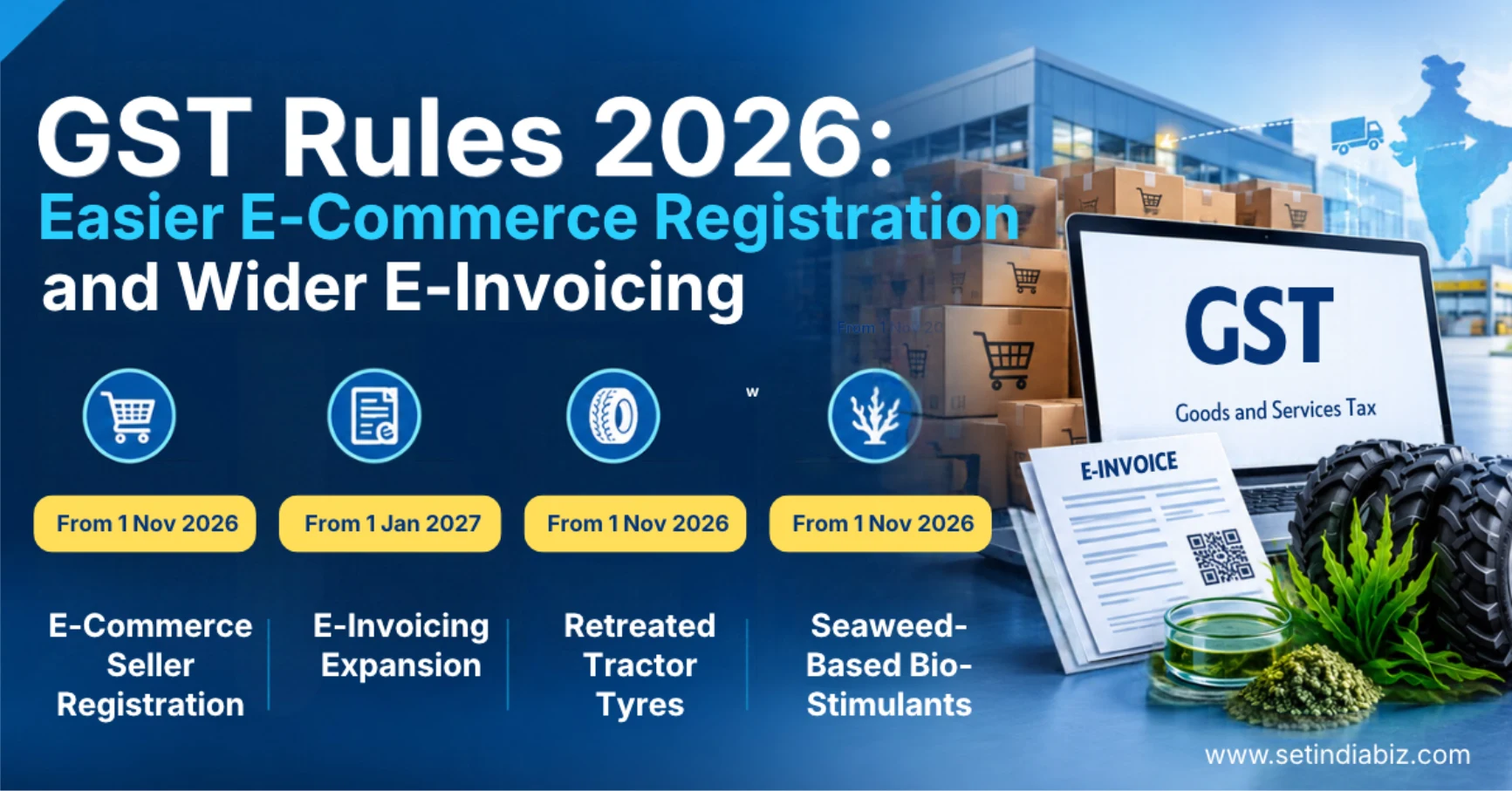
Government of India has notified a new GST registration facility for eligible e-commerce sellers, alongside changes to e-invoicing requirements and GST rates for selected goods. The amendments introduce changes from 1st November, 2026, with the expanded e-invoicing provisions taking effect on 1 January 2027.
Online sellers should check whether they qualify to register using an e-commerce operator’s warehouse, while businesses handling reverse-charge transactions or imported services should prepare for the invoicing changes. The revised rates also require affected businesses to review their product classifications and tax invoices.
Online sellers expanding into new States, businesses importing services and companies dealing in selected goods face different compliance changes under the latest GST notifications. The new provisions offer a registration route to eligible sellers, but the facility comes with conditions that businesses must check before applying.
Finance teams also need to prepare for the expanded e-invoicing requirements from January 2027. Businesses dealing in affected products should review the revised rates and classification rules before issuing invoices under the new provisions.
GST Registration for E-Commerce Sellers: New Rule 14B
Notification No. 05/2026-Central Tax, dated 26th October 2026, inserts Rule 14B into the Central Goods and Services Tax (CGST) Rules, 2017, to be effective from 1st November, 2026.
The rule allows eligible sellers to obtain GST registration in a State or Union Territory where they have no physical presence by declaring a warehouse belonging to an eligible e-commerce operator as their principal place of business (PPoB). The seller must already hold the required registration in its home State under the same Permanent Account Number (PAN).
The facility is intended for sellers supplying goods through e-commerce operators required to collect tax at source under Section 52 of the CGST Act, 2017. It does not remove the other registration and verification requirements.
Key conditions under Rule 14B
- Monthly output tax liability: The total output tax liability on the specified supplies to registered persons must not exceed ₹2.5 lakh per month. Supplies to recipients registered under the same PAN are excluded from this calculation. The limit concerns output tax liability, not input tax credit.
- Exclusive e-commerce supplies: The seller must intend to supply goods through the eligible e-commerce operator.
- Warehouse consent: The e-commerce operator must consent to the use of its warehouse as the seller’s PPoB. It must communicate its consent within seven working days. If consent for the PPoB is not received within this period, the application reference number (ARN) is not generated, and the applicant may submit the application again.
- Existing registration: The seller must meet the prescribed conditions relating to its home-State registration. A seller registered under Rule 14A must withdraw from that option through Form GST REG-32 before applying under Rule 14B.
- Authentication and verification: The application remains subject to the prescribed Aadhaar authentication, document verification and physical verification requirements, as applicable.
- One registration per PAN: Only one registration under Rule 14B is permitted against the same PAN in each State or Union Territory.
Sellers should check the status of their existing registrations, confirm the warehouse details with the e-commerce operator and arrange the required documents before applying. A warehouse address alone does not guarantee registration.
Businesses should also review their record-keeping arrangements and ensure that their books and supporting documents remain available in accordance with the applicable GST requirements.
GST E-Invoicing Expansion from 1st January, 2027
Notification No. 04/2026-Central Tax, dated 26th October, 2026, amends Notification No. 13/2020-Central Tax to expand the transactions covered by the e-invoicing framework. This change also takes effect on 1st January, 2027.
The additional categories are:
- Supplies received from unregistered persons where the recipient is liable to pay GST under the Reverse Charge Mechanism (RCM).
- Imports of services.
The existing categories, including supplies to registered persons and exports, continue to be covered under the notified framework.
The change is relevant to businesses that receive taxable supplies under RCM or purchase services from overseas suppliers. Eligible recipients may need to generate and report the prescribed self-invoices through the Invoice Registration Portal (IRP), in line with the applicable requirements.
What should businesses do before January 2027?
Finance and accounts teams should identify RCM transactions involving unregistered suppliers, review imported service arrangements and check whether their accounting systems can support the revised e-invoicing requirements. They should also ensure that self-invoicing, tax reporting and input tax credit records are properly aligned.
The amendment does not make every business receiving an RCM supply subject to e-invoicing. Applicability continues to depend on the notified framework, including the aggregate turnover threshold of more than ₹5 crore in any preceding financial year from 2017-18 onwards and the applicable exclusions.
GST Rate Changes for Retreaded Tractor Tyres and Bio-Stimulants
Notification No. 02/2026-Central Tax (Rate), dated 27th October, 2026, effective form 1st November, 2026, amends specified GST rate entries
Circular No. 265/11/2026-GST, dated 28th October, 2026, separately clarifies the classification of certain goods.
Retreaded tractor tyres: GST reduced from 18% to 5%
The revised rate entry places retreaded tractor tyres under the 5% GST schedule. The total rate therefore falls from 18% to 5%, comprising 2.5% CGST and 2.5% SGST for an intra-State supply, or the corresponding 5% IGST rate for an inter-State supply.
The reduction is specific to retreaded tractor tyres. Other retreaded or used pneumatic rubber tyres, as well as the other products covered by the relevant entry, continue to attract 18% GST.
Businesses should check the product description and applicable classification before changing their invoice rates.
Specified seaweed-based bio-stimulants: GST classification clarified
The amended rate entry includes specified pre-packaged and labelled fertilisers, including seaweed-extract-based bio-stimulants registered under Schedule VI to the Fertiliser (Inorganic, Organic or Mixed) (Control) Order, 1985.
Circular No. 265/11/2026-GST clarifies that qualifying seaweed-extract-based bio-stimulants are classifiable under Heading 3101. The GST Council has also recommended regularising past classification disputes concerning these products on an “as is, where is” basis.
The clarification does not cover every seaweed-based product. Businesses must verify the product’s registration and classification before applying the corresponding GST treatment.
Setindiabiz Support
Setindiabiz supports businesses with GST registration, registration amendments, GST returns, reconciliation and related compliance requirements. The latest changes make it particularly important for online sellers to check their State-wise registration arrangements and for finance teams to review their RCM records and invoicing systems.
Our experts support businesses with GST registration, documentation needed for compliance, reconciliation of GST transactions and applicable e-invoicing obligations.
A timely compliance review can help identify gaps in registration records, transaction reporting and invoicing before they lead to avoidable corrections.
FAQs
Rule 14B takes effect on 1st November, 2026. Eligible sellers must meet the prescribed registration, output tax liability, e-commerce operator consent and verification requirements.
No. It is the monthly output tax liability limit for specified supplies to registered persons, excluding recipients registered under the same PAN.
No. The amendment adds specified supplies received from unregistered persons under RCM and imports of services. Businesses must check the applicable turnover threshold and exclusions before determining their obligations.
The total GST rate is reduced from 18% to 5%. The revised rate specifically covers retreaded tractor tyres.
No. The clarification covers qualifying seaweed-extract-based bio-stimulants registered under Schedule VI to the specified Fertiliser Control Order. Other products must be assessed separately.
