
Overview: The 57th GST Council meeting on 8th October, 2026, recommended an optional registration route for small sellers supplying goods through e-commerce operators (ECOs). Proposed Rule 14B would allow eligible sellers to use an ECO warehouse as their principal place of business in another state. A Finance Ministry official has reportedly indicated that the facility will launch on 1 November 2026.
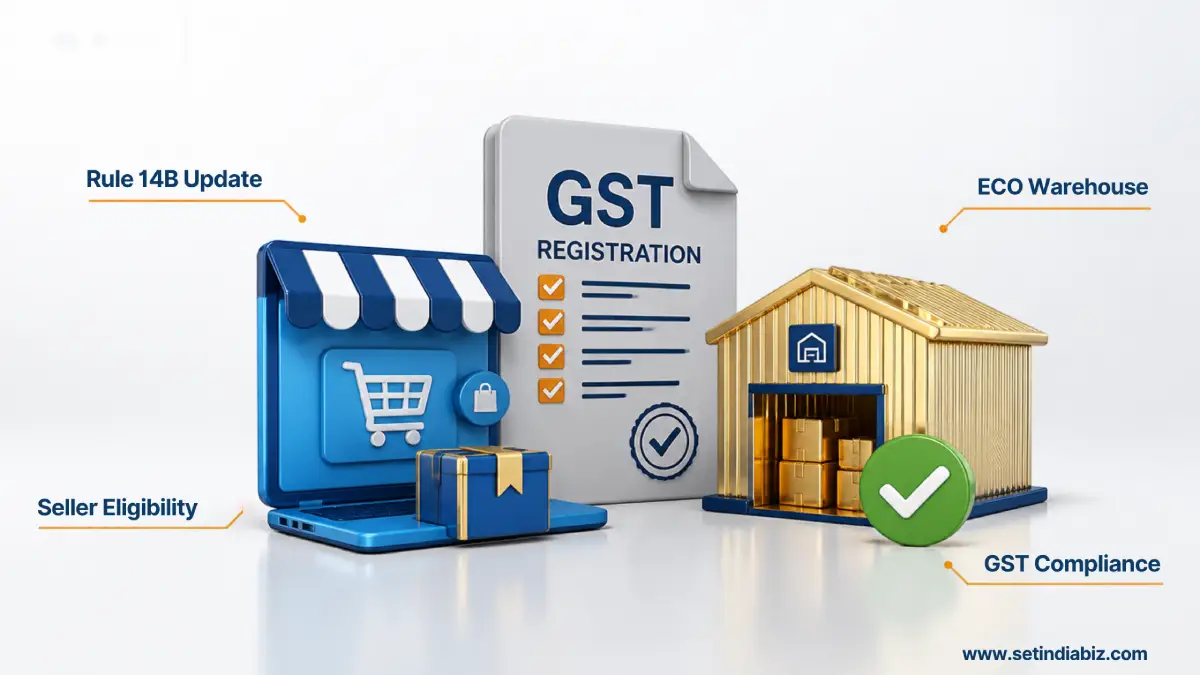
The 57th GST Council, at its meeting on 8th October, 2026, recommended a new registration route under proposed Rule 14B for eligible small sellers supplying goods through e-commerce operators. The facility is expected to become available from 1st November, 2026, allowing qualifying sellers to use an e-commerce operator’s warehouse as their principal place of business in another state, subject to prescribed conditions.
Online sellers often face an additional compliance burden when they expand into states where they have no physical business premises. The proposed GST registration route could ease this difficulty, particularly for small businesses selling through online marketplaces, subject to specific eligibility conditions.
Proposed Rule 14B: How It Works
The GST Council recommended inserting Rule 14B into the Central Goods and Services Tax (CGST) Rules, 2017. Eligible sellers could register in another State or Union Territory by declaring an e-commerce operator’s warehouse as their principal place of business (PPoB).
The facility is restricted to goods supplied exclusively through ECOs required to collect tax at source under Section 52 of the CGST Act, 2017. Direct sales outside the permitted ECO channel are not covered.
Eligibility Conditions
Applicants must meet the following requirements:
- Existing registration: The seller must have a physical business presence and regular GST registration against the same PAN in its home state. Sellers registered there only under Rule 14A must first withdraw from that option using Form GST REG-32.
- Monthly ITC limit: The Council’s recommendation specifies input tax credit (ITC) intended to be passed on of not more than ₹2.5 lakh per month, excluding stock transfers between distinct persons.
- Output tax liability: The official FAQ also specifies a separate monthly ceiling of ₹2.5 lakh on combined Central, State/UT and integrated tax liability on supplies to registered persons other than those registered under the same PAN. This is not a sales turnover cap.
- ECO consent: The operator must consent to the use of its warehouse and decide on the request within seven working days.
- Verification: Biometric Aadhaar authentication, document checks and physical verification in the home state apply where not already completed.
Application and Compliance
Once the facility becomes operational, sellers must apply through Form GST REG-01 on the common GST portal. The application will be sent to the ECO for consent, followed by any outstanding verification.
Sellers must maintain books and electronic records at their home-state principal place of business and produce them when required by the relevant tax officer.
If the ECO withdraws consent, the seller must file Form GST REG-14 within 30 days to amend the registration. Failure to amend after permission to use the warehouse as the principal place of business is withdrawn can result in deemed cancellation.
Setindiabiz Support
Expanding sales through e-commerce marketplaces into new states involves more than obtaining GST registration. Businesses must check their eligibility, complete the registration formalities and maintain compliance for each GST registration.
Setindiabiz supports businesses with GST registration, amendments, return filing and ongoing GST compliance, helping management focus on sales and business expansion while our team handles the compliance requirements. Businesses planning to expand through online marketplaces can explore our GST Registration and GST Return Filing services.
FAQs
A Finance Ministry official reportedly indicated 1 November 2026. Check the relevant notification and GST portal before applying.
No. The facility is restricted to qualifying goods supplied exclusively through eligible ECOs.
No. The proposed scheme permits only one Rule 14B registration per PAN in each State or Union Territory.
Proposed Rule 14B could make interstate expansion easier for eligible online sellers without requiring their own premises in every state. Businesses should confirm the final notification and portal instructions before relying on the new registration route.
