
Overview: GST registration in India depends on aggregate turnover, the nature of supplies and the State or Union Territory concerned. The general threshold is ₹20 lakh, with a lower limit of ₹10 lakh in four States. Eligible suppliers dealing exclusively in goods may qualify for a conditional exemption up to ₹40 lakh. Certain businesses may also need registration below these limits under specific provisions of the GST law.
Businesses must check their Goods and Services Tax (GST) registration requirements before starting taxable operations or expanding into another State. Crossing the applicable turnover limit can trigger registration, but the threshold is not the same for every business.
The applicable limit depends on the nature of supplies, aggregate turnover and the State or Union Territory concerned. Businesses selling through e-commerce platforms should also check the rules that apply to online suppliers.
GST Registration Threshold in India
Section 22 of the Central Goods and Services Tax (CGST) Act, 2017, sets out the general turnover-based registration requirement. The applicable threshold depends on the State or Union Territory from which taxable supplies are made.
| Turnover threshold | Applicable locations | General position |
|---|---|---|
| ₹10 lakh | Manipur, Mizoram, Nagaland and Tripura | Lower general threshold |
| ₹20 lakh | Other States and Union Territories, subject to applicable exemptions | General registration threshold |
| Up to ₹40 lakh | Eligible suppliers of goods in locations covered by the exemption | Conditional exemption under Notification No. 10/2019–Central Tax |
The ₹40 lakh limit is not a universal GST registration threshold. It is a conditional exemption for eligible persons engaged exclusively in supplying goods, subject to the notification’s conditions and exclusions.
States and Union Territories excluded from the ₹40 lakh exemption
Notification No. 10/2019–Central Tax excludes suppliers in the following States and Union Territories from the ₹40 lakh exemption:
- Arunachal Pradesh
- Manipur
- Meghalaya
- Mizoram
- Nagaland
- Puducherry
- Sikkim
- Telangana
- Tripura
- Uttarakhand
The applicable general threshold must be checked in these locations. Manipur, Mizoram, Nagaland and Tripura have the lower ₹10 lakh threshold. The general threshold is ₹20 lakh in the other locations listed above.
Who can claim the ₹40 lakh exemption?
The exemption applies only when the supplier meets the conditions prescribed under Notification No. 10/2019–Central Tax. Turnover below ₹40 lakh alone does not establish eligibility.
The person must be engaged exclusively in supplying goods, subject to the notification’s permitted exceptions, and must not fall within its excluded categories or locations. The notification also excludes specified goods, including ice cream and other edible ice, pan masala, and tobacco and manufactured tobacco substitutes.
Businesses should check the notification before relying on this exemption.
What Is Aggregate Turnover Under GST?
GST registration is based on aggregate turnover, not simply the sales recorded by one shop, branch or State registration.
Under Section 2(6) of the CGST Act, aggregate turnover is calculated on an all-India basis for persons having the same Permanent Account Number (PAN). It includes:
- Taxable supplies
- Exempt supplies
- Exports of goods or services
- Inter-State supplies
Central tax, State tax, Union Territory tax, integrated tax and cess are excluded from the calculation. The value of inward supplies on which the person pays tax under the reverse charge mechanism is also excluded.
A business operating across multiple States must therefore consider its relevant supplies across India when checking the registration threshold.
When Is GST Registration Mandatory?
Turnover is not the only factor that determines registration. Sections 22, 23 and 24 of the CGST Act must be read together. Section 23 provides for certain persons who are not liable to registration, while Section 24 identifies categories that may require compulsory registration, subject to applicable exemptions and notifications.
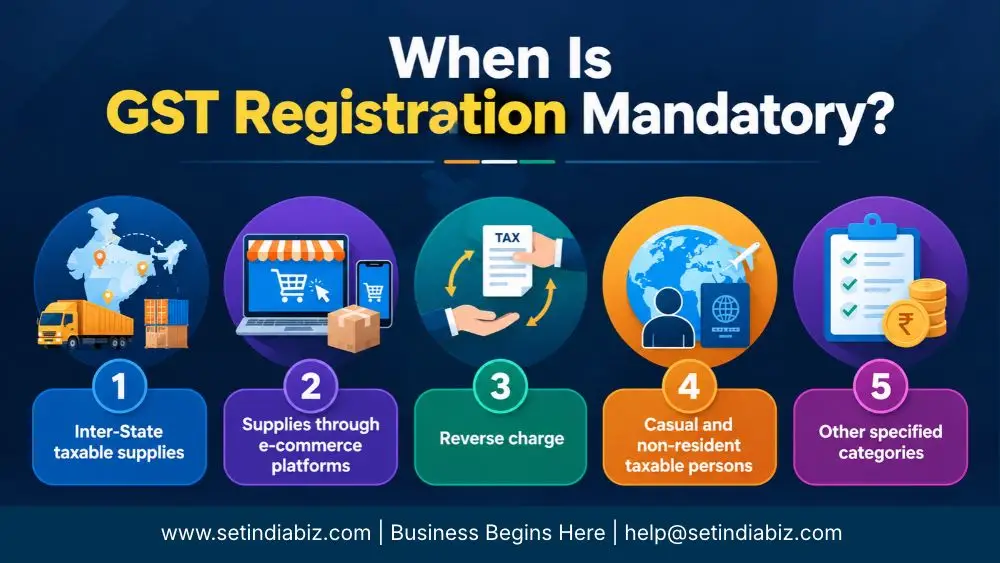
Businesses should pay particular attention to the following situations.
1. Inter-State taxable supplies
Inter-State suppliers may be required to register even when their turnover is below the general threshold. However, exemptions apply to specified categories and transactions. Businesses should check the relevant provisions before deciding whether registration is compulsory.
2. Supplies through e-commerce platforms
Suppliers selling through an electronic commerce operator (ECO) must check the rules applicable to their type of supply and the platform used. Specific registration exemptions are available to certain eligible suppliers, subject to prescribed conditions.
3. Reverse charge
Certain recipients must pay GST under the reverse charge mechanism. However, this does not mean every person receiving a supply covered by reverse charge must automatically obtain registration. The requirement depends on the applicable provisions and exemptions.
4. Casual and non-resident taxable persons
Special registration provisions apply to casual taxable persons and non-resident taxable persons making taxable supplies in India. These businesses should check the requirements before commencing taxable activities.
5. Other specified categories
Section 24 also covers specified categories, including persons liable to deduct or collect tax at source, Input Service Distributors and certain agents. The applicable conditions and exemptions must be checked for each category.
A business should not assume that staying below the turnover threshold removes every registration obligation.
Latest GST Council Update on E-commerce Registration
At its 57th meeting on 8th October, 2026, the GST Council recommended a simplified registration mechanism for certain small suppliers selling goods through e-commerce operators.
Under the proposed Rule 14B mechanism, eligible sellers could declare an e-commerce operator’s warehouse as their principal place of business in a State or Union Territory where they have no physical presence. The proposed facility would provide automatic registration, subject to prescribed conditions.
The proposal includes a monthly input tax credit (ITC) pass-through limit of ₹2.5 lakh, excluding stock transfers between distinct persons. The scheme is intended to help eligible small sellers expand through online marketplaces without establishing a physical place of business in every State.
The Press Information Bureau (PIB), in its FAQs on the proposed simplified registration scheme, lists conditions including biometric-based Aadhaar authentication, physical verification in the seller’s home State and exclusive supply of goods through the e-commerce platform. Businesses should check the final rules and official notifications before relying on the proposed facility.
This is a Council recommendation, not a change to the general turnover thresholds. Businesses should check the implementing notification and final conditions before relying on the proposed mechanism.
When Should a Business Apply for GST Registration?
A business should review its registration position before its aggregate turnover crosses the applicable threshold. It should also assess whether the nature of its supplies or activities triggers a separate registration requirement.
Before applying, check:
- Aggregate turnover across India under the same PAN.
- The State or Union Territory concerned.
- Whether the business supplies goods, services or both.
- Whether the ₹40 lakh exemption is available.
- Whether a compulsory registration provision applies.
If your business requires registration, Setindiabiz offers you a simple and complete solution, guiding you to prepare the prescribed documents and submit the application through the GST portal.
How SetIndiaBiz Supports GST Registration and Compliance
GST registration requires businesses to identify the correct threshold, prepare the necessary documents and ensure that the application reflects their actual activities.
Frequently Asked Questions
The general threshold is ₹20 lakh in aggregate turnover in a financial year. A lower threshold of ₹10 lakh applies to suppliers making taxable supplies from Manipur, Mizoram, Nagaland and Tripura. Eligible suppliers dealing exclusively in goods may qualify for an exemption up to ₹40 lakh, subject to prescribed conditions.
Not in general. But, It can be. Certain provisions may require registration below the general threshold, subject to applicable exemptions and notifications. The nature of the supplies and the relevant registration rules must be checked.
No. It is a conditional exemption for eligible persons engaged exclusively in supplying goods. Specified States, Union Territories and categories of goods are excluded.
Aggregate turnover is calculated on an all-India basis for persons having the same PAN. Businesses operating across multiple States must consider their relevant supplies across India.
The requirement depends on the seller’s activities, applicable provisions and available exemptions. The GST Council recommended a simplified mechanism under proposed Rule 14B in October 2026. Sellers should verify the implementing notification and conditions before relying on it.
The correct GST registration threshold depends on aggregate turnover, the nature of supplies, the State or Union Territory concerned and any separate registration requirements.
Checking these points early potentially reduces the risk of missed registration obligations and avoidable compliance issues. Businesses should also verify the latest notifications before relying on an exemption or a newly announced registration facility.
Setindiabiz Support
Setindiabiz professionals support businesses with GST registration, documentation and related compliance requirements. The team also supports registration amendments and other GST compliance needs as businesses expand into new markets or change their operations. This allows business owners to focus on their operations and growth while the relevant compliance work is handled by professionals.
Also watch, our GST registration process video on YouTube for a step-by-step overview of the application process.
