
Overview: The GST Council may consider greater clarity on the tax treatment of e-commerce logistics services, particularly the distinction between Goods Transport Agency (GTA) services and local delivery services provided by or through electronic commerce operators. The issue has gained importance after conflicting advance rulings on integrated e-commerce logistics models. A clearer framework could reduce classification disputes and provide greater certainty to e-commerce platforms, logistics providers and MSMEs.
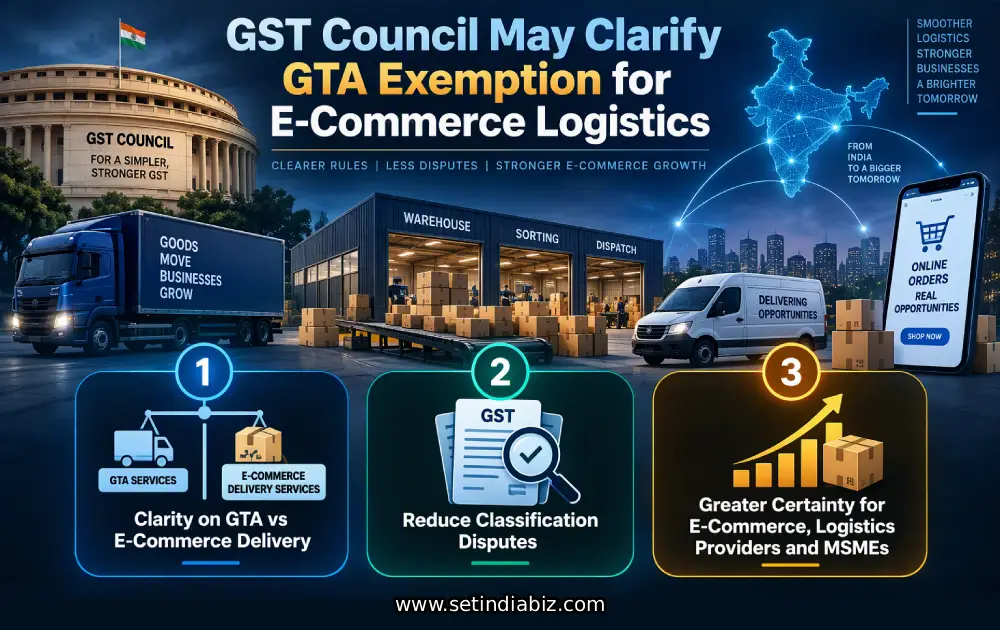
The GST Council may consider greater clarity on the tax treatment of e-commerce logistics services, particularly where transportation is combined with hub operations and last-mile delivery. Conflicting advance rulings have raised questions over when such arrangements qualify as Goods Transport Agency (GTA) services and when separate GST provisions for local delivery through electronic commerce operators apply.
A clearer position could reduce classification disputes and give e-commerce businesses, logistics providers and MSMEs greater certainty over their GST obligations.
Why this GST Issue Has Arisen
E-commerce platforms often use multiple warehouses, transit hubs and delivery centres to move goods from sellers to customers. A single order may involve transportation between locations, sorting, consolidation, tracking and final delivery.
This has raised questions over whether particular arrangements qualify as GTA services or fall within the separate GST framework for local delivery services provided by or through an electronic commerce operator (ECO).
The distinction became more significant after GST changes were introduced in 2025. Local delivery services supplied through an Electronic Commerce Operator (ECO) by suppliers covered under the specified conditions fall under Section 9(5). In such cases, the ECO is liable to pay GST at 18%. The GST framework also excludes an ECO providing or facilitating such local delivery services from the definition of Goods Transport Agency (GTA).
Conflicting Rulings Add to Uncertainty
The treatment of e-commerce transportation has also produced different advance rulings.
The issue has produced conflicting rulings. In December 2025, the West Bengal AAR allowed the GTA exemption for Flipkart’s proposed logistics model, while the Tamil Nadu AAR reached a similar conclusion in January 2026. The West Bengal Appellate Authority later reversed the West Bengal ruling in May 2026, creating further uncertainty over the GST treatment of such e-commerce logistics arrangements.
These differing interpretations highlight the difficulty of applying the GST framework to logistics models that combine transportation with hub operations and last-mile delivery.
What Greater GST Clarity Could Mean
A clearer framework could help businesses determine whether a particular service falls within the GTA provisions or the separate rules governing local delivery through ECOs.
This could be particularly relevant to arrangements involving:
- Transportation between warehouses and hubs;
- Sorting and consolidation;
- Transshipment;
- Third-party logistics providers;
- Last-mile delivery; and
- E-commerce platforms coordinating integrated delivery networks.
The applicable GST treatment will ultimately depend on the final legal position notified by the authorities. Businesses should therefore continue to follow the existing provisions rather than changing their tax treatment solely on the basis of a proposed clarification.
Why It Matters for E-Commerce and MSMEs
Logistics is a significant operating cost for online sellers, e-commerce businesses and MSMEs. Differences in GST treatment can affect the cost of delivery, invoicing, contractual arrangements and tax compliance.
A more consistent approach could reduce classification disputes and make GST treatment more predictable for e-commerce platforms, logistics providers and smaller businesses using online marketplaces.
Businesses using integrated logistics models should review their service agreements, invoices, GST classification and exemption eligibility in light of the applicable provisions.
Why This Matters
The issue highlights a wider GST challenge created by technology-driven supply chains. Modern e-commerce logistics can combine transportation, warehousing, sorting and doorstep delivery within a single network, while different GST provisions may apply depending on the nature of the underlying service.
Greater clarity could reduce compliance uncertainty and help ensure more consistent GST treatment across comparable e-commerce and logistics models.
FAQs
The issue is whether particular e-commerce logistics arrangements qualify as GTA services or fall within the separate GST framework applicable to local delivery services provided by or through an electronic commerce operator.
Advance ruling authorities have taken different views on the classification of integrated e-commerce transportation models, particularly where transportation is combined with sorting, hub operations and last-mile delivery.
Local delivery services supplied through an ECO by a person who is not liable for registration under Section 22(1) are covered under Section 9(5), with the ECO responsible for GST at 18%. The GST framework also excludes such local delivery services from the GTA definition.
A clearer framework could reduce classification disputes and provide greater certainty on GST liability, invoicing and exemption eligibility for e-commerce platforms, logistics providers and MSMEs.
Setindiabiz Support
Setindiabiz supports businesses, startups and MSMEs on GST registration, tax compliance, invoicing, business structuring and regulatory documentation.
Where logistics arrangements involve multiple parties, hubs and delivery models, the GST position depends on the actual nature of the service, contractual structure, documentation and applicable exemption conditions. Setindiabiz experts help review service classification, exemption eligibility, logistics agreements and invoices to establish and document the appropriate GST position.
