
Overview: Zee Entertainment Enterprises Ltd. has received a Ministry of Corporate Affairs (MCA) notice under Sections 210(1)(a) and 210(1)(c) of the Companies Act, 2013, seeking information in continuation of an ongoing inspection under Section 206(5). Zee has said it has already provided the information sought and will furnish further information and explanations as required. The company’s disclosure does not identify any specific violation or quantify any financial impact. The development highlights why companies need accurate records, timely responses and a well-maintained compliance trail.
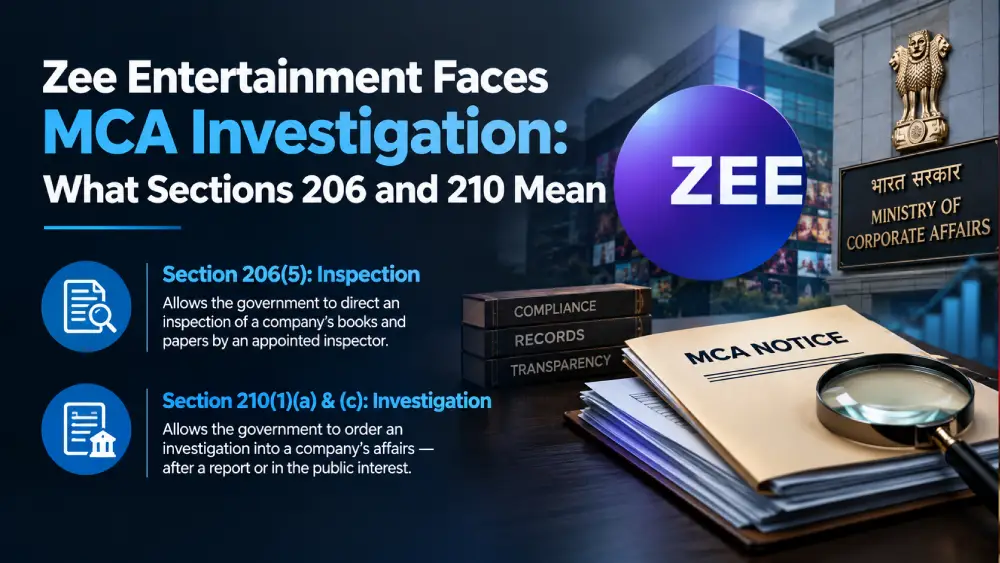
Zee Entertainment Enterprises Ltd. has disclosed that it received a notice from the Ministry of Corporate Affairs, through the Office of the Regional Director, Western Region-II, Mumbai. The notice seeks certain information under Sections 210(1)(a) and 210(1)(c) of the Companies Act, 2013, in continuation of an ongoing inspection under Section 206(5).
Zee has stated that it has already provided the required information and will furnish further information and explanations sought by the MCA.
The company’s regulatory disclosure describes the nature of the action as “Investigation under Section 210(1)(a) & (c)” and the details of the violation or contravention as “Calling for information”. It does not disclose the subject matter of the information sought or identify a specific contravention by Zee. The company has also stated that the financial, operational or other impact is not applicable in monetary terms at this stage.
The disclosure should therefore be read as an ongoing regulatory process and not as a finding that Zee has violated the Companies Act.
What Do Sections 206 and 210 Mean?
Section 206(5): Inspection
Section 206 of the Companies Act deals with the power to call for information, inspect books and conduct inquiries. Under Section 206(5), where circumstances warrant, the Central Government may direct an inspection of a company’s books and papers by an inspector appointed for the purpose.
The company and its officers may be required to furnish information, explanations or documents in connection with the regulatory process. The provision forms part of Chapter XIV of the Companies Act, which covers inspection, inquiry and investigation.
Section 210: Investigation
Section 210 provides the statutory framework for investigation into a company’s affairs by the Central Government.
Under Section 210(1)(a), the Central Government may order an investigation after receiving a report of the Registrar or inspector under Section 208. Under Section 210(1)(c), it may order an investigation where it considers an investigation necessary in the public interest.
Section 210(3) also allows the Central Government to appoint one or more inspectors to investigate the company’s affairs and report in the manner directed by the Government.
In Zee’s case, the latest disclosure refers to an investigation under both clauses (a) and (c), while stating that the information request is in continuation of the ongoing inspection under Section 206(5).
What Can Happen if a Company Does Not Comply?
An inspection or investigation itself is not a finding of non-compliance. Separate consequences can arise if a company, officer or other person fails to comply with statutory requirements during the process.
Section 206(7): Failure to furnish information or explanations or produce documents required under Section 206 can attract a fine of up to ₹1 lakh, with a further fine of up to ₹500 per day for continuing default.
Section 217(8): During an investigation, a person who, without reasonable cause, fails or refuses to produce required books or papers, furnish information, appear before the inspector, answer questions or sign examination notes may face imprisonment of up to six months, a fine of ₹25,000 to ₹1 lakh, and a further fine of up to ₹2,000 per day for continuing failure or refusal.
These provisions make timely and accurate regulatory responses particularly important when an MCA inspection or investigation is underway.
What Should Companies Take Care Of?
To stay prepared for MCA information requests, inspections or investigations and deal effectively with any such situation, companies should:
- keep statutory registers, books and supporting documents updated;
- ensure MCA filings, financial statements and internal records are consistent;
- preserve relevant records and prevent unauthorised alteration or destruction;
- respond within the prescribed timeline and retain proof of submissions;
- coordinate directors, officers and professional advisers before submitting regulatory responses; and
- obtain professional advice where the matter involves complex transactions or potential Companies Act issues.
A clear documentary trail can help a company substantiate its filings, explain past transactions and respond accurately when regulators seek additional information.
Why the Zee Matter Matters for Other Companies
The Zee disclosure is a reminder that Companies Act compliance extends beyond routine annual filings. Regulatory scrutiny can require a company to produce records and explain the basis of transactions, decisions or information previously provided to authorities.
At the same time, the current Zee disclosure does not establish a specific contravention or penalty. The company has said that it has already provided the information sought and will continue to provide further information and explanations requested by the MCA.
For other companies, the practical lesson is to maintain accurate statutory records, preserve supporting documents and ensure that corporate filings and underlying records remain consistent.
Setindiabiz Support
Setindiabiz supports businesses with Companies Act compliance, corporate records, statutory documentation and regulatory requirements. Our professionals assist with compliance reviews, statutory records, Board documentation and maintaining consistency across corporate filings and underlying records.
A strong compliance framework also helps businesses stay prepared when regulators seek information or clarification. Setindiabiz helps businesses maintain supporting documents, review compliance gaps, organise corporate records and address regulatory requirements as part of their ongoing compliance framework. We also support Companies Act compliance, Board documentation and other corporate compliance requirements.
FAQs
Zee Entertainment received a notice from the MCA, seeking certain information under Sections 210(1)(a) and 210(1)(c) of the Companies Act. The notice is stated to be in continuation of an ongoing inspection under Section 206(5). The company’s disclosure does not specify the subject matter of the information sought.
No. The current disclosure does not establish a specific contravention by Zee Entertainment. It describes the matter as calling for information and does not disclose any monetary penalty or quantifiable financial impact.
Section 206(5) allows the Central Government, where circumstances warrant, to direct an inspection of a company’s books and papers by an inspector appointed for the purpose.
Section 210(1)(a) allows the Central Government to order an investigation Section 206(5) allows the Central Government, where circumstances warrant, to direct an inspection of a company’s books and papers by an inspector appointed for the purpose.into a company’s affairs after receiving a report of the Registrar or inspector under Section 208.
Section 210(1)(c) allows the Central Government to order an investigation where it considers an investigation necessary in the public interest.
The company should identify the scope of the request, preserve relevant records, verify the accuracy and consistency of the information and submit a complete response within the prescribed timeline. Directors, officers and professional advisers should coordinate the response where the matter involves complex or potentially sensitive compliance issues.
