
Overview: The 57th GST Council meeting on October 8, 2026 is expected to consider a wide package of GST process and enforcement reforms aimed at making compliance faster, more predictable. Proposals include quicker refunds and registration, wider Input Tax Credit (ITC), fewer routine notices, simpler e-commerce compliance and changes to enforcement for ease of doing business.
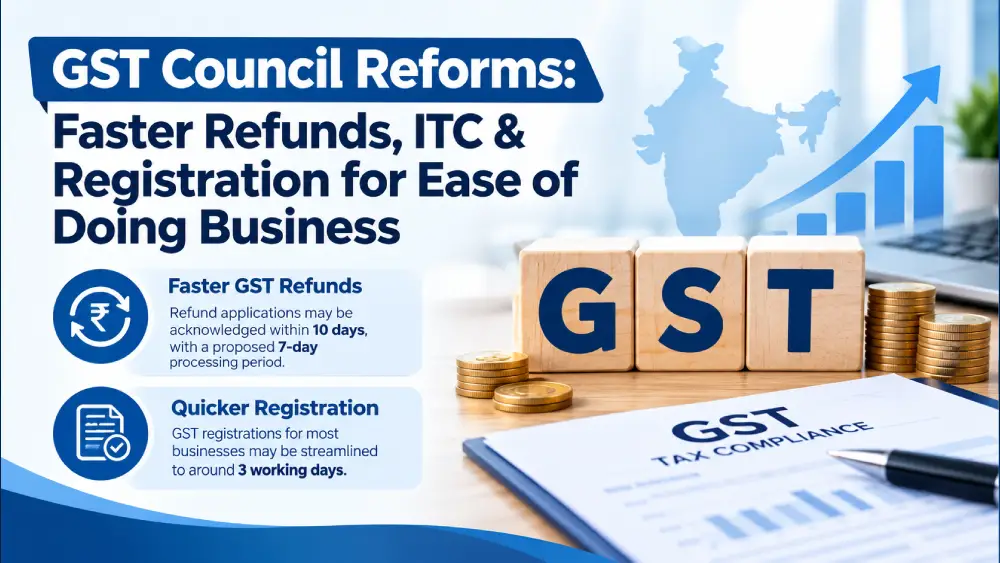
The GST Council is set to consider a broad package of compliance reforms on October 8, 2026, covering refunds, Input Tax Credit (ITC), registration, notices and enforcement. The proposals are aimed at making GST administration faster and more predictable, with particular relevance for startups, MSMEs and businesses operating across multiple States.
The Council may also consider a more predictable cycle for future GST rate changes and wider use of GST data for official statistics. However, these remain proposals until the Council takes a formal decision and the changes are subsequently notified.
Key GST Reforms Under Discussion
- Faster GST refunds: Refund applications may be acknowledged within 10 days, followed by a proposed seven-day processing period. This could bring the overall timeline for eligible claims to around 17 days.
- Swifter and wider ITC: The Council may consider protecting genuine buyers where suppliers subsequently default, along with changes to restrictions on selected business expenses. The broader objective is to reduce tax cascading by keeping legitimate business costs within the credit chain.
- Fewer notices: A more risk-based compliance approach could reduce routine notices, including those arising from certain invoice mismatches, while directing enforcement towards higher-risk cases.
- Quicker registration: GST registration for most businesses may be streamlined to around three working days, building on technology-driven processing already available to certain low-risk applicants.
- Easier registration exit: Compliant taxpayers may get a simpler route to cancel GST registration, while certain registrations suspended for procedural lapses could be restored automatically once the underlying issue is resolved.
- Simpler e-commerce compliance: Small e-commerce sellers may be allowed to use an e-commerce platform’s warehouse as their place of business in States where they do not have their own premises. The Council may also consider simpler verification and registration arrangements across States.
- Inverted-duty relief: A graded refund mechanism may be considered for accumulated ITC on input services and plant and machinery under an inverted duty structure.
GST Enforcement May Become More Trust-Based
The Council may consider decriminalising certain GST offences and reducing the circumstances in which tax officers can arrest taxpayers. Routine disputes could move towards tax recovery, interest and penalties, while serious fraud and deliberate tax evasion would continue to face stronger enforcement. Any changes would require the necessary legal amendments.
The Centre is also developing a faceless GST assessment mechanism for Central GST (CGST) taxpayers as a separate move towards technology-driven administration.
Rate Stability Could Improve Business Planning
The Council may consider limiting GST rate changes to once each fiscal year, with changes taking effect from April 1. A predictable rate cycle could help businesses plan pricing, long-term contracts and capital expenditure with greater certainty.
GST Data May Support Wider Government Statistics
The Council may also consider sharing GST data with the Ministry of Statistics and Programme Implementation (MoSPI) for official statistical purposes.
The MoSPI, according to a Mint report, has sought GST datasets including GSTR-3B and GSTR-9, along with transaction-level information such as outward supplies, reverse-charge supplies and eligible ITC for specific statistical work. The data could support trade-margin estimates and a Statistical Business Register tracking businesses by size and activity.
Wider use of GST data also makes accurate records, data governance and access controls more important for businesses.
Expected Timeline
The proposals are still under consideration and will not apply automatically. Reports suggest that public consultation on some reforms could begin by December 2026, while April 1, 2027 has been indicated as an ideal starting point. Approved measures could be rolled out in phases through 2027.
FAQs:
What GST reforms may be discussed on October 8, 2026?
The Council may consider faster refunds, wider ITC, quicker registration, fewer routine notices, simpler e-commerce compliance, changes to GST enforcement and greater predictability in future rate changes.
Will these GST reforms apply immediately?
No. The proposals will take effect only after the required approvals, legal amendments, notifications and implementation steps are completed.
How should businesses prepare?
Businesses should maintain accurate GST returns, invoices, ITC records and supporting documents. They should also keep transaction data properly reconciled and have timely processes for responding to departmental notices.
Setindiabiz Support
Setindiabiz helps businesses with GST registration, GST return filing, ITC reconciliation, GST notices, assessments and tax documentation and other compliances. Our taxation experts work with startups, MSMEs and growing businesses to review ITC positions, reconcile transaction data, maintain GST records and prepare responses to departmental notices.
Watch
In This Article
Author Bio

Setindiabiz Editorial Team is a multidisciplinary collective of Chartered Accountants, Company Secretaries, and Advocates offering authoritative insights on India’s regulatory and business landscape. With decades of experience in compliance, taxation, and advisory, they empower entrepreneurs and enterprises to make informed decisions.
