
Overview: Global Capability Centres (GCCs) are becoming more than captive technology operations for multinational companies. Established centres with skilled employees, technology capabilities and business knowledge are now attracting interest from Indian IT companies. Recent transactions involving TCS, HCLTech and Wipro show how GCC acquisitions and transfers can create a new growth route while also creating important corporate, employment, intellectual property, tax and compliance requirements.
Indian IT companies have traditionally built capabilities by winning contracts, hiring teams and developing delivery centres. A different model is now gaining attention: acquiring or taking over an established GCC.
A recent Business Standard report highlighted this trend as slower organic growth and the impact of AI put pressure on traditional IT services. Established GCCs can offer an experienced workforce, industry knowledge, technology capabilities and an existing relationship with the parent business.
For IT companies, this can provide a faster route to new capabilities. For multinational businesses, transferring a GCC can offer a different operating model while retaining access to the technology services they need.
GCC Acquisitions Are Taking Shape
Recent GCC transactions show how the model is changing. TCS’s transition of Best Buy’s India GCC, HCLTech’s acquisition of Guardian India Operations and Wipro’s acquisition of Mindsprint all combine an established technology operation with a wider or continuing services relationship.
The significance for other businesses is broader than the deals themselves. An established GCC can contain valuable employees, technology, intellectual property, business knowledge and contractual relationships. A transfer therefore needs to be structured as a proper business transaction rather than treated simply as an outsourcing arrangement.
For an IT company, the focus may be on acquiring the right capabilities and securing the continuing client relationship. For a GCC owner, the focus may be on transferring the operation without disrupting employees, contracts, technology rights or ongoing services.
Why GCCs Have Business Value
Building a specialised technology team takes time. An established GCC can provide trained employees, industry knowledge, technology infrastructure and intellectual property from day one.
For the GCC owner, a transfer can also make commercial sense. A multinational may want to focus on its core business while allowing a specialist technology provider to operate the centre and provide services under a long-term agreement.
A July 2026 report by UnearthIQ and Embark estimated that around 30% of GCCs established after 2020 had reached a growth plateau. It also estimated that around 500-520 GCCs across different establishment periods faced similar maturity challenges.
These figures do not mean that such GCCs are automatically acquisition targets. They do, however, show why some owners may review their existing operating model.
Key Checks Before a GCC Acquisition or Transfer
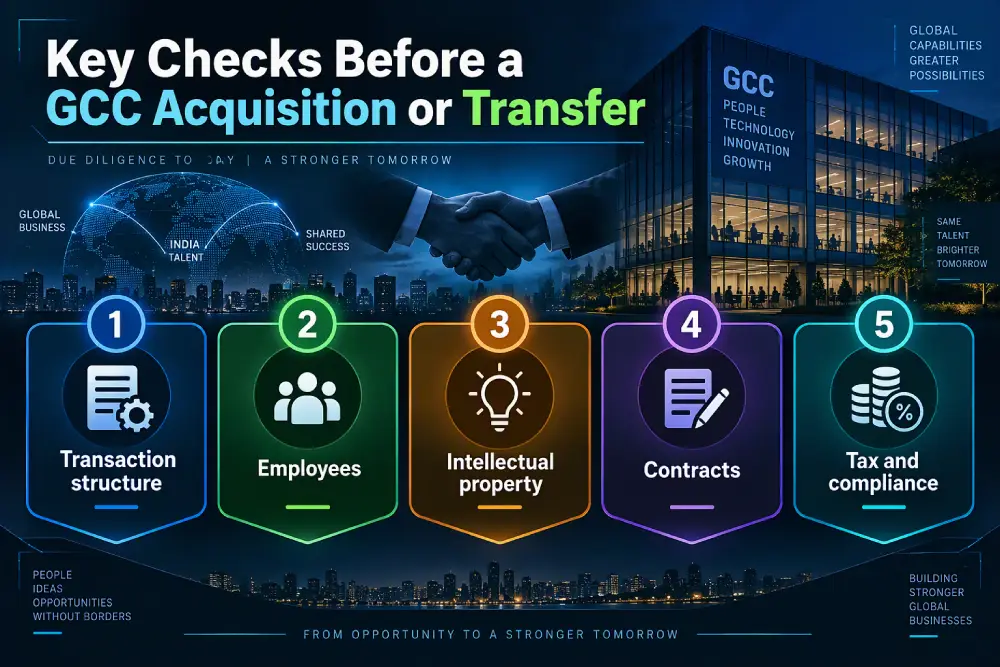
A GCC transaction involves more than its purchase price. The following areas need proper review:
- Transaction structure: Assess whether the arrangement involves a share acquisition, business transfer, transfer of operations or another structure. Review valuation, liabilities, approvals and documentation.
- Employees: Review employment contracts, benefits, continuity of service, incentives and other employee obligations before the transition.
- Intellectual property: Establish ownership and usage rights for software, source code, databases and other technology assets. Existing licences and transfer restrictions should also be checked.
- Contracts: Review parent-company agreements, customer contracts, assignment clauses, change-of-control provisions and any required consents.
- Tax and compliance: Assess tax and accounting implications, including transfer pricing or withholding tax where relevant. Corporate records, statutory filings and other compliance requirements should also be reviewed.
GCC Transactions Need the Right Structure
A GCC is not simply a technology team. Over time, it can build valuable people, intellectual property, systems and business knowledge.
That makes the structure of a transfer or acquisition important. The transaction should protect employee continuity, technology rights, contractual relationships and the commercial interests of both parties.
For IT companies, this can create a faster route to scale. For GCC owners, it can provide a new operating model without losing access to essential technology services.
FAQs
Established GCCs can provide skilled employees, technology capabilities, industry knowledge and an existing relationship with the parent business.
No. The arrangement may involve an acquisition, business transfer, transfer of operations or a wider services agreement, depending on the commercial structure.
Employee treatment depends on the transaction structure and applicable agreements. Employment contracts, benefits and continuity of service should be reviewed before the transition.
Key areas include transaction structure, employees, intellectual property, customer contracts, tax, accounting and corporate and statutory compliance.
SetIndiaBiz Support
A GCC transaction can involve corporate restructuring, business transfer documentation, employee arrangements, contracts, intellectual property and statutory compliance. SetIndiaBiz supports businesses with the structuring and documentation required for GCC acquisitions, transfers and restructuring. We support business entities with corporate structuring, transaction documentation, employee transition documentation, contract and IP review, and corporate and statutory compliance.
Whether an IT company is acquiring an established GCC or a multinational business is transferring its Indian technology centre, SetIndiaBiz can help assess the structure and documentation requirements so the transaction is properly planned and the new operating model is supported by appropriate compliance.
