
The International Financial Services Centres Authority (IFSCA) has officially accepted a progressive regulatory blueprint designed by its specialized Expert Committee. Submitted under the chairmanship of former Whole Time SEBI member Ananta Barua, this extensive roadmap outlines a visionary strategy to establish GIFT City as the premier global gateway for fractional real estate ownership and large-scale infrastructure capital pooling.
For asset management groups, cross-border corporate houses, and sophisticated property developers, the report signals a paradigm shift in how capital can be imported, managed, and structured within a tax-neutral environment.
Strategic Market Scope & Structured Vehicles
The committee’s recommendations break down traditional real estate investment constraints by adding highly anticipated financial asset variations to the existing regulatory architecture:
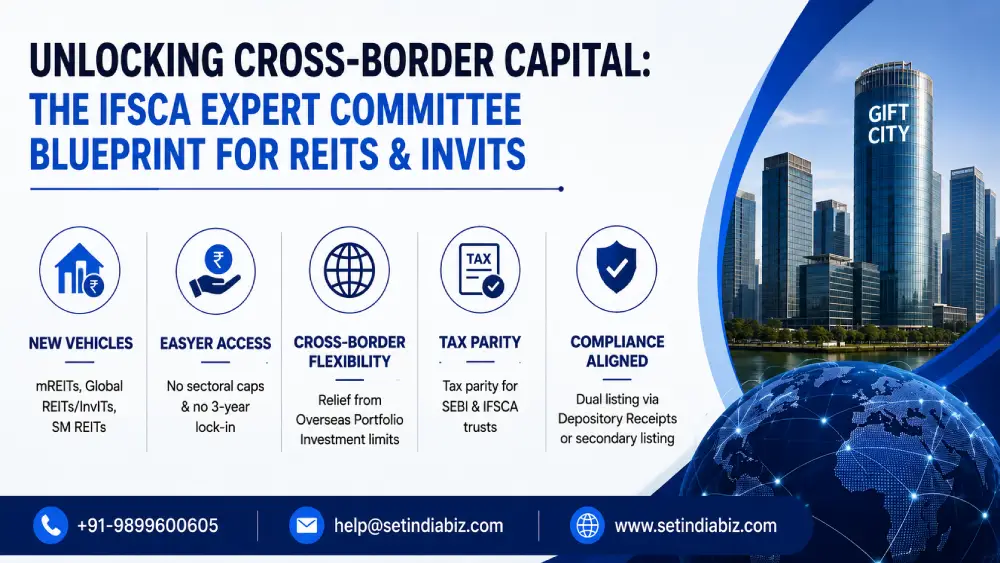
- Introduction of Mortgage REITs (mREITs): Moving past physical asset allocation, the framework structures mREITs as dedicated debt managers. These trusts generate income directly from net interest margins by providing financing solutions for real estate loans and purchasing mortgage portfolios secured by underlying real-world collateral.
- Global & Mixed Portfolios: The recommendations facilitate the structural combination of multi-jurisdictional assets into unified Global REITs and InvITs, allowing developers to build diversified baskets of domestic and international projects.
- Boutique Syndication (SM REITs): Micro-structuring parameters are mapped out for Small and Medium REITs (SM REITs), democratizing fractional property ownership and allowing mid-tier developers access to formal institutional capital mechanisms.
- Sustainable Financing: Clear guardrails extend anti-greenwashing principles to specialized Green REITs and InvITs, aligning with international ESG allocations.
Critical Regulatory & Compliance Takeaways
To seamlessly align corporate expansion plans with this updated ecosystem, businesses must prepare for several high-impact compliance realignments across multiple oversight frameworks:
- Dual Listing Configurations: The report presents operational paths enabling SEBI-registered domestic business trusts to trade on recognized IFSC stock exchanges via depository receipts or secondary listing processes.
- Relaxation of Investment Barriers: Inbound investments routed from the IFSC directly into domestic enterprise equities are completely exempted from standard sectoral restrictions and the three-year automatic-route lock-in requirements.
- Cross-Border Exchange Adjustments: Indian corporate sponsors participating in IFSC-based business trust setups are granted complete relief from standard Overseas Portfolio Investment (OPI) limits.
- Statutory Tax Realignment: The committee explicitly outlines legislative proposals to amend the core definition of business trusts within the Income Tax Act. This guarantees absolute tax parity between domestic SEBI setups and IFSCA trusts. Foreign-sourced income generated from offshore investments is entirely tax-exempt when distributed to non-resident unitholders.
FAQ’s
Can an already established, SEBI-registered Indian trust list in GIFT City?
What is the proposed tax treatment for foreign investors (Non-Residents)?
Are there any relaxations for Indian corporate sponsors regarding exchange control?
SetIndiaBiz Translates This Framework for Your Business
Capitalizing on the convergence of IFSCA fund mandates, RBI foreign exchange controls, and domestic direct tax laws demands precision execution. SetIndiaBiz provides end-to-end operational, legal, and secretarial support to structure your business inside GIFT City:
- IFSCA & GIFT City Entity Formation: Complete corporate drafting, licensing, and set up for your unique Sponsor, Trustee, and Investment Manager entities inside the IFSC zone.
- FEMA & Inbound/Outbound Structuring: Professional handling of documentation required for cross-border capital routing, OPI parameter exemptions, and compliance clearance with the Reserve Bank of India.
- Corporate Tax Advisory & CFO Governance: Expert structuring of your accounting books by our dedicated CAs to ensure complete alignment with new offshore income tax exemptions, business trust parity provisions, and automated withholding models.
- Ongoing Secretarial Compliance: Full tracking of disclosure obligations, continuous listing compliance on IFSC exchanges, and direct corporate liaison with the unified financial regulator.
In This Article
Author Bio

Setindiabiz Editorial Team is a multidisciplinary collective of Chartered Accountants, Company Secretaries, and Advocates offering authoritative insights on India’s regulatory and business landscape. With decades of experience in compliance, taxation, and advisory, they empower entrepreneurs and enterprises to make informed decisions.
