
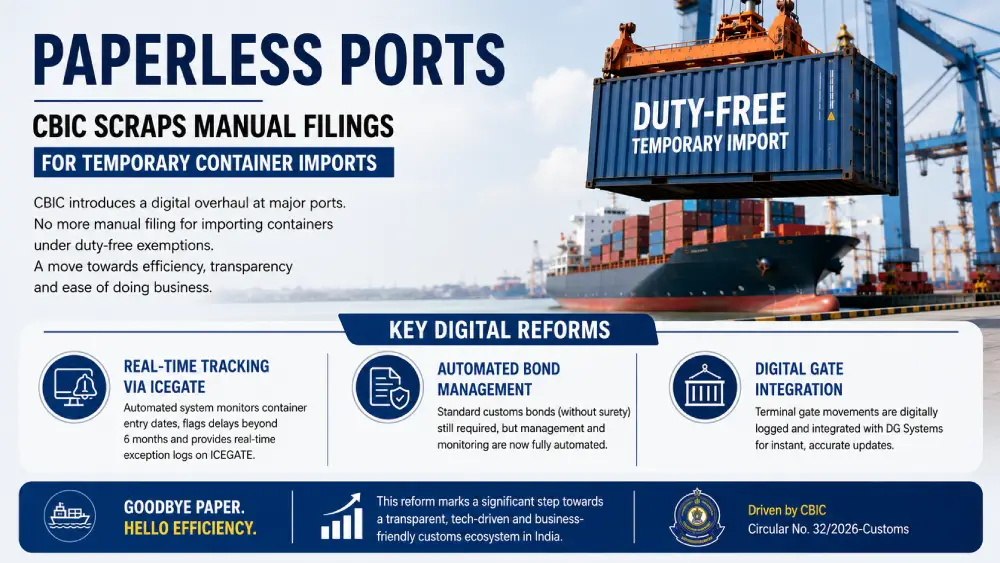
The Central Board of Indirect Taxes and Customs has cleared a digital overhaul at major ports in India in a major step to ease operational friction for cargo handlers. There will be no more manual filing while importing shipping containers under duty-free exemptions.
The reform, rolled out under Circular No. 32/2026-Customs, marks a transition away from a decades-old paper trail. Shipping lines can bring containers into India without paying import duties, provided the steel boxes are sent back out of the country within six months.
Up until now, proving compliance with this deadline involved a mountain of manual log keeping and physical declarations.
Real-Time Tracking via ICEGATE
Instead of relying on customs officers and cargo agents to manually verify paper logs, the tracking process is shifting entirely to automated system diagnostics:
- Automated Expiry Alerts: The Directorate General of Systems (DG Systems) will run back-end scripts to monitor the exact date each container enters the country.
- ICEGATE Exception Logs: If a container crosses the six-month limit without a recorded export, the system automatically flags the container and posts the details directly to the ICEGATE portal.
- Targeted Monitoring: Both logistics providers and field customs officers can instantly view these digital exception lists online, making physical audit trails obsolete.
Automated Bond Management
However, shipping lines, steamer agents, and Non-Vessel Owning Common Carriers (NVOCCs) are still required to submit standard customs bonds (without surety). But day-to-day administration of these accounts is being completely modernized.
Terminal operators are now legally required to maintain digital gate-movement logs. Local customs offices are also coordinating with port operators to link electronic physical gate-readers with DG Systems. This ensures that the moment a container passes a physical port gate, its status is updated in the central tax database automatically, without any human intervention.
In This Article
Author Bio

Setindiabiz Editorial Team is a multidisciplinary collective of Chartered Accountants, Company Secretaries, and Advocates offering authoritative insights on India’s regulatory and business landscape. With decades of experience in compliance, taxation, and advisory, they empower entrepreneurs and enterprises to make informed decisions.
