
Overview: Share transfer in a One Person Company (OPC) is a structural shift that redefines its identity. Defined by Section 3(1)(c) of the Companies Act, 2013, an OPC has a single member; transferring 100% ownership legally invalidates the current nominee. Consequently, the new member must appoint a fresh nominee under Rule 4 of the Companies (Incorporation) Rules, 2014. Compliance requires two parallel actions: executing Form SH-4 for the transfer under Section 56 and filing Form INC-4 with the Registrar, with the new nominee’s consent. This guide outlines the procedures, timelines, and penalties to ensure a compliant ownership transition.
Legal Framework for Share Transfer in an OPC
Under Section 56 of the Companies Act, 2013, transfer of securities in any company must be effected through a proper instrument of transfer. For an OPC, even though the entire shareholding rests with a single member, the transfer cannot be done informally; it must be executed on a Securities Transfer Form (Form SH-4), duly stamped under the Indian Stamp Act, 1899, and the applicable state-specific stamp duty rates. Once the company registers the transfer, the outgoing member legally relinquishes the rights attached to the shares and the incoming member assumes all corresponding rights and liabilities.
Why Does an OPC Share Transfer Trigger a Change of Nominee?
The OPC structure is built on a unique principle: every sole member must have a nominee who steps in if the member dies or becomes incapable of contracting. This requirement flows from Section 3(1) of the Companies Act, 2013, read with Rule 4 of the Companies (Incorporation) Rules, 2014. When the entire shareholding (100%) is transferred to a new individual, that person becomes the new sole member of the OPC.
The previous nominee, originally consented to by the outgoing member, no longer reflects the member on record’s choice. The law therefore requires the incoming member to appoint their own nominee and obtain fresh written consent, replacing the previous nomination by filing a proper notice with the Registrar.
Procedure for Transferring OPC Shares?
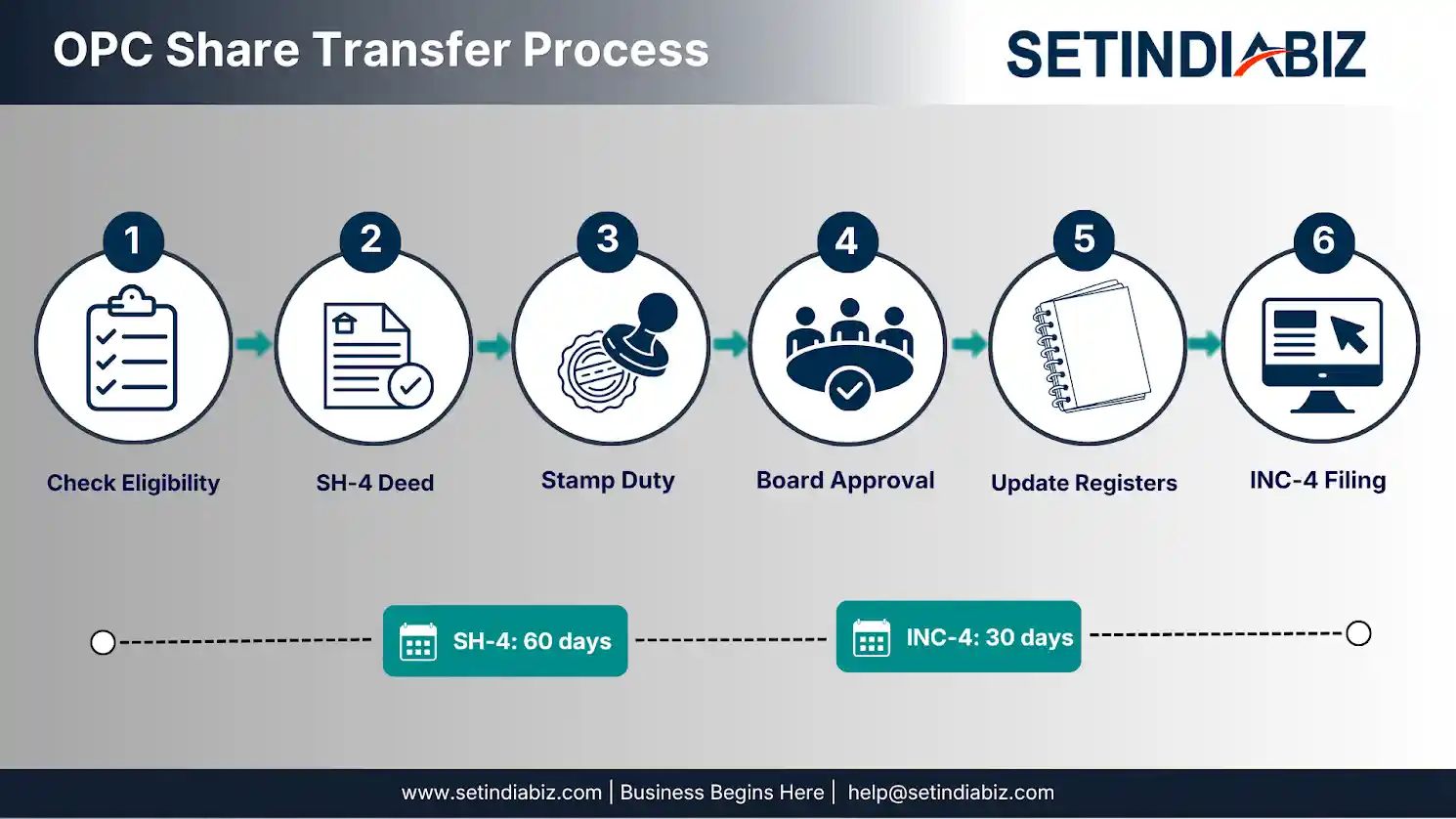
The share transfer is a sequential process in which each step is subject to a statutory timeline. The procedure unfolds as follows:
| Step | Action | Statutory Reference | Timeline |
|---|---|---|---|
| 1 | Execute Form SH-4 (duly stamped) by transferor & transferee | Section 56(1), Companies Act, 2013 | Date of execution |
| 2 | Deliver SH-4 to the company | Section 56(1) | Within 60 days of execution |
| 3 | Board approval through resolution (sole director may record by circulation under Section 175) | Section 175 / Section 179 | On receipt of SH-4 |
| 4 | Register transfer in the Register of Members | Section 56 read with Section 88 | Promptly after approval |
| 5 | Issue a fresh share certificate or endorse the existing certificate | Section 46 read with Rule 6 of Companies (Share Capital & Debentures) Rules, 2014 | Within one month of registration |
| 6 | Obtain the new nominee’s consent in Form INC-3 | Rule 4(5), Companies (Incorporation) Rules, 2014 | Before filing INC-4 |
| 7 | File Form INC-4 along with INC-3 and the updated MoA with the RoC | Rule 4(5) / 4(6) | Within 30 days of the change |
If the change in the OPC clause of the Memorandum of Association requires a formal alteration through resolution, the company should also evaluate whether Form MGT-14 needs to be filed under Section 117. Where the situation is borderline, professional consultation is strongly recommended.
New Nominee Appointment Requirement
Once the transfer is registered in the company’s Register of Members, the incoming sole member has a tight statutory window to formalise the change of nominee. Three actions must be completed in sequence.
- First, the new member must obtain written consent from their chosen nominee on Form INC-3, which includes the nominee’s PAN, address, and identification details.
- Second, the OPC clause of the Memorandum of Association must be updated to reflect the new nominee’s name.
- Third, the company must file Form INC-4 with the Registrar of Companies and attach the signed INC-3 and the revised MoA. Under Rule 4(5) of the Companies (Incorporation) Rules, 2014, this filing must be completed within thirty days of the change. Missing this window attracts penalties under Section 450 of the Companies Act, 2013, currently ₹10,000 with a further ₹1,000 per day of continuing default, capped at ₹2,00,000 for the company and ₹50,000 for the officer in default.
Eligibility of the New Member or Nominee?
Eligibility for OPC membership and nomination is governed by Rule 3 of the Companies (Incorporation) Rules, 2014, as substantially liberalised by the Companies (Incorporation) Second Amendment Rules, 2021 (G.S.R. 91(E) dated 1 February 2021, effective 1 April 2021). The amended position is:
| No | Eligibility Requirements | Description |
|---|---|---|
| 1 | Indian Citizenship | Only a natural person who is an Indian citizen, whether resident in India or otherwise, is eligible. |
| 2 | Indian Residency | “Resident in India” means a person who has stayed in India for at least 120 days during the immediately preceding financial year (reduced from 182 days). |
| 3 | NRI Inclusion | Non-Resident Indians (NRI) who are Indian citizens and meet the 120-day residency threshold are now expressly permitted to be members or nominees of an OPC. |
| 4 | Age | A minor cannot become a member, nominee, or hold beneficial interest in the shares of an OPC (Rule 3). |
| 5 | One OPC Rule | A person cannot be a member of more than one OPC, nor be a nominee in more than one OPC, at the same time. |
Both the incoming sole member and the newly appointed nominee must meet these criteria before the share transfer is legally executed.
OPC Share Transfer vs Private Limited Share Transfer
The mechanics of executing Form SH-4 are common to all companies, but the OPC’s single-member structure introduces compliance steps absent in a private limited company.
| No | Parameter | OPC Share Transfer | Private Limited Share Transfer |
|---|---|---|---|
| 1 | Instrument | Form SH-4 | Form SH-4 |
| 2 | Stamp Duty | As per the Indian Stamp Act, 1899 (state-specific) | As per the Indian Stamp Act, 1899 (state-specific) |
| 3 | Transfer of Shareholding | Must be 100% (single member) | Partial or full transfer permitted |
| 4 | Resulting Structure | Sole member changes; OPC remains | Shareholding distribution changes; no structural impact |
| 5 | Nominee Compliance | New nominee mandatory; INC-3 + INC-4 filing required | Not applicable |
| 6 | Filing Post-Transfer | INC-4 within 30 days; MGT-14 if MoA altered | Register of Members updated; no separate ROC form for transfer |
Key Legal References
- Companies Act, 2013 — Sections 3(1)(c), 2(62), 46, 56, 117, 175, 179, 450
- Companies (Incorporation) Rules, 2014 — Rules 3, 4, 6
- Companies (Incorporation) Second Amendment Rules, 2021 — MCA Notification G.S.R. 91(E) dated 1 February 2021
- Companies (Amendment) Act, 2020 — for revised penalty under Section 450
- Indian Stamp Act, 1899 — Article 62, Schedule I
Conclusion
Share transfer in an OPC is a major compliance event that necessitates a new nominee arrangement. Under the Companies Act, 2013, the process requires executing Form SH-4 (Section 56), securing fresh consent in Form INC-3, and filing Form INC-4 within 30 days. Parties must also account for the SH-4 stamp duty, potential MoA amendments, and the 2021 eligibility rules for new members and nominees. Following these steps ensures a legally compliant ownership transition and prevents future disputes.
Frequently Asked Questions
Can a Non-Resident Indian (NRI) acquire shares in an OPC?
What is the penalty for failing to file Form INC-4 within 30 days?
Can an OPC have more than one member after the share transfer?
Does the outgoing nominee need to sign a resignation?
Is stamp duty applicable to the SH-4 used for an OPC share transfer?
Is Form MGT-14 required when the nominee changes in an OPC?
In This Article
Author Bio

Setindiabiz Editorial Team is a multidisciplinary collective of Chartered Accountants, Company Secretaries, and Advocates offering authoritative insights on India’s regulatory and business landscape. With decades of experience in compliance, taxation, and advisory, they empower entrepreneurs and enterprises to make informed decisions.
