

Product Barcode Registration in India Genuine GS1 890 Barcodes
Get GS1 product barcodes starting with 890, licensed to your business, so Amazon India, other marketplaces and retail chains accept your listings. Our experts prepare your documents and online application, and GS1 India usually allots your barcodes within 7–10 working days.


Trusted By Leading Brands






























What is a Product Barcode?
A product barcode is a GS1 barcode that holds a Global Trade Item Number (GTIN), often called an EAN-13 code, which identifies one product anywhere in the world. In India, these numbers start with 890. GS1 India, the Indian member of GS1 (Brussels), allots them under a revocable, non-transferable licence.
Setindiabiz helps you choose the right barcode capacity, arrange the documents required and file your GS1 India application online. You pay the fees for barcodes directly to GS1 India, which allots the barcodes and issues the receipts in your business name.

Pradeep Vallat
Founder "Autonomo""Setindiabiz’s knowledgeable, disciplined, and organized team made our company registration, tax, and IPR filings smooth, hassle-free, and worry-free."
Structure of the 890 GS1 Barcode (EAN-13)
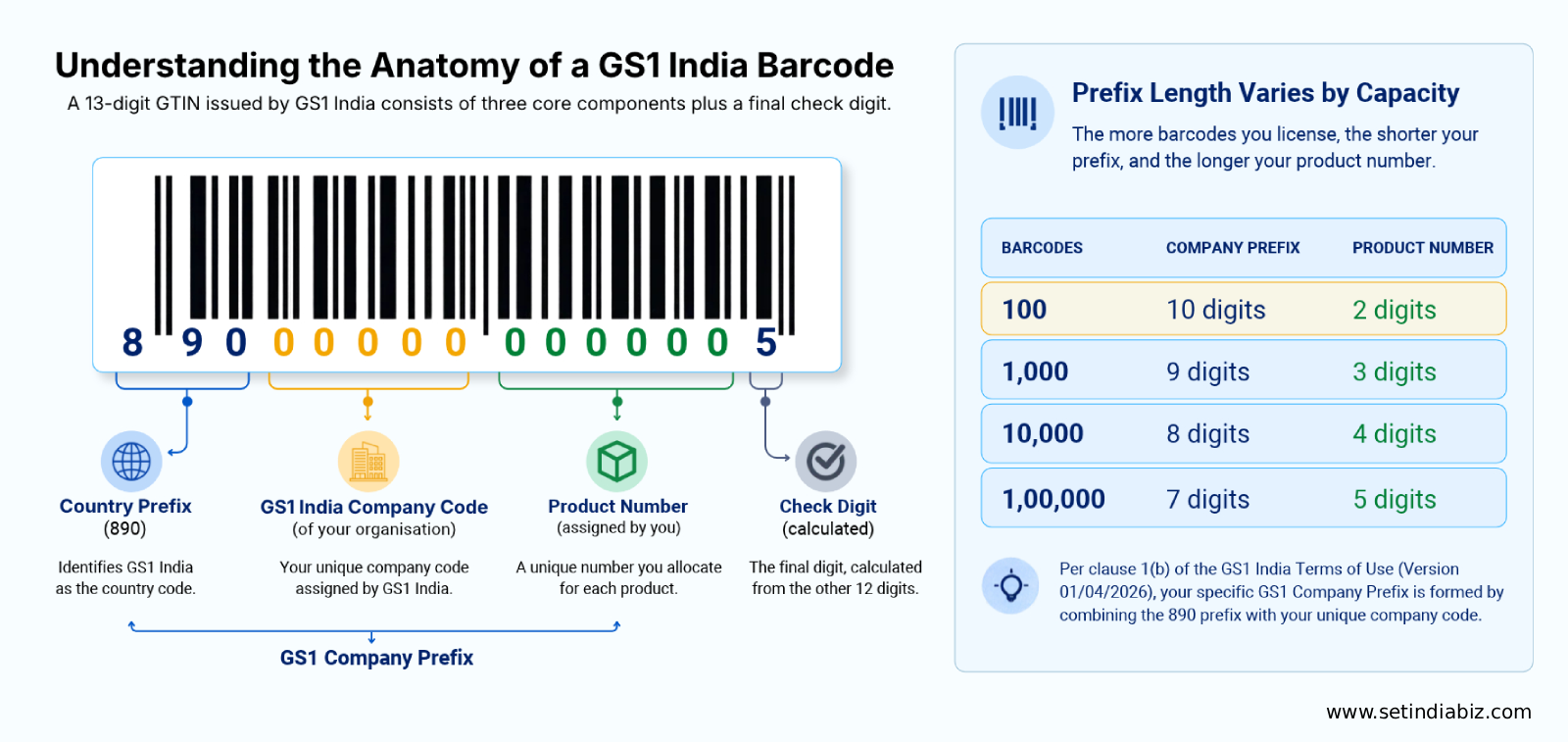
A 13-digit GTIN (EAN-13) issued by GS1 India has three parts plus a final check digit: the 890 prefix given to GS1 India, the company code GS1 India allots to you, and a product number you give each item. Under clause 1(b) of the GS1 India Terms of Use (Version 01/04/2026), the 890 prefix and your company code together form your GS1 Company Prefix. Its length depends on the capacity you buy, so a prefix for 100 barcodes is longer than a prefix for 1,00,000 barcodes.
Is a Barcode Mandatory in India?
No Indian law makes barcode registration mandatory for all goods. The legal barcode rules that exist are sector-specific, and the clearest are in the Drugs Rules, 1945 for medicines. For most consumer goods, the need for a GS1 barcode comes from the marketplaces and retail chains you sell through, and they accept only GS1 numbers. The table below lists the legal rules; the next section explains why, in practice, the 890 barcode is the one that counts.
| No | Law or rule | Who it covers | What it requires | Status |
|---|---|---|---|---|
| 1 | Drugs Rules, 1945, amended by G.S.R. 20(E) dated 18-01-2022 | APIs (bulk drugs) made or imported in India | QR code on the label at each level of packaging | In force from 01-01-2023 |
| 2 | Drugs Rules, 1945, amended by G.S.R. 823(E) dated 17-11-2022 | Makers of the 300 brands listed in Schedule H2 | Bar code or QR code on the primary label, or secondary label if space is short | In force from 01-08-2023 |
| 3 | Handbook of Procedures 2023, Para 2.76 (DGFT) | Export consignments of drug formulations | Track-and-trace barcoding at packaging levels | Withdrawn on 31-01-2025 |
The Directorate General of Foreign Trade (DGFT) withdrew Para 2.76 by Public Notice 44/2024-25 on 31 January 2025, and export medicines are now under the Drugs Rules. G.S.R. 506(E) dated 22-06-2026 extends Schedule H2 codes to all vaccines, anti-cancer and NDPS drugs from 1 July 2027. Outside medicines, the need is commercial. Amazon’s seller blog names GS1 India as the only body issuing the UPCs and EANs Amazon accepts, and says Amazon checks product IDs against GS1’s database
GS1 Barcodes vs Generic Barcodes
Resellers sell generic barcodes that usually come from company prefixes GS1 first licensed to some other business. These barcodes may scan at the billing counter, but a GS1 lookup, such as Verified by GS1 (https://www.gs1.org/services/verified-by-gs1), shows the original licensee, not your brand. That is why online marketplaces such as Amazon often reject such barcodes or suppress the listings. GS1 India has also publicly warned buyers against purchasing cheap or unauthorised 890 numbers sold online.
| No | Point | GS1 India (890) barcode | Generic or resold barcode |
|---|---|---|---|
| 1 | Who issues it | GS1 India, the only body allowed to allot barcode numbers starting with 890 in India | A private reseller with no licence from GS1 or GS1 India, who sells small lots of numbers taken from other licensees |
| 2 | Whose name it carries | Your business, recorded against the number in GS1 India’s records | The company that first licensed the prefix, not your business |
| 3 | Verified by GS1 check | Shows your company name, matching your brand and label | Shows another company’s name, or finds no match at all |
| 4 | Amazon India listing | Accepted as an authorised product ID for your brand | Often rejected when checked; live listings may be suppressed |
| 5 | Legal position | You hold a licence from GS1 India for as long as you renew | Fake 890 numbers have drawn court injunctions and damages |
| 6 | What you pay for | Registration plus an annual or multi-year fee to GS1 India | A one-time payment to a reseller, with no GS1 record for you |
| Quick Takeaway: A generic barcode may look the same on the pack, but it is registered to someone else. If you sell on Amazon, through retail chains or for export, get your barcode numbers from GS1 India in your own business name. | |||
Why GS1 Is Practically the Only Barcode in India
GS1 India was set up in 1996 by the Ministry of Commerce and Industry together with the Confederation of Indian Industry (CII), the Federation of Indian Chambers of Commerce and Industry (FICCI), the Associated Chambers of Commerce and Industry of India (ASSOCHAM), the Federation of Indian Export Organisations (FIEO), the Indian Merchants’ Chamber (IMC), the Bureau of Indian Standards (BIS), the Spices Board, the Agricultural and Processed Food Products Export Development Authority (APEDA) and the Indian Institute of Packaging (IIP).
It is a society registered under the Societies Registration Act, 1860, not a government department. No law makes it compulsory, but GS1 India’s 890 barcode is practically essential for goods sold in India or exported. Retail GTINs (EAN-13 or UPC) follow GS1 standards, and GS1 India holds the exclusive right to issue them in India. Marketplaces, retailers and foreign buyers check barcodes against GS1 records, and generic numbers fail that check. Two recent Delhi High Court rulings show the legal position.
| No | Case | Court and date | Outcome |
|---|---|---|---|
| 1 | GS1 India v. Global Barcodes SL & Ors, CS(COMM) 147/2020 | Delhi High Court, 12-01-2021 | Permanent injunction on an online seller of 890 numbers, ₹20 lakh damages |
| 2 | GS1 India v. Tophill Pharma Ltd & Ors, CS(COMM) 1084/2025 | Delhi High Court, 10-10-2025 | Interim injunction on use of 890 barcodes after the licence expired |
In the 2021 case, the Court also ordered websites selling 890 numbers to be blocked, and decided the case ex parte against the main seller. In the 2025 order, the Court restrained use of the barcodes after expiry and allowed GS1 India to ask marketplaces to take down the listings within 48 hours if the pending fee and penalty were not paid within a week.
Who Can Apply for a Product Barcode?
Product barcode registration with GS1 India is open to the brand owner of the products, or to a business the brand owner authorises. GS1 India accepts proprietorships, partnerships, LLPs, private and public limited companies, and other entities such as registered societies and Hindu undivided families (HUFs), each with its own proof of status. The licence belongs to the applicant alone, so clause 9(a) of the Terms of Use bars its use by a sister concern, subsidiary or related party.
Brand Owners
Only the brand owner, or an entity it authorises, may apply, per GS1 India's registration guidelines. The numbers are licensed to the applicant.
Job Workers
If you make goods for another brand, ask the brand owner to apply to GS1 India directly for its barcodes.
Authorised Non-Owners
If you are not the brand owner, apply separately for each company or brand, and print the brand owner's name on the pack.
Eligible Entity Types
Proprietorships, partnerships, LLPs, private or public limited companies, registered societies and HUFs.
New Businesses
A newly formed company can apply without turnover proof; existing businesses give turnover for the year ending 2025 or 2026.
Businesses Outside India
A company registered outside India applies by writing to GS1 India's registration desk rather than using the standard route.
GS1 Barcode Registration Fees and Cost in India
GS1 India’s barcode registration fee has four parts: a one-time registration fee, a subscription for the chosen term, an interest-free refundable ₹3,000 security deposit (none for 10-year terms) and 18% GST. The total cost depends on turnover, number of barcodes and term. From 1 October 2026, 100 barcodes cost ₹50,200 for the first year at turnover up to ₹5 crore, paid directly to GS1 India. Our professional fee is extra and not included in this table.
| Sr. No. | Annual Sales (In Rs Crores) | Registration Fee (₹) | Annual Subscription Fee | GST @18% | Security deposit | Total fee for 1 year Period |
|---|
Documents Required for Product Barcode Registration
The documents required for barcode registration with GS1 India are few: your PAN, proof of legal status, turnover proof, a request letter on letterhead and a cancelled cheque. GS1 India may ask for more in some cases before it allots numbers. Every document must show the same legal name, because clause 11(a)(v) of the Terms of Use lets GS1 India end a licence if it cannot verify the details you give.
Identity and Legal Status
Financial and Other Documents
Note: The authorised signatory must sign each copy and stamp it with your business seal, if you use one. Make sure your legal name matches exactly on your PAN, GST certificate, cancelled cheque and letterhead. Name mismatches are the most common cause of verification delays, and GS1 India issues receipts only in the subscriber's name.
Step-by-Step Process to Get a Barcode for Products in India
Getting a barcode for products in India through GS1 India takes five steps, from choosing your barcode capacity to publishing product data on GS1 India’s DataKart portal. The capacity choice in step one matters most, because more barcodes later need a fresh application and a new prefix. The steps below follow the full route for an existing business; a new company skips the turnover proof, and an authorised non-owner adds the brand owner’s authorisation.
Step 01: Map Your Products and Choose Barcode Capacity
First, fill in our questionnaire listing every product, size, colour and pack you sell or plan to launch. Each needs its own GTIN, and a change in the net quantity printed on the pack needs a new one under the GS1 GTIN rules. We then match the total to a 100, 1,000, 10,000 or 1,00,000 barcode pack.
🕒 Turnaround: Same working day as your SKU list reaches us.Step 02: Collect Your Registration Documents
Next, we collect your PAN, status proof such as the Certificate of Incorporation and GST Registration Certificate, turnover certificate and cancelled cheque, and draft your request letter and authorisation. We check that the legal name matches on all of them.
🕒 Turnaround: 1 working day after complete documents.Step 03: File the GS1 India Application and Pay the Fee
Now we fill in GS1 India’s online barcode registration form with your turnover slab, capacity and term, on behalf of your business. You pay the fee directly to GS1 India, online, by NEFT or by demand draft We act only as an independent facilitator, on your instructions.
🕒 Turnaround: Same day as your documents are cleared.Step 04: Track Verification and Allotment by GS1 India
After the application is filed, GS1 India verifies your documents and allots your GS1 Company Prefix. We track the application and answer any request for more documents on your behalf until your GS1 allotment letter and DataKart login reach you.
🕒 Turnaround: 7–10 working days after form, documents and fee.Step 05: Generate GTINs and Publish Them on DataKart
Lastly, we help you create a separate GTIN for every product on DataKart and upload its details and product photos, as clause 5(b) requires. You must publish these listings within 30 days, or DataKart publishes them on its own under clause 5(c). Then download the barcode image for printing, and print the brand owner’s name clearly on every pack, as clause 7(c) requires.
🕒 Turnaround: Publish within 30 days of upload.Timeline for Product Barcode Registration
SKU and Documents
We map your SKUs to a capacity and check PAN, GST and status proofs.
Application and Fee
We file GS1 India's online form; you pay GS1 India's fee in your name.
GS1 India Allotment
GS1 India verifies documents and allots your prefix in 7–10 working days.
GTINs on DataKart
You generate GTINs on DataKart and publish product data within 30 days
Benefits of GS1 Barcode Registration
GS1 barcode registration gives your products an identity that retailers, marketplaces and overseas buyers can check against GS1’s global records. The benefits below come from the GS1 India licence itself and from a Ministry of MSME scheme that refunds most of the fee for micro enterprises. Each one depends on the numbers being licensed to your business, which a GS1 India registration gives you and a resold barcode does not.

Accepted by Marketplaces
Amazon India accepts only GS1-issued UPCs and EANs and checks product IDs against GS1's database, so your listings can go live under your own brand.
Recognised Worldwide
GS1 barcodes are accepted all over the world, so one 890 number serves Indian retail chains, online stores and export buyers alike.
Your Brand on the Record
Each number is registered to your business, and anyone checking it on Verified by GS1 sees your company name, which builds trust with buyers.
Legally Backed Identity
You hold a licence from GS1 India, whose "890" mark is registered and has been enforced in the Delhi High Court against fake sellers.
DataKart Portal Included
Your licence includes GS1 India's DataKart portal, where you create barcode numbers and publish product details that retailers can read.
80% Fees Back for MSMEs
Udyam-registered micro enterprises can claim back 80% of GS1 fees for the first 3 years, up to ₹50,650, under the Ministry of MSME's PMS Scheme.
What Is DataKart and How to Use It
DataKart is GS1 India’s online portal for managing your barcodes and product data. GS1 India calls it “the national repository of product attributes”. Once GS1 India allots your company prefix, DataKart is where you create a barcode number (GTIN) for each product. You also record that product’s details there, and retailers, online marketplaces and GS1’s global registry read those details from it. Your GS1 India licence includes the basic version at no extra cost.
| How to add a product and get its barcode (from GS1 India’s “Add Product” guide, June 2024) | Updating product details against an existing barcode |
|---|---|
|
|
When to Create a New Barcode Instead of Editing
Not every change can be made on the same barcode. GS1’s rules require a new GTIN whenever the declared net content printed on the pack changes, for example, a 500 g pack becoming 450 g. A new size, colour or variant also gets its own GTIN. Descriptions, images, MRP and similar details can be edited on the existing barcode.
MSME and Startup Barcode Fee Reimbursement
Micro enterprises can recover 80% of their GS1 barcode fees under the Adoption of Bar Code component of the Ministry of MSME’s Procurement and Marketing Support (PMS) Scheme, up to ₹50,650. The guidelines, issued by the Office of the Development Commissioner (MSME) by OM No. 5(1)/2021-2Z/PMS/SFC dated 26 July 2022, cover the one-time registration fee and the annual fee for the first three years. The MSME-DI decides each claim.
| No | Point | Adoption of Bar Code, PMS Scheme |
|---|---|---|
| 1 | Who qualifies | Registered MSMEs who are Udyam-registered micro enterprises that have paid GS1 India for barcode registration fees |
| 2 | What is reimbursed | 80% of the one-time registration fee and the annual fee for the first 3 years |
| 3 | Barcode limit | Fees for up to 100 barcodes, or actual, whichever is less |
| 4 | Maximum amount | ₹50,650 per enterprise |
| 5 | Where to apply | Head of Office, MSME-Development Institute (MSME-DI) of your region |
| 6 | Application form | Annexure-A to the PMS Scheme guidelines |
Startups get no separate GS1 fee concession: GS1 India’s schedule is priced only by turnover, capacity and term. A DPIIT-recognised startup that is also a Udyam-registered micro enterprise in production can claim through the PMS route above.
Renewal and Validity of GS1 Barcodes
A GS1 barcode licence is valid only for the term you pay for and must be renewed to keep using the numbers. Under clause 5(a) of the Terms of Use, using the numbers after expiry breaches the licence and may lead to legal action by GS1 India. Renewing for 3, 5 or 10 years before expiry adds 3 months of validity, and multi-year renewals get 10% off. The figures below follow GS1 India’s renewal schedule effective September 2026.
Renewal Fees: From September 2026, renewal costs are as follows:
| No | Bar Codes | Renewal Fee |
|---|---|---|
| 1 | 100 | ₹13,250 |
| 2 | 1000 | ₹14,500 |
| 3 | 10,000 | ₹17,000 |
| 4 | 1,00,000 | ₹19,000 |
- Grace Period: GS1 India allows 45 days (clauses 1(k) and 11(c)): 15 days with no penalty, then 30 days with a ₹1,180 penalty, after which the licence ends.
- After Lapse/Expiry: A lapsed user who keeps using the numbers pays dues, costs, any compensation and a ₹10,000 penalty, plus a fresh registration fee to keep the same prefix (clause 3(a)).
- Need Extra Barcodes?: Extra barcodes need a fresh application and fees for a new prefix, at the rates then in force (clause 4).
- Changes to Report: Report a change in constitution within 10 working days, and a change in name, legal status or ownership within 90 days (clauses 9(d) and 9(e)).
- Refunds: Fees are refunded only if you cancel within 30 days of the subscription start, with GS1 India’s approval, less ₹3,000 plus GST (Annexure I, w.e.f. 1 April 2026).
Frequently Asked Questions
A GS1 barcode holds a Global Trade Item Number (GTIN), the unique product number used by retailers and marketplaces worldwide. In India, GS1 India allots these numbers with the 890 prefix under its Terms of Use (Version 01/04/2026). You create one GTIN per product on GS1 India’s DataKart portal.
Largely, yes: GS1 India describes its barcodes as GTINs, also known as EANs. The standard Indian product number is a 13-digit GTIN (EAN-13), and clause 1(b) of the Terms of Use also provides an 8-digit GTIN-8 for small products. GS1 also has other barcode types, such as GS1 DataBar, GS1-128, ITF-14 for cartons, GS1 DataMatrix and GS1 QR Code.
No, GS1 India charges a registration fee, a subscription and a refundable deposit, from ₹50,200 in the first year for 100 barcodes (w.e.f. 1 October 2026). Micro enterprises can claim back 80% under the Ministry of MSME’s PMS Scheme, up to ₹50,650. Free online barcode generators only draw a barcode image; they do not license a number to you.
No, you hold a licence, not ownership. Under clause 2 of the Terms of Use, GS1 India remains the sole owner, and clause 4 makes your right to use the numbers revocable and non-transferable. The licence lasts only while you keep renewing it.
Yes, each distinct product needs its own GTIN under clause 5(b) of the Terms of Use. GS1’s GTIN rules also require a new GTIN whenever the declared net content printed on the pack changes. Count every size, colour, flavour and pack type before choosing capacity.
Not for all goods. The legal rules are sector-specific, mainly the Drugs Rules, 1945 a QR code on APIs from 1 January 2023, a bar code or QR code on 300 Schedule H2 brands from 1 August 2023, and on vaccines and anti-cancer drugs from 1 July 2027. For other goods, marketplaces and retailers make a GS1 barcode a condition of listing.
Retailers and marketplaces check a GTIN against GS1’s records to see which company it belongs to. Amazon’s India seller blog names GS1 India as the only authorised body for the UPCs and EANs Amazon accepts. GS1 India states that it alone may issue 890 numbers in India.
Using a resold number is mainly a commercial risk, because it stays registered to its original licensee and Amazon’s guidance says reseller barcodes often lead to rejection. Numbers starting with 890 not issued by GS1 India are different: the Delhi High Court has granted GS1 India injunctions and ₹20 lakh damages against a seller of such numbers.
Not under the Foreign Trade Policy now. The Directorate General of Foreign Trade (DGFT) withdrew the track-and-trace barcoding procedure in Para 2.76 of the Handbook of Procedures 2023 by Public Notice 44/2024-25 on 31 January 2025. Authentication now falls under the Drugs Rules, 1945, and export markets apply their own rules.
Use GS1’s Verified by GS1 service or GS1 India’s GTIN validation tool. Verified by GS1 shows whether a GTIN is valid and the company it is licensed to. If the result names a business other than yours, the number was not licensed to you.
Usually not. GS1 India’s guidelines say only the brand owner, or an entity it authorises, can apply, and a job worker should ask the brand owner to apply directly. If you are authorised for a single brand, clause 7(c) requires the brand owner’s name on the pack.
No, the licence covers only your entity. Clause 9(a) of the Terms of Use limits the numbers to the entity they were allotted to and bars their use by sister concerns, subsidiaries and related parties. Each entity selling under its own name needs its own GS1 India registration.
No, a new company is exempt from that item. GS1 India asks for the relevant balance-sheet page for the year ending 2025 or 2026, but not from a new company. A proprietorship, for example, still needs the proprietor’s PAN, its GST certificate as status proof, a request letter and a cancelled cheque.
Not necessarily. You can apply to GS1 India yourself, and GS1 India states that it does not appoint agents. A consultant such as Setindiabiz helps you choose capacity, prepare documents and file the online form. The licence, the fee payment and the receipts stay in your business name under clause 6(b) of the Terms of Use.
From 1 October 2026, 100 barcodes for turnover up to ₹5 crore cost ₹50,200 in the first year: ₹27,000 registration, ₹13,000 subscription, ₹7,200 GST and a ₹3,000 refundable deposit. Fees rise with turnover and capacity; 1,000 barcodes cost ₹55,510.
No. Under clause 1(h) of GS1 India’s Terms of Use, GST at 18% applies only to the registration and subscription fees. On 100 barcodes for turnover up to ₹5 crore, GST is ₹7,200 on ₹40,000 of fees, and the ₹3,000 deposit is added without tax. Give GS1 India your GSTIN and GST address so that you can claim input tax credit on its invoice under Section 16 of the CGST Act, 2017.
Yes, for micro enterprises with Udyam Registration. The Adoption of Bar Code component of the PMS Scheme (OM dated 26 July 2022) reimburses 80% of GS1 registration and annual fees for the first 3 years, on up to 100 barcodes, capped at ₹50,650. Apply to your regional MSME-DI in Annexure-A.
Only in a narrow window. Fees are refundable if you cancel within 30 days of the subscription start, with GS1 India’s approval, less ₹3,000 plus GST (Annexure I, w.e.f. 1 April 2026). The ₹3,000 security deposit is refunded on cancellation after dues are adjusted, against a request letter and an affidavit.
You still buy GS1 India’s smallest block of 100 barcodes, from ₹50,200 in the first year for turnover up to ₹5 crore (w.e.f. 1 October 2026). A Udyam-registered micro enterprise can recover 80% under the PMS Scheme, up to ₹50,650. Amazon-only sellers may qualify for Amazon’s GTIN exemption.
Your right to use the numbers ends with validity, after a grace period of 15 days free and 30 days with a ₹1,180 penalty (clause 11(c)). Continued use after lapse makes you liable for dues, costs and a ₹10,000 penalty under clause 3(a). Remove the barcode from packs and listings if you do not renew.
GS1 India’s schedule effective September 2026 sets 1-year renewal at ₹15,635 for 100 barcodes and ₹17,110 for 1,000 barcodes, including GST. Renewing for 3, 5 or 10 years before expiry adds 3 months of validity. GS1 India may revise renewal fees each year under clause 5(d).
No, you need a new registration. Under clause 4 of the Terms of Use, more barcodes need a fresh application, with fees, for a new GS1 Company Prefix. That is why you should plan your SKUs for the next few years before you choose capacity.
Tell GS1 India within 90 days under clause 9(e); it then decides whether the new entity may keep the numbers or must register afresh. A name change costs ₹1,180 with GST (an administrative charge), and ₹1,000 plus GST more if reported late under clause 9(f).
Yes. GS1 India’s 890 numbers follow GS1 global standards and are accepted in domestic and international markets, according to GS1 India. If a buyer in the US or Canada asks for a 12-digit UPC, GS1 India can allot one under clause 1(c).
