

Form PAS-6 Filing with ROC. Half-yearly share capital reconciliation.
Form PAS-6 is the half-yearly Reconciliation of Share Capital Audit Report that companies under the demat mandate file with the ROC. Setindiabiz reconciles your records with depository data, gets the form certified by a practising CS or CA, and files it within your 60-day window.


🗹 Key Information about PAS-6 |
||
|---|---|---|
| 1 | Statutory Basis | Rule 9A and Rule 9B, Companies (Prospectus and Allotment of Securities) Rules, 2014 |
| 2 | Frequency | Half-yearly — one PAS-6 per ISIN, per half-year |
| 3 | Due dates |
|
| 4 | Who must file | Unlisted public companies (Rule 9A) and private companies that are not small companies (Rule 9B) |
| 5 | Certification | CA or CS in practice (Rule 9A(8)) |
| 6 | Prerequisite | An active ISIN from NSDL/CDSL |
| 7 | Late filing | ₹10,000 + ₹1,000/day |
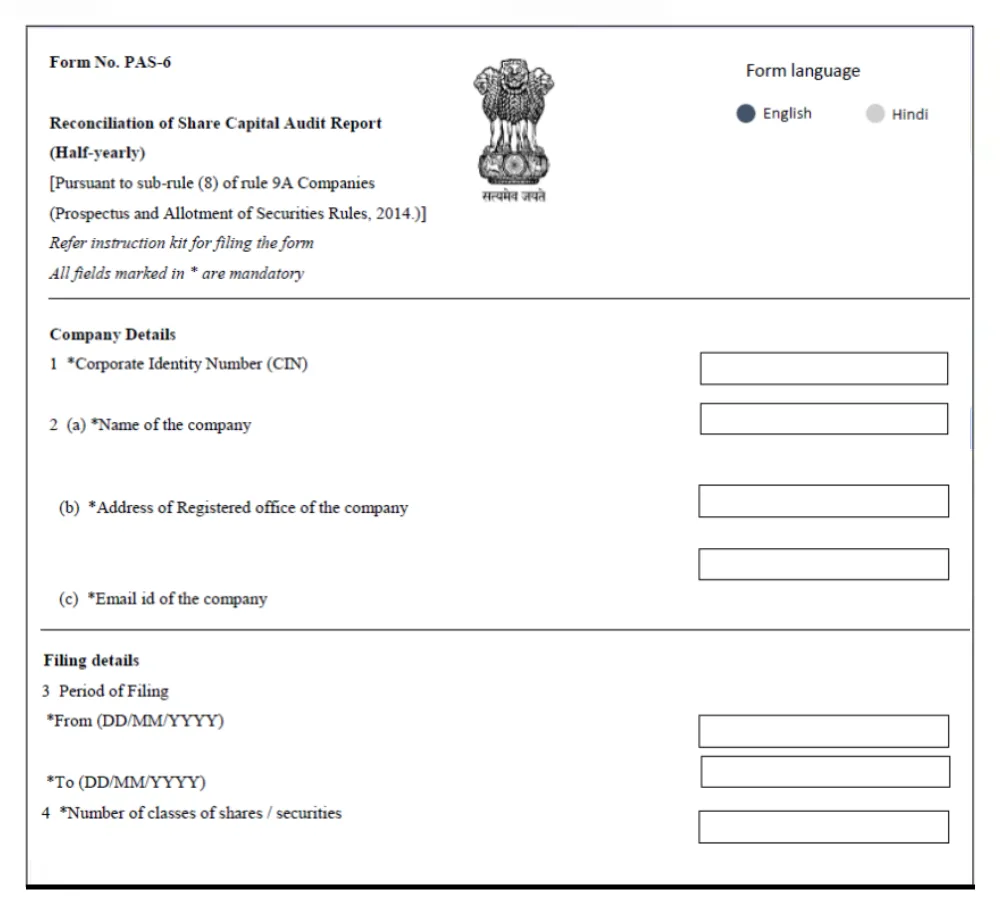
Sample of PAS 6 Form
What is Form PAS-6?
Form PAS-6 is the half-yearly “Reconciliation of Share Capital Audit Report” under Rule 9A(8) of the Companies (PAS) Rules, 2014. It reconciles a company’s internal capital records with securities held in demat form via NSDL or CDSL and is filed with the ROC for each ISIN.
Mandatory for unlisted public companies (Rule 9A) and non-small private companies (Rule 9B), PAS-6 must be filed within 60 days of each half-year end. The form requires certification by a practising CS or CA. Setindiabiz manages the entire process, including data reconciliation, drafting, certification, and MCA V3 portal filing.

Pradeep Vallat
Founder "Autonomo""Setindiabiz’s knowledgeable, disciplined, and organized team made our company registration, tax, and IPR filings smooth, hassle-free, and worry-free."
Who Must File Form PAS-6
Whether you have to file PAS-6 depends on one thing: whether you are required to hold your shares in demat (electronic) form. If yes, you file every half-year, for each ISIN. Turnover and profit don’t decide it. Here’s who’s covered:
Unlisted public companies.
All of them must demat their shares and file PAS-6, except three: a Nidhi company, a Government company, and a wholly owned subsidiary. These three are exempt (Rule 9A).
Private companies that are not "small".
A private company must demat and file PAS-6 if it crosses the small-company line — that is, paid-up capital above ₹4 crore or turnover above ₹40 crore. If you're below both, you're a small company, and you're out.
Subsidiaries — including subsidiaries of a foreign company.
If your company is a subsidiary of any other company, Indian or foreign, you're covered no matter how small you are. The law says a subsidiary can never be a "small company", so the ₹4 crore / ₹40 crore test simply doesn't apply to you. An Indian subsidiary of a foreign parent is in from day one.
Section 8 (not-for-profit) companies with share capital.
A Section 8 company is also never treated as "small", so if it has share capital, it must demat and file PAS-6. (A Section 8 company limited by guarantee, with no share capital, has no shares to demat, so it doesn't file.)
Producer companies.
These are covered too, but they get a longer deadline to demat — up to 31 March 2028. Until they've dematerialised and obtained an ISIN, the PAS-6 clock hasn't started.
The one thing that triggers it all — an ISIN.
PAS-6 is filed against your ISIN (the unique number for each type of share, issued by NSDL or CDSL). No ISIN, no PAS-6 — but not having one when you should is itself a demat default. Once you hold any shares in demat form, you file PAS-6 every half-year, even if nothing has changed and there's nothing to report.
Statutory Due Dates
PAS-6 is a half-yearly return, so the financial year is split into two reporting periods, and each carries its own 60-day filing window. The dates do not move with the AGM or the annual filing cycle — they are fixed to the close of each half-year. A separate PAS-6 is filed for every ISIN the company holds, for each period. The table below sets out both windows; the worked dates assume a standard April–March financial year.
| No | Half-year period | Period covered | PAS-6 due date |
|---|---|---|---|
| 1 | First half | 01st April – 30th September | 29 November (within 60 days) |
| 2 | Second half | 0st October – 31st March | 30 May (within 60 days) |
| Note: One PAS-6 per ISIN per half-year. Where the due date falls on a holiday, file on or before that date — the MCA portal does not auto-extend. First-time filers should obtain the ISIN well ahead of the half-year close, since PAS-6 cannot be filed without it. | |||
Information & Documents Required
PAS-6 is a reconciliation, so the inputs are records that let the certifying professional match three numbers: capital issued per the company’s books, capital held in demat with NSDL and CDSL, and any capital still in physical form. The cleaner your Register of Members and your RTA/depository statements, the fewer queries the form attracts. The two lists below separate what the form actually captures from what you need to hand over to prepare it.
What Form PAS-6 captures
Inputs you provide to Setindiabiz
Pro Tip: Keep the RTA reconciliation statement current. A mismatch between the Register of Members and the depository data is the single most common cause of PAS-6 queries — resolving it before drafting saves a re-filing.
Timeline for PAS-6 Filing
Kick-off & data collection
Register of Members, capital statement, ISIN, and NSDL/CDSL/RTA statements gathered.
Reconciliation
Issued capital matched against demat and physical holdings; differences flagged.
Draft & certify
Form PAS-6 drafted per ISIN and certified by a CS/CA in practice (Rule 9A(8)).
DSC & MCA V3 filing
DSCs affixed, form filed, SRN generated, and acknowledgement shared.
Indicative turnaround is about 3–4 working days once a valid ISIN and clean reconciliation data are in hand. Where the ISIN is still to be obtained, the demat set-up timeline is added ahead of this.
Process to File Form PAS-6
Filing PAS-6 is less about the form and more about getting the reconciliation right before the form is touched. The workflow below moves from confirming whether the company is even covered, through matching the books to the depositories, to certification and the MCA V3 upload. We handle the drafting, the professional certification and the filing; you supply the records and approve the reconciled figures. Simpler cases (a single ISIN with no half-year changes) collapse steps 2 and 3.
Step 01: Confirm applicability and ISIN.
We verify whether the company is covered under Rule 9A or Rule 9B and confirm that an active ISIN exists for each security type.
⏳ Turnaround: Same day.Step 02: Collect and reconcile data.
We gather the Register of Members, the capital statement and the NSDL/CDSL/RTA holding statements, then match issued capital against demat and physical holdings.
⏳ Turnaround: 1 working day.Step 03: Resolve differences.
Any gap between issued and demat capital is investigated and documented, and corrective intimation to the depository is coordinated under Rule 9A(8A).
⏳ Turnaround: As required.Step 04: Draft Form PAS-6.
We populate the form for the half-year, per ISIN, with the reconciled figures and the prescribed particulars.
⏳ Turnaround: Same day.Step 05: Professional certification.
A Company Secretary or Chartered Accountant in practice certifies the form as Rule 9A(8) requires.
⏳ Turnaround: Same day.Step 06: DSC and MCA V3 filing.
The form is signed with the authorised signatory’s and the certifying professional’s DSCs, filed on the MCA V3 portal, and the SRN and acknowledgement are shared.
⏳ Turnaround: Same day.Governing Law for Form PAS-6
PAS-6 sits on top of the dematerialisation framework built into the Companies Act, 2013 and its allotment rules. The obligation flows from the demat mandate: once a company must hold its securities in electronic form, it must also prove, every half-year, that its books and the depositories agree. The provisions below set out who is covered, what must be filed, who certifies it, and what happens on default — each anchored to the enacted Act and Rules rather than to any superseded position.
| S.No | Section | Description | |
|---|---|---|---|
| 1 | Section 29, Companies Act, 2013 | Provides for the issue and holding of securities in dematerialised form. It is the parent provision under which the demat mandate and the PAS-6 reporting obligation operate. | |
| 2 | Rule 9A, Companies (Prospectus and Allotment of Securities) Rules, 2014 | Requires every unlisted public company to issue securities only in demat form and to dematerialise its existing securities. Inserted by the Third Amendment Rules, 2018 (G.S.R. 853(E), 10 September 2018; effective 2 October 2018). | |
| 3 | Rule 9A(8) | The operative PAS-6 provision: every company governed by the rule must submit Form PAS-6 to the Registrar within 60 days of each half-year, with the fee under the Fee Rules, duly certified by a Company Secretary or Chartered Accountant in practice. Substituted by G.S.R. 376(E), 22 May 2019. | |
| 4 | Rule 9A(8A) | Requires the company to bring to the depositories’ notice any difference observed between its issued capital and the capital held in demat form, so mismatches are corrected rather than carried forward. | |
| 5 | Rule 9A(11) | Exempts a Nidhi, a Government company and a wholly owned subsidiary from Rule 9A; these unlisted public companies do not file PAS-6. | |
| 6 | Rule 9B | Extends mandatory demat to every private company that is not a small company, and pulls those companies into the same PAS-6 obligation once covered. Inserted by the Second Amendment Rules, 2023 (G.S.R. 802(E), 27 October 2023). The Rule 9A(11) exemptions do not apply under Rule 9B. | |
| 7 | Depositories Act, 1996 | The framework under which securities are dematerialised and held by NSDL and CDSL; demat under Rule 9A/9B is carried out in accordance with this Act and the SEBI regulations made under it. | |
| 8 | Section 450, Companies Act, 2013 | The general penalty that applies because Rule 9A prescribes no specific penalty for non-filing of PAS-6 (detailed in the penalty section below). | |
| Note: One PAS-6 per ISIN per half-year. Where the due date falls on a holiday, file on or before that date — the MCA portal does not auto-extend. First-time filers should obtain the ISIN well ahead of the half-year close, since PAS-6 cannot be filed without it. | |||
Late Filing & Penalty
Rule 9A prescribes no specific penalty for not filing PAS-6, so the general penalty in Section 450 of the Companies Act, 2013, applies, and it bites both the company and every officer in default. Because the per-day component continues until the form is filed, a missed half-year quietly compounds. Separately, the underlying demat default carries its own commercial consequences that can freeze the company’s ability to issue or move shares. The table sets out the main exposures and their source provisions.
| No | Default | Consequence | Provision |
|---|---|---|---|
| 1 | Late or non-filing of PAS-6 | ₹10,000 on the company and every officer in default; plus ₹1,000/day of continuing default; capped at ₹2,00,000 (company) and ₹50,000 (officer in default / other person) | Section 450, Companies Act, 2013 |
| 2 | ISIN not obtained | PAS-6 cannot be filed — continuing non-compliance with the demat mandate | Rule 9A(8) / Rule 9B |
| 3 | Securities still in physical form after the demat trigger | No further issue, buyback, bonus or rights; shareholders cannot transfer physical shares or subscribe to new issues | Rule 9A / Rule 9B |
Frequently Asked Questions
A1. It is the half-yearly “Reconciliation of Share Capital Audit Report” filed with the ROC under Rule 9A(8) of the Companies (Prospectus and Allotment of Securities) Rules, 2014. It reconciles a company’s issued capital with the securities held in demat form with NSDL and CDSL.
A2. To confirm, every half-year, that a company’s own capital records agree with the depositories’ records once securities are dematerialised. It supports the demat mandate brought in by Rule 9A (2018) and extended by Rule 9B (2023), reducing the risk of mismatched or duplicate shareholdings.
A3. No. MGT-7 is the annual return under Section 92 filed once a year after the AGM. PAS-6 is a separate half-yearly demat reconciliation under Rule 9A(8), with its own due dates and certification requirements.
A4. Twice a year — for the half-year ending 30 September and the half-year ending 31 March — and separately for each ISIN the company holds.
A5. Unlisted public companies under Rule 9A, and private companies that are not small companies under Rule 9B, once they hold securities in demat form and have an ISIN.
A6. Yes — a private company that is not a small company (paid-up capital above ₹4 crore or turnover above ₹40 crore, per Section 2(85)) is covered by Rule 9B and files PAS-6 for each half-year after demat.
A7. A genuine small company under Section 2(85) is outside Rule 9B and does not file PAS-6. But a holding or subsidiary company is never “small”, so it is covered regardless of its size.
A8. For unlisted public companies, Rule 9A(11) exempts a Nidhi, a Government company and a wholly owned subsidiary. These exemptions do not extend to private companies under Rule 9B.
A9. Producer companies are covered by Rule 9B but on a longer timeline — demat up to 31 March 2028 under the Amendment Rules, 2025 — after which the half-yearly PAS-6 obligation applies.
A10. No. PAS-6 is for unlisted companies under Rule 9A/9B. Listed companies report share capital reconciliation under the SEBI listing framework instead.
A11. Within 60 days of each half-year, 29 November for the April–September half-year and 30 May for the October–March half-year.
A12. No. ISIN is a mandatory field. Until the company obtains an ISIN from NSDL/CDSL through an RTA, PAS-6 cannot be filed, which itself is a demat non-compliance.
A13. One PAS-6 per ISIN. Different security types carry different ISINs, so a separate form is filed for each, for each half-year.
A14. Yes. Once a company holds securities in demat form, PAS-6 is filed every half-year, even where there is no difference and no change to report.
A15. A Company Secretary in practice or a Chartered Accountant in practice, as required by Rule 9A(8). The certifying professional’s membership/COP number is entered, and their DSC is affixed.
A16. The ISIN letter, the Register of Members/shareholding, the issued-subscribed-paid-up capital statement, NSDL and CDSL (or RTA) holding statements, details of any capital changes in the half-year, and DSC details for the signatory and certifying professional.
A17. With the Registrar of Companies through the MCA V3 portal (mca.gov.in). On successful filing and payment, an SRN and an acknowledgement are generated.
A18. About 3–4 working days once a valid ISIN and clean reconciliation data are available. If the ISIN is still to be obtained, the demat set-up time is added first.
A19. A mismatch between the Register of Members and the depository data. Reconciling the RTA statement with the books before drafting prevents most queries.
A20. Rule 9A has no specific penalty, so Section 450 of the Companies Act, 2013 applies — ₹10,000 on the company and every officer in default, plus ₹1,000 for each day of continuing default, capped at ₹2,00,000 for a company and ₹50,000 for an officer in default.
A21. The form carries the fee prescribed under the Companies (Registration Offices and Fees) Rules, 2014; we confirm the current amount before filing. The bigger exposure for delay is the Section 450 penalty rather than the base fee.
A22. Beyond the PAS-6 penalty, the company cannot make further issues, buyback, bonus or rights issues, and shareholders cannot transfer physical shares or subscribe to new issues, until demat compliance is restored (Rule 9A/9B).
A23. Yes. We can arrange the ISIN and demat set-up under Rule 9A/9B and then file PAS-6 for each half-year, tracking both due dates for you.
