
Overview : The Employees’ Provident Fund Organisation (EPFO) compliance is mandatory for all Indian businesses employing 20 or more workers, as governed by the Social Security Code, 2020. This guide covers core compliance requirements, contribution rates, registration procedures, and penalty avoidance strategies for employers. Understanding EPFO obligations ensures legal compliance, avoids penalties, and provides essential social security benefits to employees while managing operational costs effectively.
What is EPFO and When is Compliance Mandatory?
The Employees’ Provident Fund Organisation administers social security schemes now governed by the Social Security Code, 2020. The Code, which subsumes the erstwhile EPF & MP Act, 1952, applies to every establishment in which 20 or more employees are employed. EPFO continues to operate the EPF, EPS, and EDLI schemes under the new legislative framework.
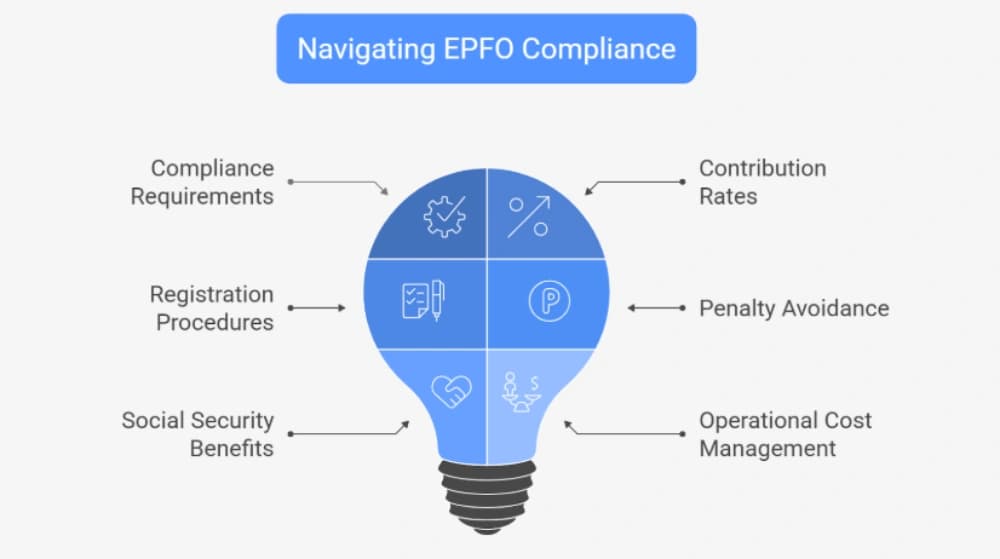
Compliance becomes mandatory when establishments cross 20 employees, including all worker categories, regardless of designation or salary. Employers must register within one month of becoming eligible, with penalties for delays applying under the provisions of the Social Security Code, 2020.
EPFO Compliance Requirements: Key Statistics & Obligations
| Compliance Aspect | Requirement | Timeline/Rate | Penalty for Non-Compliance |
|---|---|---|---|
| Registration Threshold | 20+ employees | Within 1 month of eligibility | Prosecution under the Social Security Code |
| Employer Contribution | 12% of wages | Monthly by the 15th | Interest @ 12% p.a. + graded damages |
| Employee Contribution | 12% of wages | Deducted from salary | Criminal offence if not remitted |
| EPS Contribution | 8.33% of the employer’s share | Part of a 12% employer contribution | Pension benefit loss |
| EDLI Contribution | 0.5% of wages | Paid by employer | Insurance coverage loss |
| Administrative Charges | 0.5% of wages | Paid by employer | Total employer liability 13% |
| ECR Filing | Monthly returns | By the 15th of next month | Late filing penalties |
| Maximum Wage Ceiling | Rs. 15,000/month | For contribution calculation | Higher wages are excluded unless declared |
| Reduced Rates | 10% (both parties) | For certain notified establishments | As specified by the Central Government |
*Source: Based on epfindia.gov.in and Social Security Code, 2020 provisions
Who Must Register: Mandatory vs Voluntary Coverage 🎯
Mandatory registration applies by default to all establishments employing 20 or more persons, and the Central Government holds the power to notify its applicability to specific establishments even with fewer than 20 employees. The threshold includes all workers, including those engaged through contractors.
Voluntary registration is available for establishments with fewer than 20 employees, allowing smaller businesses to provide EPF benefits. However, once registered voluntarily, establishments become bound by all EPF provisions. Registration must be completed within one month of crossing the 20-employee threshold, with penalties for delays and retrospective contribution applicability from the eligibility date.
EPFO Contribution Structure: Employer and Employee Obligations 💰
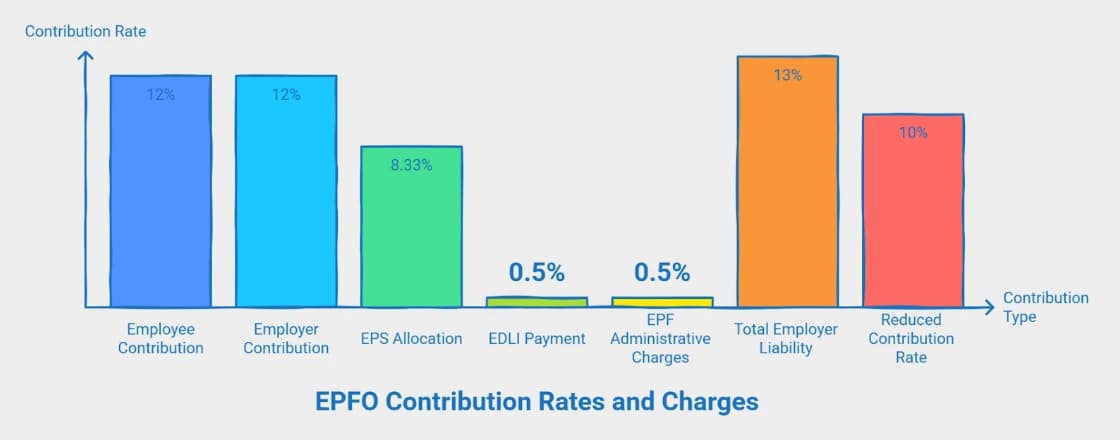
Under the Social Security Code, 2020, both employer and employee contribute 12% of ‘wages’, capped at ₹15,000 per month for mandatory contributions. ‘Wages’ includes all remuneration, but specified exclusions (like HRA, bonus) cannot exceed 50% of total pay; any excess is added to the wage base. From the employer’s 12% share, 8.33% is allocated to EPS. Employers also pay 0.5% for EDLI and 0.5% in EPF administrative charges, making the total employer liability 13%. For certain notified classes of establishments, the Central Government may specify a reduced contribution rate of 10% for both the employer and the employee, instead of the standard 12%.
Contributions are calculated on ‘wages’ as defined under the Social Security Code, 2020, excluding overtime, bonus, or commission (unless these exclusions exceed 50% of total pay). Monthly remittance is due by the 15th of the following month, with late payments attracting 12% annual interest plus graded damages. The online payment system through the EPFO portal facilitates compliance and provides real-time payment tracking.
Step-by-Step EPFO Registration Process 📋
EPFO registration is completed through the Unified Shram Suvidha Portal (USSP), requiring employers to create an account and select EPFO registration options. Essential documents include PAN card, address proof (electricity/water bills within 2 months), Aadhaar card, shop establishment certificate or GST certificate, digital signature, cancelled cheque, and relevant licenses.
The online process involves completing establishment details, contact information, and employee data sections. Upon submission, EPFO officials verify documents and allocate an establishment code with employer portal access. The process typically takes 7-15 working days, with email confirmation upon successful registration enabling immediate compliance facility access.
Monthly Compliance: ECR Filing and Contribution Management 💼
Monthly compliance involves filing the Electronic Challan cum Return (ECR) and remitting contributions by the 15th of each month. ECR contains employee details, wages, and calculated contributions under EPF, EPS, and EDLI schemes. The system validates data and generates payment challans, with payments possible through internet banking from 58 partner banks.
Employers must maintain updated employee information, including UAN activation, bank account details, and KYC completion. Changes in employee status, salary revisions, or workforce additions must be reflected in monthly ECR for accurate calculations. Early payment helps avoid technical issues and ensures timely processing, while late payments attract interest charges and may trigger compliance audits.
Penalties and Consequences of Non-Compliance 🚨
EPFO non-compliance carries significant financial and legal consequences affecting business operations. Financial penalties include simple interest at 12% per annum on delayed contributions plus damages levied at a graded scale based on the delay period (from 5% to 25% per annum of the arrear amount), which is capped at a maximum of 100% of the arrears. These charges accumulate quickly, making delayed compliance expensive.
Legal consequences include prosecution under the Social Security Code, 2020, with punishment for failing to pay contributions extending to imprisonment for up to three years (but not less than one year for non-payment of the employee’s share), alongside criminal charges under the IPC and recovery actions including bank account attachment and property seizure. Administrative actions involve compliance audits, show-cause notices, and potential blacklisting from government contracts, affecting business growth and reputation.
Benefits of EPFO Compliance for Employers 🎯
EPFO compliance offers advantages beyond legal obligations, contributing to business sustainability and employee satisfaction. Employee retention improves significantly through comprehensive social security benefits, with EPF-covered workers showing higher job satisfaction and organisational commitment.
Operational benefits include streamlined payroll processing, reduced administrative burden through digital platforms, and enhanced record-keeping capabilities. Business reputation is enhanced through demonstrated employee welfare commitment, helping attract quality talent and secure partnerships. Government contract eligibility often requires EPFO compliance, opening additional revenue opportunities while reducing legal risks and operational disruptions.
Technology and Digital Solutions 🚀
EPFO’s digital transformation simplifies compliance through the Unified Portal, offering registration, ECR filing, payment processing, and compliance tracking. Mobile applications and SMS services provide real-time updates on contributions, deadlines, and compliance status with automated reminders.
Digital signature implementation allows authorised personnel to file returns remotely, benefiting businesses with multiple locations. API integration enables direct payroll system connections with EPFO platforms, automating data transfer and reducing manual intervention for large employers with complex structures.
Conclusion
EPFO compliance is a fundamental business obligation extending beyond legal requirements to encompass employee welfare and organisational sustainability under the Social Security Code, 2020. With mandatory registration for establishments employing 20+ workers, understanding contribution rates, filing deadlines, and penalty structures becomes essential for business success. The streamlined digital processes through EPFO’s Unified Portal have simplified compliance while maintaining rigorous employer obligation standards. Businesses prioritising EPFO compliance benefit from enhanced employee retention, improved operational efficiency, and reduced legal risks while contributing to India’s social security framework.
FAQ’s
What happens if we temporarily reduce the workforce below 20 employees?
Can we voluntarily withdraw from EPFO coverage?
How do we handle part-time or contract employees for EPF purposes?
What are the consequences of not activating employee UANs?
How do we manage EPF for employees earning above Rs. 15,000?
In This Article
Author Bio

Setindiabiz Editorial Team is a multidisciplinary collective of Chartered Accountants, Company Secretaries, and Advocates offering authoritative insights on India’s regulatory and business landscape. With decades of experience in compliance, taxation, and advisory, they empower entrepreneurs and enterprises to make informed decisions.
