
The Ministry of Corporate Affairs (MCA) has rewritten the ROC fee schedule for Form DIR-3 KYC Web through Notification G.S.R. 300(E) dated 21st April 2026 — the Companies (Registration Offices and Fees) Amendment Rules, 2026. 📌 For the first time, the rules formally recognise a modest ₹500 fee for mid-year KYC update filings, alongside the long-standing NIL and ₹5,000 slabs. This blog is a focused, fee-first explainer of the revised ROC fee structure for every director holding an active Director Identification Number (DIN).
Why Directors File DIR-3 KYC
Under Rule 12A of the Companies (Appointment and Qualification of Directors) Rules, 2014, every individual holding an approved DIN as on 31st March of a financial year must file Form DIR-3 KYC on or before 30th September of the immediately following financial year. Missing the deadline causes the DIN to be marked “Deactivated due to non-filing of DIR-3 KYC”, freezing the director from signing any e-form on the MCA portal until the KYC is refiled along with the prescribed fee.
The 2026 Amendment by MCA
Exercising powers under sections 396, 398, 399, 403 and 404 read with section 469(1) and (2) of the Companies Act, 2013, the Central Government has substituted Item VII of the Annexure to the Companies (Registration Offices and Fees) Rules, 2014 with a fresh three-row fee schedule. The notification was issued by the MCA under F. No. 01/16/2013-CL-V (Pt-I).
Revised ROC Fee for Form DIR-3 KYC Web
The Ministry of Corporate Affairs (MCA) has revised the fee structure for the annual Director KYC filing. This new fee system, introduced through the Companies (Registration Offices and Fees) Amendment Rules, 2026, now requires Directors to pay a Government fee when submitting their annual KYC via the web-based service. The specific amount is determined according to the prescribed fee slabs.
| No | Scenario of Filing Form DIR-3 KYC Web | Government Fee (₹) |
|---|---|---|
| 1 | Form filed by the deadline | NIL |
| 2 | Form filed after the deadline, or for the reactivation of a deactivated DIN | ₹5,000 |
| 3 | Form DIR-3 KYC filed at any time for any change | ₹500 (for every filing) |
Source: Item VII, Annexure to the Companies (Registration Offices and Fees) Rules, 2014, as substituted by G.S.R. 300(E) dated 21.04.2026.
What Is Actually New vs. What Stays the Same
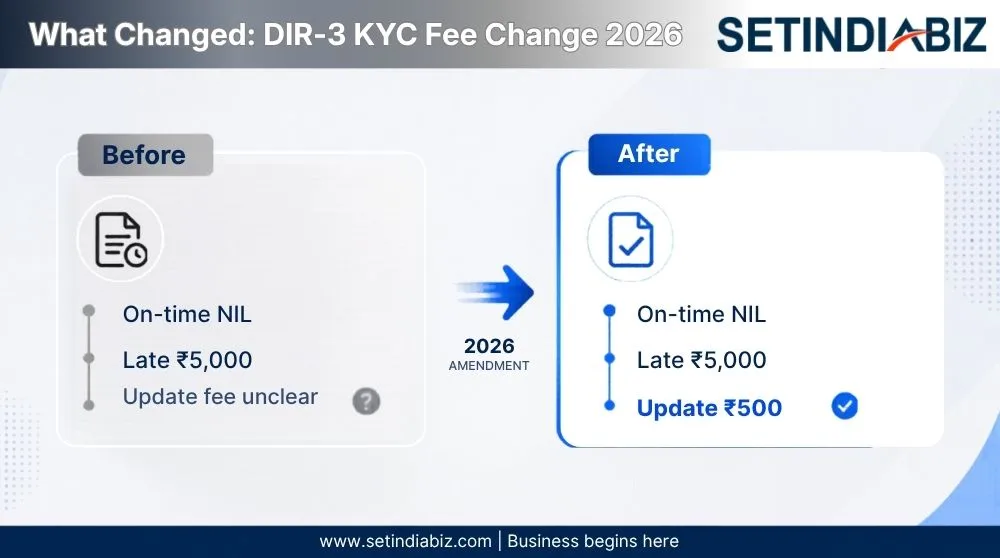
Two of the three fee points are familiar. Only one is genuinely new. The comparison below shows exactly which entry has moved:
| Aspect | Before G.S.R. 300(E) | After G.S.R. 300(E) |
|---|---|---|
| Fee for timely filing | NIL | NIL (unchanged) |
| Fee for late filing / DIN reactivation | ₹5,000 | ₹5,000 (unchanged) |
| Fee for mid-year update filing | Not expressly prescribed | ₹500 per filing (new) |
Source: Ministry of Corporate Affairs, Notification G.S.R. 300(E) dated 21.04.2026, F. No. 01/16/2013-CL-V (Pt-I) — Companies (Registration Offices and Fees) Amendment Rules, 2026. Principal rules: G.S.R. 268(E) dated 31.03.2014; last amended vide G.S.R. 360(E) dated 30.05.2025.
FAQ’s
What is Notification G.S.R. 300(E) dated 21 April 2026?
What is the government fee if Form DIR-3 KYC is filed after 30 September?
When is the new ₹500 government fee applicable?
Is the ₹5,000 a penalty or a government filing fee?
From when is the revised DIR-3 KYC Web fee structure effective?
Does the 2026 amendment change the annual DIR-3 KYC due date?
Can I combine multiple updates in one filing to avoid paying ₹500 each time?
In This Article
Author Bio

Setindiabiz Editorial Team is a multidisciplinary collective of Chartered Accountants, Company Secretaries, and Advocates offering authoritative insights on India’s regulatory and business landscape. With decades of experience in compliance, taxation, and advisory, they empower entrepreneurs and enterprises to make informed decisions.
