
FSSAI’s Instant (Tatkal) License and Registration facility helps certain food businesses get approval faster through the FoSCoS portal. Instead of going through the usual pre-grant scrutiny cycle, eligible applications are processed through digital verification and self-declaration. That said, Tatkal does not reduce your compliance responsibility. If your business is found non-compliant later, FSSAI can still inspect, suspend, cancel, or take action under the Food Safety and Standards Act, 2006. ⚠️
What is the FSSAI Instant (Tatkal) License?
FSSAI Instant (Tatkal) License or Registration is a fast-track approval route available for selected food business categories on FoSCoS (Food Safety Compliance System). It is meant to reduce delay in straightforward, low-risk cases by using digital verification instead of the normal scrutiny and inspection process.
The scheme was formally launched under FSSAI’s “Ease of Doing Business” initiative, effective from 1 July 2024, under the FSS (Licensing and Registration of Food Businesses) Regulations, 2011.
In simple terms:
- You apply online on FoSCoS
- The system verifies key details digitally (GST, PAN, Aadhaar)
- Eligible cases get approval instantly, based on self-declaration
- Post-approval inspection is still possible under the risk-based framework
Where is the Tatkal Scheme Available? 📍
The Tatkal scheme was initially launched in select States/UTs and was later rolled out across India. However, as per the restriction note uploaded on FoSCoS, Tatkal is still not uniformly available in every jurisdiction.
At present, the position is as follows:
- Not enabled: Chandigarh, Meghalaya, and West Bengal.
- Partially enabled: Himachal Pradesh, where Tatkal is available only for selected food product categories.
- Special restriction: In Jammu & Kashmir, all listed Kind of Businesses (KoBs) are allowed except Hawker/Itinerant/Mobile Food Vendor.
This means applicants should not assume that Tatkal is available simply because the scheme is described as pan-India. State/UT-level restrictions and food-category restrictions must still be checked before filing on FoSCoS.
Who Can Apply Under the Tatkal Scheme?
Tatkal eligibility is officially defined primarily by Kind of Business (KoB) and food category, while applicant-structure clarity appears only partly through the digital verification rules set out in the July 2024 order. The 1 July 2024 FSSAI order clearly enables Tatkal for specified business categories and also prescribes different verification methods for certain applicant types.
| For Instant License, the July 2024 order specifies two digital verification routes: |
| 1. Proprietorship firms: verification through GST and Aadhaar. 2. Partnership/registered firms: verification through CIN/GST and Aadhaar. |
However, the official documents reviewed do not publish a complete legal-entity-wise Tatkal eligibility table for LLPs, private limited companies, OPCs, trusts, societies, and other structures. Therefore, the correct position is that Tatkal eligibility is clearly notified for specified business categories, while structure-wise clarity is only partly available from the verification framework.
The commonly covered business categories (Kind of Business or KoB) include
| S.No. | Business Category (KoB) | Tatkal License | Tatkal Registration |
|---|---|---|---|
| 1 | Wholesalers | ✅ | ✅ |
| 2 | Distributors | ✅ | ✅ |
| 3 | Retailers | ✅ | ✅ |
| 4 | Transporters | ✅ | ✅ |
| 5 | Storage without atmospheric control | ✅ | ✅ |
| 6 | Importers | ✅ | ✅ |
| 7 | Food Vending Agencies | ✅ | ✅ |
| 8 | Direct Sellers | ✅ | ✅ |
| 9 | Merchant Exporters | ✅ | ✅ |
| 10 | Petty Retailers of Snacks/Tea Shops | — | ✅ |
| 11 | Hawkers (Itinerant/Mobile Food Vendors) | — | ✅ |
Important restrictions on food categories:
Most of the above business types are eligible for Tatkal only if they deal in pre-packed products. Prepared food or loose food is allowed only for Petty Retailers of Snacks/Tea Shops and Hawkers (Itinerant/Mobile Food Vendors).
As per Annexure-1 of the FSSAI order:
- Importers and Merchant-Exporters are allowed for all food categories.
- Wholesalers, Distributors, Retailers, Storage without Atmospheric Control, Food Vending Agencies, and Direct Sellers are allowed for all food categories except Meat and Fish.
- Transporters are allowed for all food categories except Dairy, Meat, and Fish.
- Petty Retailers of Snacks/Tea Shops and Hawkers are allowed for all food categories except Meat and Fish.
| Practical tip: The safest way to explain Tatkal eligibility is this: first check whether your KoB is covered, then check whether your food category is allowed, and then confirm whether the live FoSCoS workflow supports your applicant profile. |
Who Should Avoid Relying on Tatkal?
Tatkal is not meant for every food business. It is best suited for cases that clearly fall within the notified KoBs, permitted food categories, applicable state/UT availability, and portal-based verification flow. You should generally consider the regular route if:
- Your business activity is not a listed Tatkal KoB.
- Your product (like meat, fish, or some dairy) is restricted.
- Your State/UT has Tatkal restrictions or exclusions.
- Your applicant structure is not clearly reflected in the published Tatkal documents or the live FoSCoS workflow.
- You anticipate frequent changes or close scrutiny.
Key Restrictions Under the Tatkal Route
Tatkal is a conditional fast-track facility, not a blanket right. Its availability depends on the notified Kind of Business, food category, jurisdiction, and successful digital verification.
Some important restrictions include:
- Only select KoBs are covered under the Tatkal scheme.
- For most KoBs, only pre-packed products are allowed. Prepared or loose food is allowed only for Petty Retailers of Snacks/Tea Shops and Hawkers.
- Meat and fish categories are excluded for most KoBs, while dairy is additionally excluded for Transporters.
- A valid existing license or registration at the same premises blocks Tatkal use.
- Applicants must declare that their license/registration has not been suspended or cancelled in the past three months.
- State/UT restrictions may apply even if the KoB is otherwise covered nationally. Chandigarh, Meghalaya, and West Bengal are not enabled; Himachal Pradesh is partially enabled; Jammu & Kashmir excludes the Hawker/Itinerant/Mobile Food Vendor KoB.
| Risk of false declaration: The instant grant is based on self-declaration. The July 2024 FSSAI Tatkal order states that any false declaration can attract penalty up to ₹10 lakh under Section 61 of the Food Safety and Standards Act, 2006, and the competent food safety authorities continue to retain full enforcement powers over instantly granted licenses and registrations. |
Documents and Verification Required
The Tatkal process is based on digital verification, but the exact verification route depends on the nature of the application. The official order specifically distinguishes between Instant License and Instant Registration.
| No. | Application Type | Verification Documents | Additional Requirement |
|---|---|---|---|
| 1 | Instant License – Proprietorship firm | GST + Aadhaar | Premises photographs |
| 2 | Instant License – Partnership/registered firm | CIN/GST + Aadhaar | Premises photographs |
| 3 | Instant Registration – Petty FBOs (Sr. No. 1 to 9) | PAN + Aadhaar | Premises photographs |
| 4 | Instant Registration – Petty snack/tea shops & hawkers (Sr. No. 10 & 11) | Aadhaar only | Premises photographs |
Photo Requirement: Applicants must upload photographs of the unit, especially the entrance/front-facing image of the premises, so that the food business location can be identified.
- These photographs should clearly show:
- The business premises from the outside
- The address or signboard of the premises
- The FBO standing in front of the premises
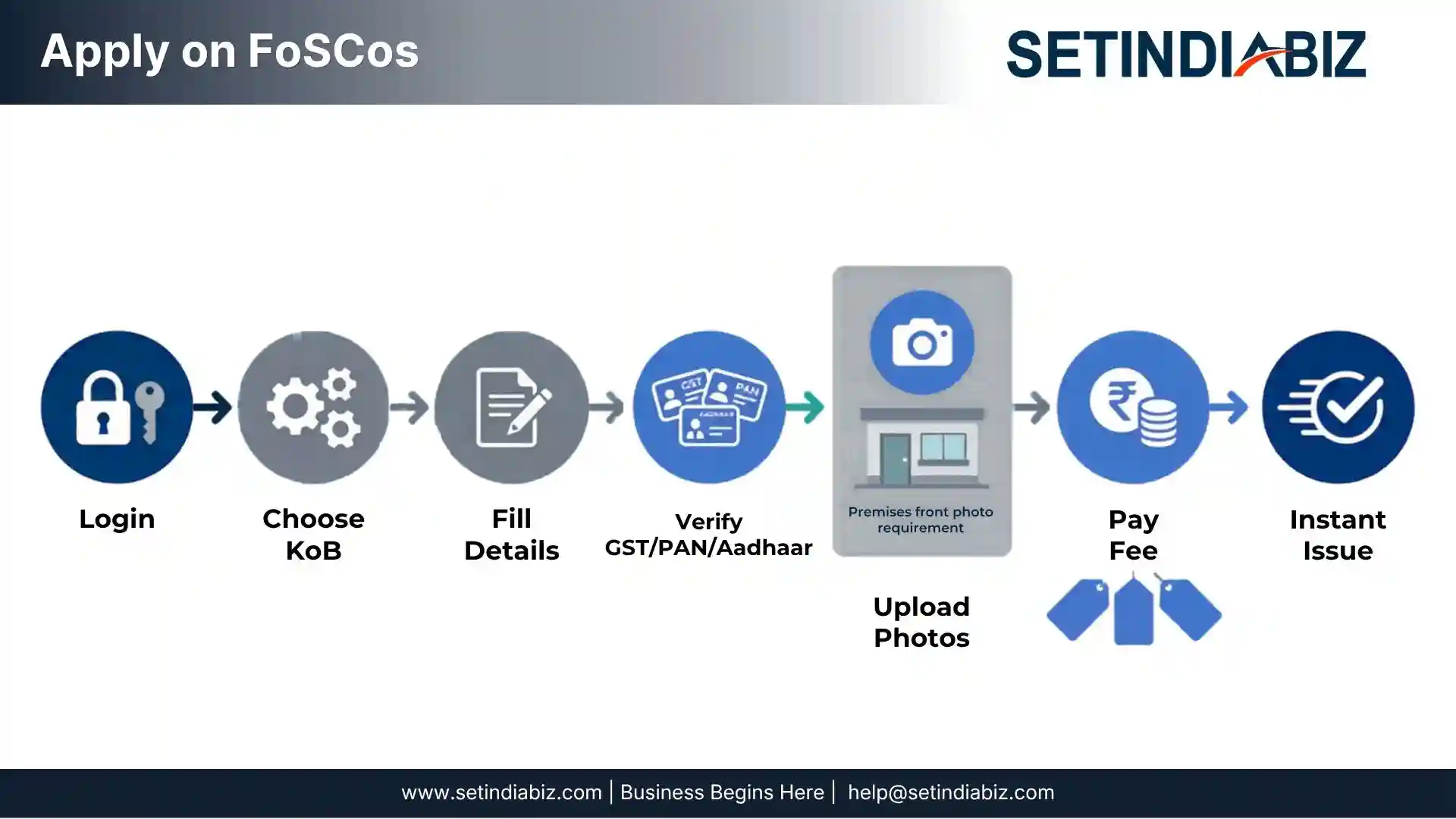
How to Apply to FoSCoS: Applications are filed online through the FoSCoS portal. The official portal is: https://foscos.fssai.gov.in The basic process is:
- Log in or create an account on FoSCoS
- Select the “Apply for Tatkal License/Registration” option
- Choose the correct business category (KoB)
- Fill in the application details accurately
- Complete digital verification (GST/PAN/Aadhaar as applicable)
- Upload the required premises photographs
- Pay the applicable fee and submit the application
If your category is enabled and the digital verification succeeds, the system may issue the license or registration instantly. The fee structure for Tatkal is the same as the regular route: Registration costs ₹100 per year, State License ₹2,000 per year, and Central License ₹7,500 per year (plus GST where applicable). For assistance, FBOs can contact the FSSAI helpline at 1800-112-100 or email helpdesk-foscos@fssai.gov.in.
Validity of Tatkal License in 2026 ✅
This is the most important 2026 update. Earlier Tatkal discussions referred to shorter validity and renewal cycles, but the law has now changed significantly. Under the Food Safety and Standards (Licensing and Registration of Food Businesses) Amendment Regulations, 2026 — notified via Gazette Notification No. RCD-01002/1/2021-Regulatory-FSSAI-Part(1) dated 10 March 2026:
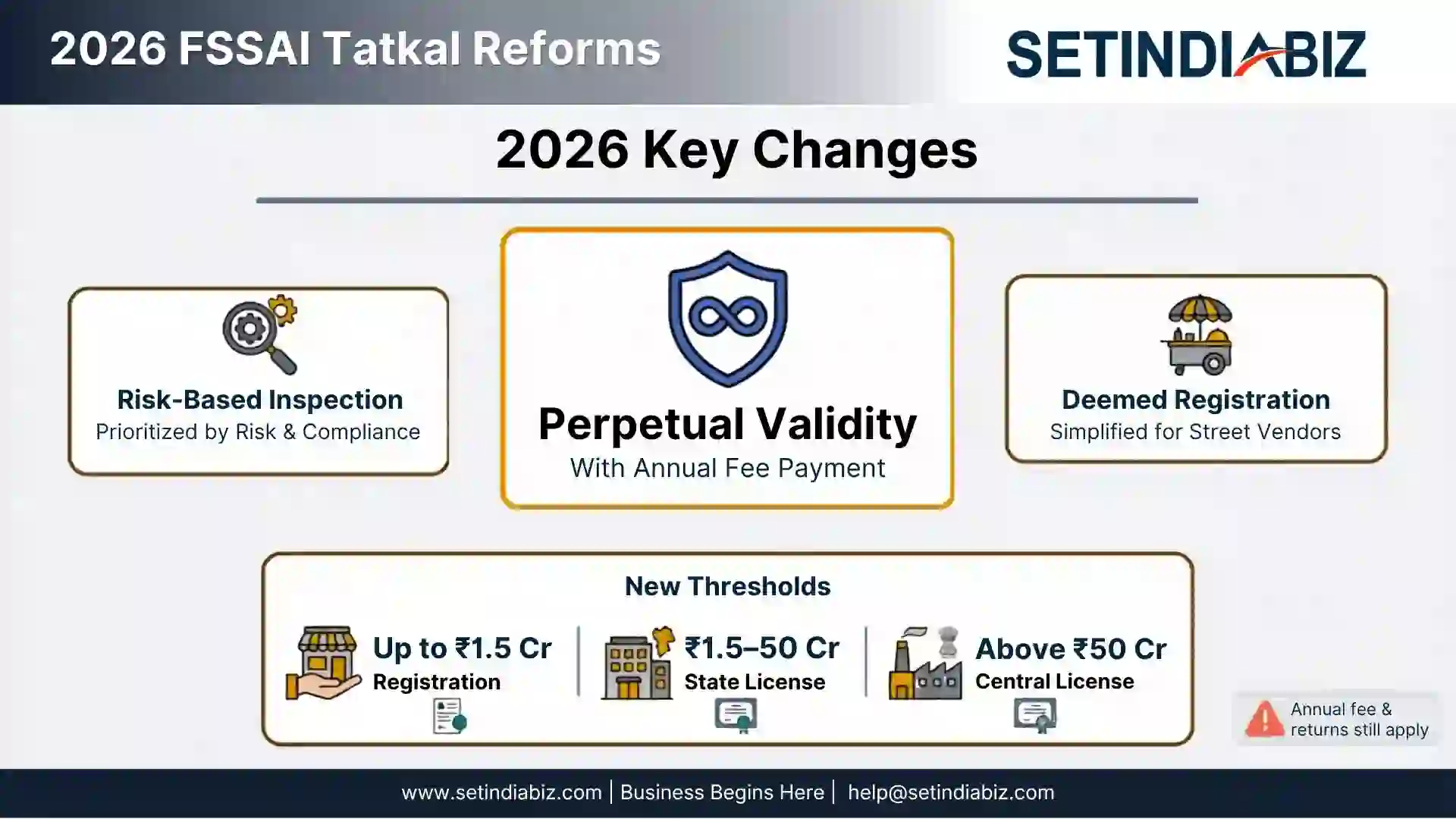
- Licenses and registrations now carry perpetual validity — they remain valid unless suspended, cancelled, or surrendered. The earlier renewal-based expiry model has been replaced under the amended Regulation 2.1.7(1)
- FSSAI’s official FAQ dated 27 March 2026 (Q.9) further confirms: Perpetual validity and revised turnover thresholds apply to Tatkal licenses and registrations as well — no exceptions. This means any Tatkal license or registration issued on or after 1 April 2026 will have perpetual validity, regardless of when the application was submitted.
- Although the original Tatkal order dated 1 July 2024 prescribed one-year validity for instant grants, the later 2026 amendment framework and official FAQ clarify that perpetual validity now applies to Tatkal licenses and registrations issued on or after 1 April 2026.
Does Perpetual Validity Mean No Compliance?
No. Perpetual validity does not mean the license can be ignored after grant. Ongoing compliance is still compulsory under the FSS Act and Regulations. You must continue to ensure:
- Annual Fee Payment: FBOs can pay for multiple years at once, anytime.
- Return Filing: Required where applicable (e.g., for manufacturers/importers).
- Compliance: Maintain hygiene and safety as per FSS (L&R) Regulations, 2011.
- Correct and updated business details on your license
If the annual fee is not paid, or required returns are not filed on time, the license or registration can be deemed suspended under the amended regulations. This means your business could effectively lose its valid FSSAI approval without any formal order — simply by missing compliance deadlines.
Is Inspection Still Possible After Instant Approval?
Yes. An instant grant only speeds up the approval process. It does not remove the food authority’s power to inspect or audit your business at any time. FSSAI’s 2026 framework now follows a risk-based inspection model (as confirmed in Q.14 of the official FAQ dated 27 March 2026). This is a computer-assisted system that determines inspection frequency based on multiple inputs, including:
- Nature and category of the food business
- Risk category of food handled (dairy, meat, infant food, etc.)
- Past compliance history during enforcement and surveillance
- Self-compliance testing records
- Third-party audit outcomes
- Other enforcement inputs
Important 2026 Changes Businesses Should Know
The 2026 amendment notified via Gazette dated 10 March 2026 and implemented through the FSSAI Order dated 13 March 2026 introduced major structural changes to the entire licensing and registration framework. These are relevant even if you are applying under the Tatkal route. Key 2026 changes include:
| No | Reform | What Changed | Effective Date |
|---|---|---|---|
| 1 | Perpetual Validity | Licenses/registrations no longer expire; remain valid unless suspended, cancelled, or surrendered | 10 March 2026 |
| 2 | Deemed Registration | Street vendors registered under the Street Vendors Act, 2014, are automatically registered underthe FSS Act | 10 March 2026 |
| 3 | Risk-Based Inspection | Computer-assisted inspection replaces the calendar-based model | 10 March 2026 |
| 4 | Revised Turnover Thresholds | New categorisation limits for Registration, State License, and Central License | 1 April 2026 |
Revised Turnover Thresholds (w.e.f. 1 April 2026): The revised turnover thresholds as per the FSSAI Order dated 13 March 2026 (Order No. I/36087/2026) are:
| No | Category | Annual Turnover |
|---|---|---|
| 1 | Registration | Up to ₹1.5 crore |
| 2 | State License | Above ₹1.5 crore and up to ₹50 crore |
| 3 | Central License | Above ₹50 crore |
These thresholds replace the earlier limits (₹12 lakh for Registration, ₹20 crore for State License). Existing FBOs will be given sufficient time to migrate via FoSCoS to align with the revised thresholds, and no modification fee is applicable for threshold-based migration.
Street Vendors and Hawkers
The 2026 amendment gives an important benefit to certain street food businesses. Street food vendors, hawkers, food trucks, carts, and similar businesses already registered under the Street Vendors (Protection of Livelihood and Regulation of Street Vending) Act, 2014, are now deemed registered under the FSS Act, 2006.
This means eligible small vendors do not need a separate FSSAI registration application. The dual registration and dual fee burden have been removed. However, hygiene and sanitary conditions under Schedule 4 of the FSS (Licensing and Registration of Food Businesses) Regulations, 2011 must still be followed.
Instant Modification of License: Instant modification is a separate concept fromthe Tatkal grant. It applies in specific cases and should not be confused with general Tatkal eligibility.
The instant modification facility applies to:
- Existing licensed manufacturers only
- Addition or deletion of standardised non-high-risk food products
The modification fee is ₹1,000 plus the differential fee, if applicable. FSSAI’s 2026 FAQ (Q.13) confirms that modification applications (other than threshold-based migration) will continue to follow the existing procedure.
Should You Choose Tatkal or Regular Route?
Tatkal is a good option where the business clearly falls within the notified KoBs, permitted food categories, and digital verification flow. It is especially useful for straightforward trading, distribution, retail, transport, storage, import-export, and petty food business cases that match the notified scheme conditions.
| Factor | Tatkal Route | Regular Route |
|---|---|---|
| Processing Speed | Instant, subject to successful digital verification | Up to the normal regulatory timelines |
| Best For | Clearly covered KoBs and permitted food categories | Businesses outside Tatkal KoBs or with restricted food categories |
| Applicant Profile | Applicant types supported in the live Tatkal verification flow | Any applicant type under the ordinary licensing/registration process |
| Product Restriction | Pre-packed products for most KoBs; prepared/loose food only for snack/tea shops and hawkers | No Tatkal-specific product restriction |
| Geography | Subject to state/UT restrictions and partial enablement | Available through the normal process |
| Post-Approval Scrutiny | Yes, inspection and enforcement powers continue | Yes |
The regular route may be better if:
- Your business is not one of the listed Tatkal KoBs.
- Your products fall in restricted categories such as meat, fish, or in some cases dairy.
- Your State/UT has implementation restrictions.
- Your applicant structure is not clearly reflected in the published Tatkal documents or the live Tatkal workflow on FoSCoS.
- You want to avoid filing risk where the portal or category mapping is unclear.
Conclusion
The FSSAI Tatkal License and Registration offers eligible food businesses a fast-track option, but legal responsibility remains. Crucially for 2026, Tatkal licenses/registrations issued on or after April 1, 2026, now have perpetual validity under the FSS Amendment Regulations, 2026. However, annual fee payment, return filing, and ongoing hygiene compliance are still mandatory.
FAQs
It is a fast-track facility on the FoSCoS portal for selected food business categories. Approval is issued through digital verification of GST, PAN, and Aadhaar instead of the regular pre-grant scrutiny cycle. The scheme was introduced under FSSAI’s “Ease of Doing Business” initiative.
No. As per the restriction note available on FoSCoS, Chandigarh, Meghalaya, and West Bengal are not enabled for Tatkal. Himachal Pradesh is only partially enabled for selected food product categories, and Jammu & Kashmir excludes the Hawker/Itinerant/Mobile Food Vendor KoB.
Tatkal is clearly notified for specific business categories and food categories. For Instant License, the official order expressly mentions proprietorship firms as well as partnership/registered firms in the digital verification framework. For Instant Registration, petty FBOs in specified KoBs can apply through PAN/Aadhaar or Aadhaar-only verification, depending on the category. However, the official documents reviewed do not publish a complete legal-entity-wise eligibility list for all applicant structures such as LLPs or companies.
For Instant License, proprietorship firms are verified through GST and Aadhaar, while partnership/registered firms are verified through CIN/GST and Aadhaar. For Instant Registration, PAN and Aadhaar are required for most petty FBO categories, while petty snack/tea shops and hawkers can apply with Aadhaar only. Premises photographs are mandatory in all cases.
Yes. Front-facing or entrance photographs of the premises are mandatory. They should clearly show the business premises, the address or signboard, and the FBO standing in front of the premises.
For licenses and registrations issued on or after 1 April 2026, validity is perpetual — they remain valid unless suspended, cancelled, or surrendered. This applies to Tatkal licenses and registrations as well, as confirmed by FSSAI’s official FAQ dated 27 March 2026.
Under the perpetual validity regime introduced by the 2026 Amendment Regulations, routine renewal is no longer required. However, annual fee payment and return filing, wherever applicabl,e remain compulsory. Non-payment of annual fees can result in deemed suspension.
Yes. FSSAI retains full power to inspect or audit businesses at any time under the risk-based inspection framework introduced in the 2026 amendment. Inspection frequency depends on the business’s compliance history, food risk category, and other enforcement inputs.
For Tatkal applications, the July 2024 FSSAI order states that any false declaration can attract penalty up to ₹10 lakh under Section 61 of the Food Safety and Standards Act, 2006. Since Tatkal approval is based on self-declaration, applicants should ensure that all information and uploads are fully accurate before submission.
No. Tatkal is suitable only where the business falls within the notified KoBs, permitted food categories, and jurisdiction-wise enablement. It is not a universal shortcut for all food businesses, and applicants should also confirm whether the live FoSCoS workflow supports their applicant profile before filing.
