
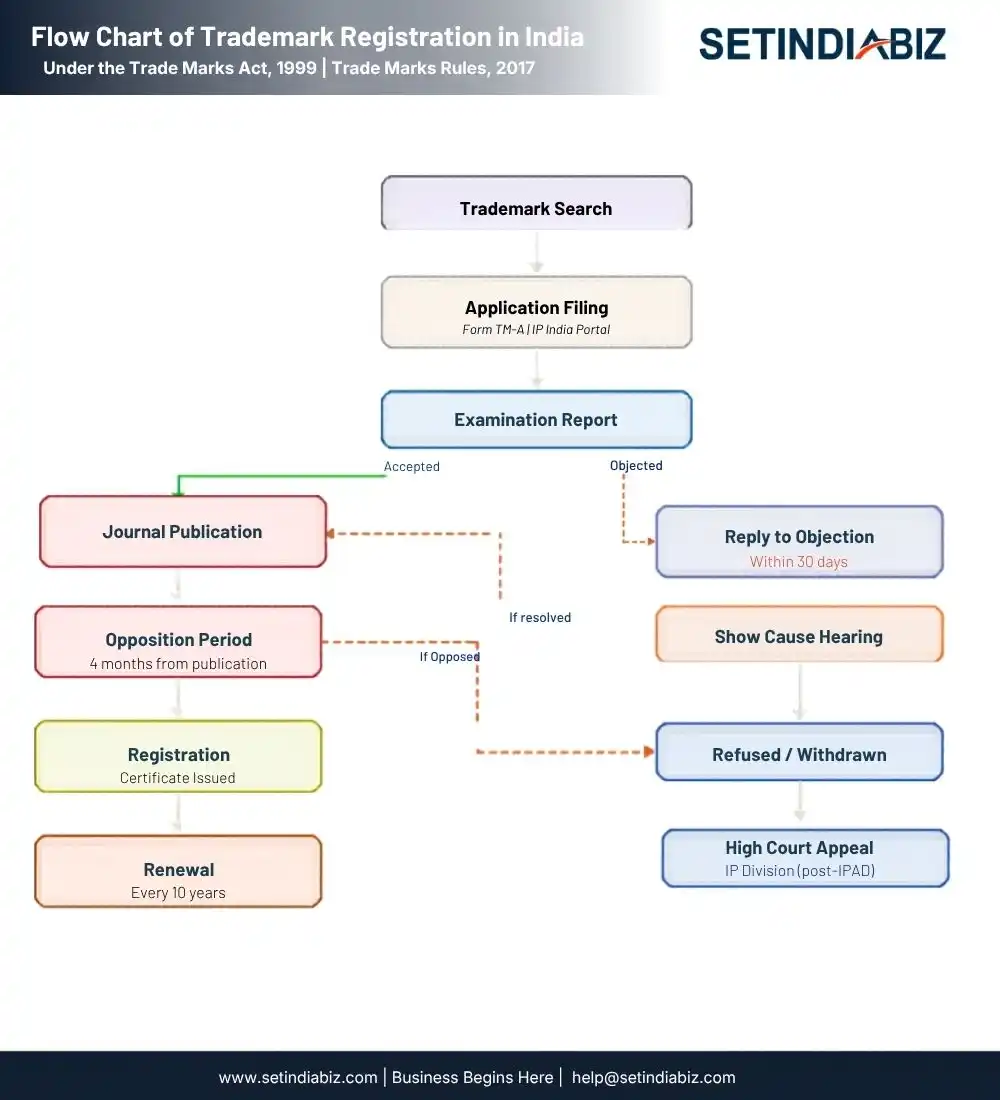
Are you having difficulty understanding the different stages of Trademark Registration? You are not alone — the process can feel overwhelming at first glance. This Trademark Registration Process Flow Chart is designed to simplify your journey! This blog provides a comprehensive step-by-step guide to help you navigate each stage swiftly and with confidence. Since Trademark Registration is a legally involved process governed by the Trade Marks Act, 1999, and the Trade Marks Rules, 2017, a flow chart can be the simplest way to understand it.
This blog guides you through the trademark registration flowchart in India, providing essential steps from application to final registration. Understanding this process, including trademark searches and the stages of examination and publication, is crucial to confidently safeguarding your brand assets and avoiding common pitfalls and delays.
What is the Process of Trademark Registration?
Trademark registration is a crucial legal process that protects unique brand identities and grants exclusive ownership rights to their owners. It involves obtaining legal recognition and protection against plagiarism for trademarks — whether they are logos, names, symbols, or phrases — used in connection with specific goods or services. In India, the entire process is governed by the Trade Marks Act, 1999 (Act No. 47 of 1999) and administered by the Office of the Controller General of Patents, Designs and Trademarks (CGPDTM) under the Ministry of Commerce and Industry.
The process of trademark registration in India involves several clearly defined stages. Here is a brief overview of the typical process:
| Step | Process | ||||||||||||
|---|---|---|---|---|---|---|---|---|---|---|---|---|---|
| 1 |
Trademark Search:
Before filing, you should conduct a thorough search to ensure your proposed trademark is unique and not already registered or in use by others in a similar or related class. This helps you assess potential conflicts and objections early in the process. For this, you need to determine the appropriate class or classes of goods or services under the Nice Classification system, which categorises goods and services into 45 classes — Classes 1 to 34 cover goods, and Classes 35 to 45 cover services. Selecting the right class is fundamental because trademark protection is granted only within the class(es) applied for. Read more about trademark search at https://www.setindiabiz.com/trademark-search |
||||||||||||
| 2 |
Trademark Application Filing
Prepare and file the trademark application using Form TM-A with the CGPDTM. The application can be filed electronically through the IP India e-filing portal. It should include all necessary details such as the Applicant’s Name, Address, a clear Trademark Representation, and a list of Goods or Services under the relevant class(es). The government fees for filing are as follows:
Note: These fees are prescribed under the First Schedule of the Trade Marks Rules, 2017. Read more about the trademark filing process at https://www.setindiabiz.com/trademark-registration |
||||||||||||
| 3 |
Examination by Trademark Examiner
Once the application is filed, the Trademark Registry examines it to assess compliance with legal requirements under the Act. The examiner reviews factors such as distinctiveness (Section 9), similarity to existing trademarks (Section 11), and adherence to trademark laws. If any objections or discrepancies are found, the examiner issues an Examination Report, and the applicant must respond within 30 days of receiving it. If the response is satisfactory, the application proceeds to the next stage. |
||||||||||||
| 4 | Show Cause Hearing | ||||||||||||
| 5 |
Journal Publication
If the trademark application clears the examination stage, it is published in the Trade Marks Journal under Section 20 of the Act. This official publication allows third parties to review the application and raise any opposition within a specified period of four months from the date of publication. If no opposition is raised, the application moves forward to registration. |
||||||||||||
| 6 |
Opposition
If a third party raises opposition during the four-month window, they must file a Notice of Opposition in Form TM-O under Section 21 of the Act. The applicant then needs to file a counter-statement and supporting evidence. If the opposing party is not satisfied with the response, the Registrar may call a Show Cause Hearing to resolve the matter. If the opposition is dismissed, registration proceeds. If it is allowed, the application may be refused. |
||||||||||||
| 7 | Trademark Registration – Upon successful completion of all stages, the trademark registration is granted, and the Registrar issues a Certificate of Registration. Under Section 25 of the Trade Marks Act, 1999, the registration is valid for a period of ten years from the date of application. It can be renewed indefinitely for successive ten-year periods by paying the prescribed renewal fees before the expiry date. |
Practical Tip: The entire registration timeline – from filing to certificate – typically takes anywhere between 8 and 18 months, depending on whether objections or oppositions are raised. Working with a qualified trademark attorney can help ensure a smoother process.
It is important to note that actual timelines and requirements may vary based on the specifics of your application and any potential objections or oppositions encountered. This overview provides a general outline – for case-specific guidance, professional consultation is recommended. ✅
Important Update: The Intellectual Property Appellate Board (IPAB) was abolished in 2021 through the Tribunal Reforms Act, 2021. All appeals against decisions of the Registrar of Trademarks are now filed directly before the concerned High Courts. Several High Courts, including Delhi and Madras, have established dedicated Intellectual Property Divisions to handle such matters efficiently.
To prevent infringement issues and protect your brand, the first essential step is conducting a proper trademark search, which we discuss in the next section. Understanding what “R” and “TM” symbols mean and how to verify existing marks is critical before you invest in building your brand. ⚖️
Conclusion
Trademark registration in India is crucial for exclusive rights and legal protection of brand assets. Following the flowchart’s steps—search, filing, examination, publication, opposition, and registration—allows brand owners to navigate the process efficiently. A registered trademark under the Trade Marks Act, 1999, enables business owners to operate confidently, enforce rights, explore licensing, and build for success.
FAQs
Is it mandatory to register a Trademark in India?
What are the essential conditions to register a Trademark?
What is the difference between the symbols ‘R’ and ‘TM’ in Trademark?
What cannot be registered as a Trademark in India?
Who is authorised to register a Trademark in India?
How long does trademark registration take in India?
What is the validity of a registered trademark in India?
In This Article
Author Bio

Setindiabiz Editorial Team is a multidisciplinary collective of Chartered Accountants, Company Secretaries, and Advocates offering authoritative insights on India’s regulatory and business landscape. With decades of experience in compliance, taxation, and advisory, they empower entrepreneurs and enterprises to make informed decisions.
