
Start a Business in India
Choose Your Business Structure
Starting a business in India begins with one choice: a sole proprietorship, a partnership firm, an LLP, a One Person Company, or a private or public limited company. A non-profit chooses between a Section 8 company, a trust and a society. We help you choose, register the business and add PAN, GST and the registrations your work needs.

Trusted By Leading Brands
























What Is Business Registration?
Business registration in India involves selecting and formally registering a legal structure. It requires two steps: legal setup, then obtaining tax/trade registrations (PAN, GST, Udyam, Shops Act) to operate. The Registrar of Companies registers companies and LLPs via the MCA and issues incorporation certificates. Partnerships register with the State Registrar of Firms. Proprietorships use the owner’s PAN with extra registrations, while NGOs use Section 8, trusts, or societies.
Setindiabiz helps you choose the right legal form, drafts and files the registration, and adds all required tax registrations.
Disclaimer: Setindiabiz is an independent consultancy, not a government body or law firm. Our own teams handle most work; where the law requires one, an independent CA, CS or advocate is engaged. Only the authority concerned registers a business and issues its certificate.
For-Profit Businesses: Choose by Who Owns It
Start with who will own the business. One founder can run a sole proprietorship or form a One Person Company. Two or more partners can sign a partnership deed or register an LLP. Founders who want shareholders, investors and a board form a private or a public limited company. In the first two pairs, the second option limits your liability and adds yearly filings with the Registrar; a bank may still ask you for a personal guarantee on a loan. Each card opens that structure’s own page with documents, steps, fees and pricing.
One FounderOn Your Own
You alone own the business. A proprietorship needs no incorporation; an OPC is a company with one member and a nominee, so your liability is limited.
Two or MoreWith Partners
Two or more people share the profits. A firm runs on a deed, and its partners are personally liable; an LLP is a body corporate that limits each partner’s liability.
ShareholdersWith Shareholders
Owners hold shares and a board of directors runs the company. A private company suits founders raising investment; only a public company can offer shares to the public.
Foreign founder or investor? A foreign national cannot form an OPC, and needs RBI permission to own a proprietorship or invest in a firm; NRIs and OCIs may invest in either only on a non-repatriation basis. Foreign investment usually comes in through a company or an LLP: see India Entry Services, or our pages on LLP registration for NRIs and LLP registration for foreigners, which set out the rules and documents for each case.
Non-Profit Organisations: Choose Your NGO Form
A non-profit organisation (NGO) in India takes one of three forms. A Section 8 company is registered under a licence from the Central Government and must apply its income to its objects and pay no dividend to its members. A society is formed by seven or more persons under the Societies Registration Act, 1860 or a State’s own Act, and a charitable trust by a trust deed. Our NGO registration guide compares the three.
FormationThree NGO Forms
A Section 8 company holds a licence under the Companies Act, 2013; a trust is formed by its deed, and a society by a memorandum signed by seven or more persons.
After FormationRegistrations That Follow
Formation gives the NGO its legal form. These registrations decide how it is funded: tax exemption and donors’ deduction, CSR money from companies, and foreign contributions.
Need help?Not Sure Which NGO Form Fits?
Tell us your objects, where you will work and how you will be funded. A process expert will suggest the form and the registrations it needs.
- Free consultation call
- Form matched to objects
- Estimate before payment
- Tax and FCRA guidance
- Mon–Sat, 9:30–6:30
Six Business Structures, One by One
Each tab gives the structure’s legal shape, who it suits and the rules that may stop you from using it, with a link to its own page for documents, steps, fees and pricing. For tax, yearly compliance, set-up fees and conversion routes side by side, see our business structure comparison.
Sole Proprietorship
Sole proprietorship registration- Owners
- One individual, who owns and runs it
- Liability
- Unlimited: the owner pays personally
- Registered with
- No registrar; proved by Udyam, GST or a licence
- Foreign investment
- NRI or OCI only, on a non-repatriation basis
A sole proprietorship is a business owned and run by one individual. No law registers it as such: it has no certificate of incorporation or CIN, it uses the proprietor’s PAN, and its income is the proprietor’s own income. The business is proved by registrations in its name, such as Udyam, GST or a Shops Act licence, which banks accept for a current account.
Important points
- Quickest to start; no MCA filing
- Udyam registration is free and online
- GST once turnover crosses the limit
- Bank asks for two proof-of-business documents
- Owner answers for debts personally
Before you choose it
Liability is unlimited, and the business cannot take in a co-owner without changing its form. An NRI or OCI may invest only on a non-repatriation basis, and anyone else resident outside India needs RBI permission. A proprietorship cannot be converted under company law or the LLP Act; you form the new entity and transfer the business.
Partnership Firm
Partnership firm registration- Owners
- Two to 50 partners, under a deed
- Liability
- Unlimited, joint and several for every partner
- Registered with
- Registrar of Firms; optional, some States set a deadline
- Foreign investment
- NRI or OCI only, on a non-repatriation basis
A partnership firm is two or more people who agree to share the profits of a business that all of them, or any of them acting for all, carry on. The partners sign a deed, and the firm can start. Registering it with the Registrar of Firms of your State is optional under the central law and can be done at any time, though some States, such as Maharashtra, set a time limit.
Important points
- Two partners minimum, 50 maximum
- Deed on the stamp paper of your State
- Firm applies for its own PAN
- Registered by the State, not the MCA
- Can later convert into an LLP
Before you choose it
Every partner is personally liable, jointly and severally, for the acts of the firm. An unregistered firm cannot go to court to enforce its contracts, and its partners cannot sue each other on them. From abroad, only NRIs and OCIs may invest, and only on a non-repatriation basis.
Limited Liability Partnership (LLP)
LLP registration- Owners
- Two or more partners, no upper limit
- Liability
- Limited; not liable for another partner’s wrong
- Registered with
- Registrar of Companies, through FiLLiP
- Foreign investment
- 100%, only in automatic-route sectors
A limited liability partnership is a body corporate under the LLP Act, 2008: it is separate from its partners and continues when partners change. It needs at least two partners and two designated partners who are individuals, one of whom stays in India for 120 days or more in the financial year. The Registrar issues its certificate of incorporation in Form 16 after the FiLLiP filing.
Important points
- No upper limit on partners
- Not liable for another partner’s wrong
- FiLLiP fee from ₹500, by contribution
- LLP agreement in Form 3 within 30 days
- Form 11 by 30 May, Form 8 by 30 October
Before you choose it
An LLP has no shares: an investor comes in as a partner with a contribution of money, property or services, so it cannot issue shares or stock options. Foreign investment is allowed only in sectors open to 100% foreign investment on the automatic route with no FDI-linked performance conditions.
One Person Company (OPC)
One person company registration- Owners
- One member, an Indian citizen, with a nominee
- Liability
- Limited to any amount unpaid on your shares
- Registered with
- Registrar of Companies, through SPICe+
- Foreign investment
- Indian citizens only; not open to OCI or foreigners
A One Person Company is a private company with only one member. Its memorandum names a nominee, who must consent in writing. Only a natural person who is an Indian citizen, living in India or abroad, may form an OPC or be its nominee.
Important points
- One member, at least one director
- Liability limited to unpaid share capital
- No AGM; accounts audited every year
- No SPICe+ fee up to ₹15 lakh capital
- Convert to a private company any time
Before you choose it
A person can be a member of only one OPC, a foreign national cannot form one, and an OPC cannot carry on non-banking financial investment activity or become a Section 8 company. To bring in co-founders or investors, convert it into a private company by raising members and directors to two.
Private Limited Company
Private limited company registration- Owners
- Two to 200 members, two directors minimum
- Liability
- Limited to any amount unpaid on your shares
- Registered with
- Registrar of Companies, through SPICe+
- Foreign investment
- 100% on the automatic route in most sectors
A private limited company is formed by two or more persons. Its articles restrict the transfer of shares, cap members at 200 and bar any invitation to the public. It needs at least two directors, one of whom stays in India for 182 days or more in the financial year. It is a body corporate from the date of its certificate of incorporation.
Important points
- 2 to 200 members; 2 directors minimum
- Shares by rights, bonus or private placement
- Employee stock options possible
- No SPICe+ fee up to ₹15 lakh capital
- INC-20A within 180 days of incorporation
Before you choose it
Expect more yearly work than an LLP or a firm: board meetings, an annual general meeting, an audit regardless of turnover, and annual filings with the Registrar. Most sectors take 100% foreign investment on the automatic route, but an investor from a country sharing a land border with India needs Government approval.
Public Limited Company
Public limited company registration- Owners
- Seven or more members, three directors minimum
- Liability
- Limited to any amount unpaid on your shares
- Registered with
- Registrar of Companies, through SPICe+
- Foreign investment
- Same sector rules as a private limited company
A public limited company is any company that is not a private company. Seven or more persons form it; it needs at least three directors, and its shares are freely transferable. It is the only form that can raise money from the public through a prospectus, after applying to a recognised stock exchange.
Important points
- 7 members and 3 directors minimum
- Public offer, private placement or rights
- Securities in demat form
- Never a small company
- No SPICe+ fee up to ₹15 lakh capital
Before you choose it
It carries the heaviest compliance of the six: independent directors, whole-time key managerial personnel and a secretarial audit apply as capital and turnover grow. A private company can become a public one later by a special resolution and Form INC-27 filed within 15 days.
Six Business Structures at a Glance
One line for each structure: who owns it, who answers for its debts and who registers it. Our business structure comparison sets out tax, yearly compliance, government fees and conversion routes in full.
| No. | Structure | Owners | Owner’s liability | Registered with |
|---|---|---|---|---|
| 1 | Sole Proprietorship | One individual | Unlimited: personal assets | None as such; Udyam or GST |
| 2 | Partnership Firm | 2 to 50 partners | Unlimited, joint and several | Registrar of Firms; optional |
| 3 | LLP | 2 or more partners | Limited by the LLP Act | Registrar of Companies, FiLLiP |
| 4 | One Person Company | One member, an Indian citizen | Limited to unpaid share capital | Registrar of Companies, SPICe+ |
| 5 | Private Limited | 2 to 200 members | Limited to unpaid share capital | Registrar of Companies, SPICe+ |
| 6 | Public Limited | 7 or more members | Limited to unpaid share capital | Registrar of Companies, SPICe+ |
| Quick Takeaway Limited liability comes only with incorporation, as a company or an LLP registered by the Registrar of Companies. A proprietorship or a firm is quicker and cheaper to start, but its owners answer for its debts personally. Full comparison: Business Structure in India. | ||||
← Swipe sideways to see all three columns →
Registrations You May Need After Setup
Registration creates the business; the registrations below let it bank, bill and trade. A company or an LLP gets its PAN and TAN with the incorporation filing, and SPICe+ can also apply for GSTIN, EPFO and ESIC numbers and, in some States, professional tax and Shops and Establishments Act registration. The rest depend on what you sell, where and to whom. A private limited company, an LLP or a registered firm working on a new product or a scalable model can also seek free DPIIT recognition under Startup India (G.S.R. 108(E), 4 February 2026).
| No. | Registration | When you need it | Law |
|---|---|---|---|
| 1 | PAN and TAN | Company and LLP: allotted with SPICe+ or FiLLiP. Firm: applies for PAN with its deed, and for TAN before the first tax deduction. Proprietor: own PAN | Income-tax Act, 2025; Income-tax Rules, 2026 |
| 2 | Current account | Opened on the KYC set in the RBI’s Directions; a proprietorship shows two proof-of-business documents in its name | RBI (Commercial Banks – KYC) Directions, 2025 |
| 3 | GST registration | Turnover above ₹20 lakh (₹10 lakh in four special category States; ₹40 lakh for goods-only suppliers in most States), or any turnover in a Section 24 case; apply within 30 days | CGST Act, 2017, ss. 22, 24, 25 |
| 4 | Udyam (MSME) | Optional for micro and small enterprises; free, online, on self-declaration | MSMED Act, 2006, s. 8 |
| 5 | Shops and Establishments | Under the Act of the State where you work; thresholds differ, e.g. Gujarat at ten workers, Uttar Pradesh at twenty employees | State Shops and Establishments Acts |
| 6 | Professional Tax | In States that levy it; SPICe+ applies in Maharashtra, Karnataka and West Bengal | State Professional Tax Acts |
| 7 | Import Export Code | Before any import or export of goods; for services, only when claiming foreign trade policy benefits or dealing in specified services | Foreign Trade (Development and Regulation) Act, 1992, s. 7 |
| 8 | FSSAI licence | Before starting a food business; small operators such as petty retailers and hawkers register instead. | Food Safety and Standards Act, 2006, s. 31 |
| 9 | Trade mark | Optional; until the mark is registered, no infringement action lies, only passing off. | Trade Marks Act, 1999, ss. 27, 34 |
← Swipe sideways to see the law column →
How Setindiabiz Helps You Start
Setindiabiz handles the start of a business in three stages: choosing the structure, registering it, and adding the registrations it needs to trade. The same process expert stays with your case from the first call to the first filing deadline.
A structure that fits your plan
We map your owners, funding plans, liability and activity to the business or NGO forms open to you, and tell you in writing which fit.
Name check before you file
We search the MCA and trade marks registers so the name is not refused for resembling an existing company, LLP or registered mark.
DSC and DIN for each signatory
A Class 3 DSC for every director, designated partner or subscriber who signs, and the DIN or DPIN applied for in the same filing.
Drafting and filing
MOA and AOA, LLP agreement or partnership deed drafted for your business (you buy the stamp paper), then filed and followed up to the certificate.
PAN, TAN and bank account
PAN and TAN come with SPICe+ and FiLLiP; we prepare the KYC set your bank asks for to open the current account.
Registrations and first deadlines
GST, Udyam and Shops Act registrations as your activity needs, and a calendar of first deadlines such as INC-20A within 180 days.
Video Guide on Starting a Business in India
Two videos from the Setindiabiz channel for founders who are still choosing a legal form. The first walks through the main business structures and who each one suits. The second explains how a proprietorship, a firm, an LLP and a company differ in law. Each video loads only when you press play.
How to start a business in India: a beginner’s guide
Covers the main business structures from a sole proprietorship to a private limited company, which one suits you, and the points to weigh before you choose. About six minutes.
Types of business and legal structures in India
Explains how proprietorships, partnership firms, LLPs and companies differ in legal structure, and how that choice affects the way a business grows. About five minutes.
Further Reading on Starting a Business in India
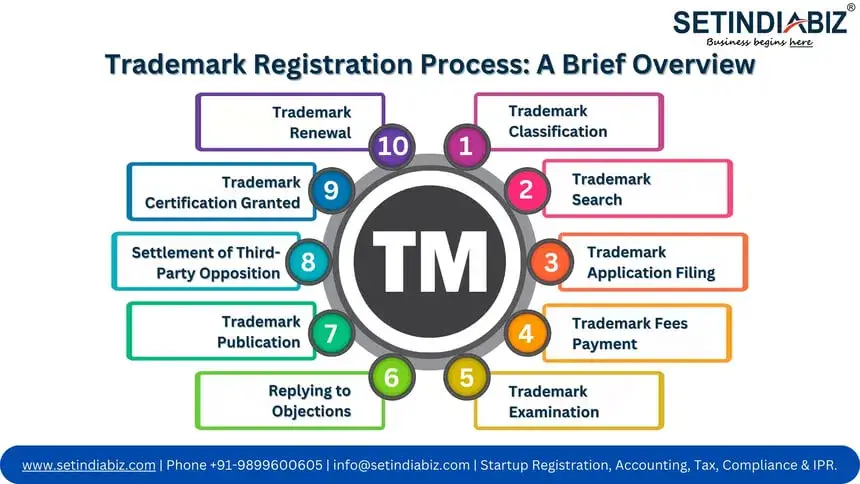
Trademark registration process in India
Follows a trade mark application step by step: the search, filing, examination, advertisement in the journal and registration of your brand.
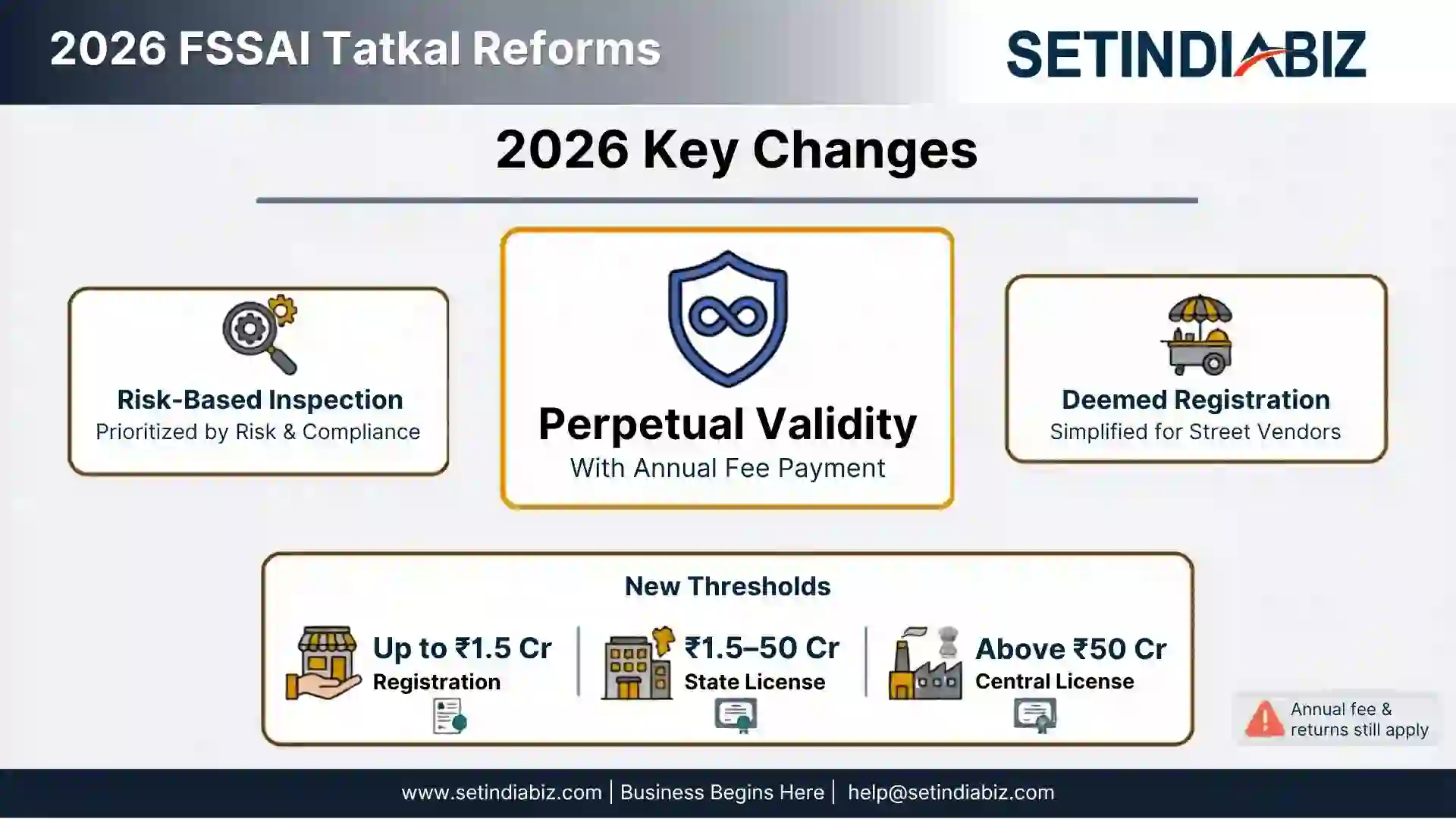
FSSAI instant licence and registration guide
Explains FSSAI registration and licences for food businesses on FoSCoS: who is eligible, the documents and how long each is valid.

Resident Director vs. Designated Partner: 182 Days or 120 Days?
Sets the 182-day stay test for a company’s resident director against the 120-day test for an LLP’s designated partner, rule by rule.
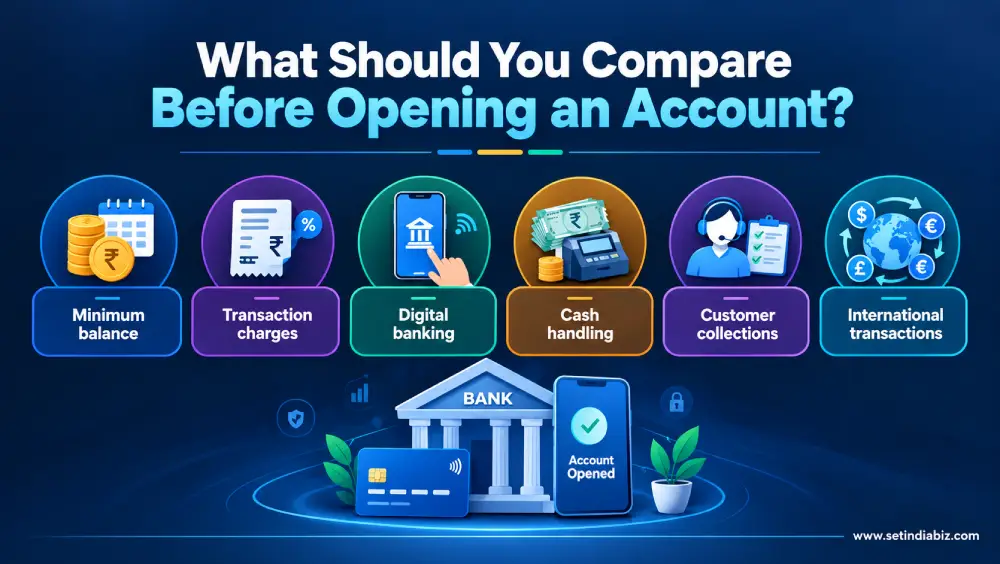
Business current account in India: which account suits your structure
Compares current account options for proprietorships, firms, LLPs and companies, with the KYC papers a bank asks for from each one.

MSME definition: investment and turnover criteria
Explains how an enterprise is classed as micro, small or medium under the MSMED Act by investment and turnover, with current limits.

Ten online business ideas in India
Ten online business models that suit India, each with the legal structure, registrations and yearly compliance that it usually calls for.
Frequently Asked Questions
Most answers carry the section or rule behind them. The documents, steps, fees and pricing of each structure are on that structure’s own page.
Choosing a structure
No single structure is best: it depends on who owns the business and how you will fund it. One founder chooses between a sole proprietorship and a One Person Company, partners choose between a firm and an LLP, and founders who will issue shares to investors form a private limited company. If cost and speed matter most, a sole proprietorship is the cheapest and quickest to start, as it needs no incorporation. Our business structure comparison sets the six side by side.
Yes, as a One Person Company, a private company with one member (Section 3(1)(c), Companies Act, 2013). The member must be a natural person and an Indian citizen, resident in India or not, and must name a nominee (Rule 3, Companies (Incorporation) Rules, 2014). A person can be a member of only one OPC.
A proprietorship is not incorporated: it runs on the owner’s PAN, and the owner answers for its debts with personal assets. An OPC is a company with a certificate of incorporation and a CIN, and the member’s liability is limited to the amount unpaid on the shares (Section 4(1)(d)(i), Companies Act, 2013). In contrast, the OPC must have its accounts audited and file them with the Registrar every year.
A firm starts on a signed deed and suits partners who accept personal liability: each is liable jointly and severally for the acts of the firm (Section 25, Indian Partnership Act, 1932). An LLP is a body corporate, and a partner is not liable for another partner’s wrongful act (Section 28, LLP Act, 2008), but it files Form 11 and Form 8 with the Registrar every year.
Usually a private limited company. It can issue shares to investors by private placement or a rights issue (Section 23(2), Companies Act, 2013) and grant employee stock options, while an LLP has no shares and an OPC can have only one member. A public company is needed only for an offer of shares to the public.
Some changes are provided for: a firm can convert into an LLP (Section 55, LLP Act, 2008), an OPC into a private or public company at any time (Rule 6, Companies (Incorporation) Rules, 2014), and a private company into a public one by special resolution (Section 14, Companies Act, 2013). A proprietorship cannot be converted under company law or the LLP Act; you form the new entity and transfer the business to it. The comparison page lists every route.
Founders & residence
A director must be an individual and needs a Director Identification Number before appointment (Section 152(3), Companies Act, 2013); SPICe+ applies for up to three DINs. An LLP partner can be an individual or a body corporate, but its designated partners must be individuals (Sections 5 and 7, LLP Act, 2008).
Yes. At least one director must stay in India for 182 days or more during the financial year, counted proportionately in the year of incorporation (Section 149(3), Companies Act, 2013). This applies to every company, including an OPC and a company owned entirely by foreign shareholders.
Yes. One of its designated partners must be resident in India, meaning a stay of at least 120 days during the financial year (Section 7(1) and Explanation, LLP Act, 2008, from 1 April 2022). The earlier test was 182 days.
Yes. An NRI who is an Indian citizen can form an OPC, since residence stopped being a condition on 1 April 2021 (Rule 3, Companies (Incorporation) Rules, 2014), and can hold shares in a company or be a partner in an LLP. A company still needs one director who stays in India for 182 days or more in the year, and an LLP needs one designated partner who stays for 120 days. An NRI or OCI may put money into a proprietorship or a firm only on a non-repatriation basis, outside agriculture, print media and real estate business (Schedule IV, NDI Rules, 2019).
Yes, through an Indian company or an LLP. Most sectors take 100% foreign investment in a company on the automatic route, subject to sector caps; an LLP can take it only where the sector allows 100% on the automatic route with no FDI-linked performance conditions. An investor from a country sharing a land border with India, or whose beneficial owner is a citizen of one, invests only with Government approval (Rule 6(a), NDI Rules, from 2 May 2026). See India Entry Services.
Registration & fees
No law registers a proprietorship; it registers under the laws that apply to its activity, such as GST, Udyam or the State Shops Act. A firm may register with the State Registrar of Firms at any time (Section 58, Indian Partnership Act, 1932), but until it does, it cannot sue to enforce its contracts (Section 69 of the same Act). Some States, such as Maharashtra, set a time limit.
The Registrar of Companies registers companies through SPICe+, and LLPs through FiLLiP, on the MCA portal. The Registrar of Firms appointed by each State registers partnership firms (Section 57, Indian Partnership Act, 1932). Nobody registers a sole proprietorship as such.
No. The minimum paid-up capital was omitted from the definitions of private and public company (Sections 2(68) and 2(71), Companies Act, 2013), so you can start with any amount. Each subscriber to the memorandum must take at least one share (Section 4(1)(e) of the same Act).
For a company or an LLP, yes: MCA forms are signed with a Class 2 or Class 3 DSC (Rule 8, Companies (Registration Offices and Fees) Rules, 2014; Rule 36, LLP Rules, 2009). Certifying authorities now issue individual signing certificates as Class 3, which meet both. See Digital Signature Certificate.
A company pays no SPICe+ registration fee on nominal capital up to ₹15 lakh (Rule 38(2), Companies (Incorporation) Rules, 2014); above that, the Fees Rules slabs apply, and stamp duty on the MOA and AOA depends on the State. An LLP pays a FiLLiP fee by contribution, from ₹500 for a contribution up to ₹1 lakh, rising to ₹25,000 above ₹1 crore (LLP Rules, Annexure A). Each structure’s page gives the full table.
Non-profit (NGO)
Choose one of three forms. A Section 8 company is registered under a licence from the Central Government, must apply its income to its objects and may pay no dividend to its members (Section 8, Companies Act, 2013). A society is formed by seven or more persons who sign a memorandum and file it with the Registrar (Section 1, Societies Registration Act, 1860, or the State’s own Act). A charitable trust is formed by a trust deed. See our NGO registration guide.
Usually not the Indian Trusts Act, 1882: Section 1 of that Act keeps public and private religious or charitable endowments outside it. A public charitable trust follows its deed and, where the State has a public trusts Act, that Act: in Maharashtra the trustee applies for registration to the Deputy or Assistant Charity Commissioner (Section 18, Maharashtra Public Trusts Act), and Rajasthan has a similar rule (Section 17, Rajasthan Public Trust Act, 1959).
Only to receive foreign contribution. A person with a definite cultural, economic, educational, religious or social programme may accept it only after registration with the Central Government, or with prior permission that is valid for the specific purpose and source (Section 11, Foreign Contribution (Regulation) Act, 2010).
After registration
When aggregate turnover in a financial year crosses ₹20 lakh, or ₹10 lakh in Manipur, Mizoram, Nagaland and Tripura (Section 22, CGST Act, 2017). Suppliers of goods only have a ₹40 lakh limit in most States (Notification 10/2019-Central Tax). The cases in Section 24 must register regardless of turnover; anyone may register voluntarily, and the application is due within 30 days of becoming liable.
No. Filing the Udyam memorandum is at the discretion of a micro or small enterprise (Section 8(1), MSMED Act, 2006). It is free, online and based on self-declaration, with no documents uploaded (S.O. 2119(E)). From 1 April 2025, a micro enterprise has investment up to ₹2.5 crore and turnover up to ₹10 crore.
Within 180 days, a director files Form INC-20A declaring that every subscriber has paid for the shares, and the company may not start business or borrow until it does (Section 10A, Companies Act, 2013). The registered office must be in place and verified within 30 days (Section 12 of the same Act), and the board appoints the first auditor within 30 days (Section 139(6)).
A company gets both through SPICe+, and an LLP’s certificate of incorporation in Form 16 carries its PAN and TAN (Rule 11(3), LLP Rules, 2009). A firm applies for PAN in Form No. 94 on its deed and for TAN in Form No. 135 before its first deduction (Income-tax Rules, 2026). A proprietor uses their own PAN.
Yes, if it is a private limited company, an LLP, a registered partnership firm or a cooperative society, is less than 10 years old, has never crossed ₹200 crore turnover in a financial year, and works on innovation or a scalable model (G.S.R. 108(E), DPIIT, 4 February 2026). A Deep Tech startup gets 20 years and ₹300 crore. A sole proprietorship does not qualify. You apply for free on the Startup India portal.
It depends on the structure. For a company or an LLP, each director, partner and subscriber gives PAN (a passport for a foreign national), proof of identity and address and a photograph, and the registered office needs a recent utility bill with the owner’s no-objection certificate or a rent agreement. A firm files its signed deed and the partners’ KYC. A proprietor uses PAN, Aadhaar and proof of business in their own name. Each structure’s page lists the full set.
No questions in this category yet. Choose another category or select “All”.
Request a Call / Quote
Tell us who will own the business, what it will sell and where it will operate. You will receive a written note on the structure that fits and an estimate showing the professional fee, government fees, stamp duty and GST as separate heads, with the documents we need. No payment is taken before you have read it.
Written estimate first
Fee, statutory charges and GST shown separately, upfront.
Free consultation
A process expert explains the scope and options. No obligation.
Quality you can check
Defined deliverables; qualified professionals where required.
Support through completion
One point of contact, status updates and a support portal.
Clear scope and timeline
Documents needed, working-day timeline, exclusions listed.
Online, across India
Online delivery from Noida, Mumbai, Bengaluru, Hyderabad.
📞 +91 98996 00605 📧 info@setindiabiz.com
🕒 Mon–Sat · 9:30 AM – 6:30 PM How we handle your details: read our privacy policy.
