
Overview : Obtaining official recognition as a startup from the Department for Promotion of Industry and Internal Trade (DPIIT) is a critical milestone for any emerging Indian business. This government certification provides access to Startup India benefits, including tax exemptions, streamlined compliance, and government funding. The entire process is managed online through the National Single Window System (NSWS) portal with complete transparency and zero government fees. This guide provides a definitive walkthrough of securing your DPIIT recognition certificate, from checking eligibility criteria defined under notification G.S.R. 127(E) dated February 19, 2019, to submitting your application successfully.
What is DPIIT Startup Recognition?
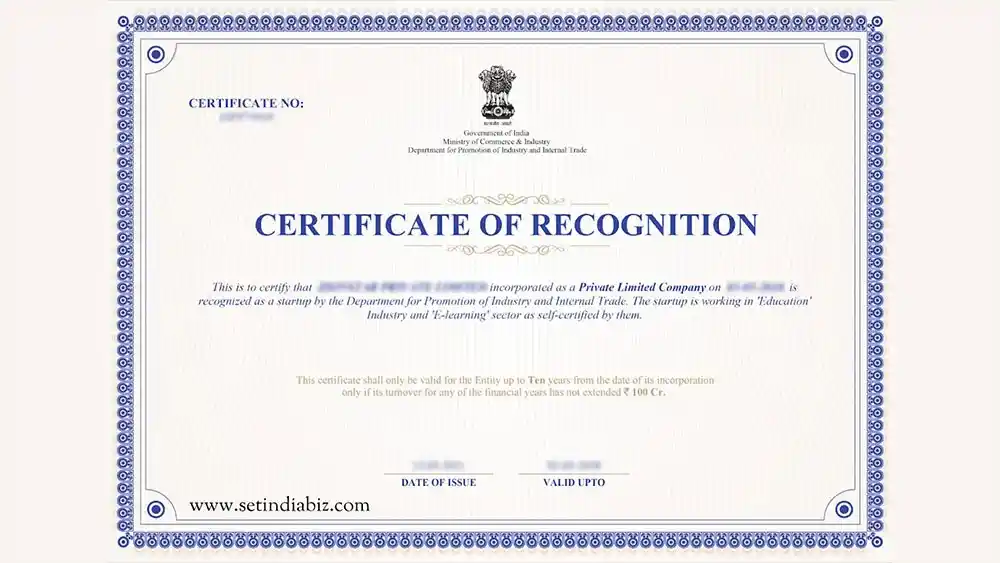
DPIIT Startup Recognition is a formal certification provided by the Department for Promotion of Industry and Internal Trade, Ministry of Commerce and Industry, Government of India. It officially acknowledges a business as a “startup,” making it eligible for benefits under the Startup India Action Plan. The startup recognition certificate issued by the DPIIT includes a unique startup recognition number that serves as primary proof for availing the benefits of the Startup India schemes related to intellectual property rights, public procurement, and various tax benefits. According to government data, over 1,40,803 startups have received DPIIT recognition as of June 2024, generating more than 15.53 lakh direct employment opportunities across India 🚀.
Who is Eligible for Startup Recognition?
To qualify for DPIIT recognition, your business must satisfy all conditions defined in Gazette Notification G.S.R. 127(E) dated February 19, 2019, which superseded earlier notifications. An entity must meet the following criteria simultaneously to qualify for this valuable government recognition.
1. Type of Legal Entity
Your business must be incorporated under one of three specific legal structures.
| No | Legal Structure | Governing Act/Authority |
|---|---|---|
| 1 | Private Limited Company | Companies Act, 2013 – Ministry of Corporate Affairs |
| 2 | Limited Liability Partnership | LLP Act, 2008 – Ministry of Corporate Affairs |
| 3 | Registered Partnership Firm | Partnership Act, 1932 – Registrar of Firms (State) |
Sole proprietorships, Hindu Undivided Families (HUF), or other informal business arrangements are excluded from eligibility.
2. Age of the Entity
Your entity must not have completed ten years from the date of incorporation (for companies/LLPs) or registration (for partnership firms). This ensures benefits target genuinely new businesses requiring support during their critical growth phase, rather than established enterprises.
3. Annual Turnover Limit
The entity’s annual turnover must not exceed ₹100 crores in any previous financial year since incorporation. If turnover crosses this threshold in any year, the entity permanently loses eligibility for startup recognition from that point onwards.
4. Originality of the Entity
The startup must be a genuinely new venture. Entities formed through splitting up or reconstruction of existing businesses cannot obtain DPIIT recognition, subject to certain exceptions under Section 33B of the Income Tax Act, 1961. This prevents established companies from restructuring to unfairly access startup benefits 💼.
5. Additional Entity
The startup must not have incorporated additional entities having similar address with same production line/services and at least one common director/ designated partner/partner. Such duplication may be seen as an attempt to circumvent compliance norms or gain undue benefits and may disqualify the startup from recognition or incentives
6. Innovative & Scalable Business Model 💡
Your entity must be engaged in innovation, development, or improvement of products, processes, or services. Alternatively, it must demonstrate a scalable business model with high potential for employment generation or wealth creation. Simple resale businesses or standard services without innovative elements will not qualify.
What Documents Are Required for the Application? ✅
Having correct documentation ensures smooth processing without delays or rejections.
| No | Document | Description |
|---|---|---|
| 1 | Incorporation Certificate | Certificate of Incorporation for Pvt Ltd/LLP, issued by the Registrar of Companies or Registration Certificate for Partnership Firm issued by the Registrar of Firms |
| 2 | Entity PAN Card | Company/LLP/Firm PAN (not individual PAN) |
| 3 | Proof of Innovation 🎯 | Website/app link AND detailed pitch deck (10-15 slides) |
| 4 | Authorization Letter | Letter on letterhead authorising application submission |
| 5 | Digital Signature | Organisation DSC of Class 3 |
Step-by-Step Guide to Apply for DPIIT Recognition 📋
The application process is entirely digital through the National Single Window System (NSWS), which integrates services from 32 Central Ministries and 29 State Governments. The process requires no government fees.
Step 1: Incorporate Your Business Entity
Before applying, register your business as a Private Limited Company, LLP, or Partnership Firm. Complete all incorporation formalities and obtain your CIN/LLPIN from the Ministry of Corporate Affairs or registration certificate from the Registrar of Firms.
Step 2: Register on the National Single Window System (NSWS)
Visit www.nsws.gov.in and create an investor account using your email and mobile number. Verify both through OTP and complete your business profile with accurate details, as this information auto-populates in application forms.
Step 3: Access the DPIIT Recognition Application
After logging in, click “Add Approvals” then “Central Approvals.” Search for “Registration as a Startup” and add it to your dashboard. This enables direct access to the startup recognition application form.
Step 4: Fill the DPIIT Recognition Form
The comprehensive form includes:
- Entity Details (auto-populated from profile)
- Registered Office Address
- Authorised Representative Information
- Director(s)/Partner(s) Details with DIN/DPIN numbers
- Business Information explaining your innovation and scalability
Step 5: Upload Required Documents
Upload all documents in PDF format (maximum 5MB per file). Ensure documents are clearly legible with current information. Any discrepancy may lead to rejection.
Step 6: Self-Certify Compliance
Self-certify that your entity meets all eligibility conditions through a legally binding declaration. False declarations can lead to criminal prosecution and permanent blacklisting from government schemes.
Step 7: Submit and Track Application
Submit the application and receive a unique reference number. DPIIT typically reviews applications within 2-7 working days. Upon approval, you’ll receive the Certificate of Recognition via email with your unique DPIIT recognition number.
Conclusion
DPIIT Startup Recognition represents more than a certificate; it’s official validation of your innovative vision and a robust growth catalyst backed by government support. The online, transparent, zero-fee process through NSWS makes recognition accessible to all eligible entrepreneurs. By ensuring your business meets criteria in notification G.S.R. 127(E) – particularly regarding entity type, age, turnover, and innovation – you can successfully secure recognition. This strategic step unlocks tax savings worth lakhs through Section 80-IAC exemptions, regulatory relief through self-certification, and competitive advantages in government procurement, providing the foundation needed to thrive in India’s competitive business landscape.
FAQ’s
Can a sole proprietorship get DPIIT startup recognition?
Is there any government fee for applying for DPIIT recognition?
How long is the DPIIT recognition certificate valid?
Do I need a patent to be considered an ‘innovative’ startup?
Can a startup recognition application be rejected?
What happens if the application is rejected?
In This Article
Author Bio

Setindiabiz Editorial Team is a multidisciplinary collective of Chartered Accountants, Company Secretaries, and Advocates offering authoritative insights on India’s regulatory and business landscape. With decades of experience in compliance, taxation, and advisory, they empower entrepreneurs and enterprises to make informed decisions.
