
Overview: A Private Limited Company offers several structural advantages for businesses seeking organised ownership, limited liability and long-term growth. From separate legal identity and equity funding to ESOPs, perpetual succession and access to foreign investment, the structure can support different stages of business expansion, subject to applicable laws and regulatory requirements.
If you are planning to grow your business, bring in investors, hire senior employees, enter into large commercial contracts, or expand into international markets, choosing the right business structure becomes important. A Private Limited Company is one of the most commonly used corporate structures in India. It is incorporated under the Companies Act, 2013 and provides a legal framework for ownership, management, investment and long-term business continuity.
Unlike an unincorporated business, a Private Limited Company has a separate legal identity from its members. It also provides limited liability protection and allows the business to structure ownership through shares. These features make it relevant for businesses with plans for fundraising, employee incentives, professional management and long-term expansion.
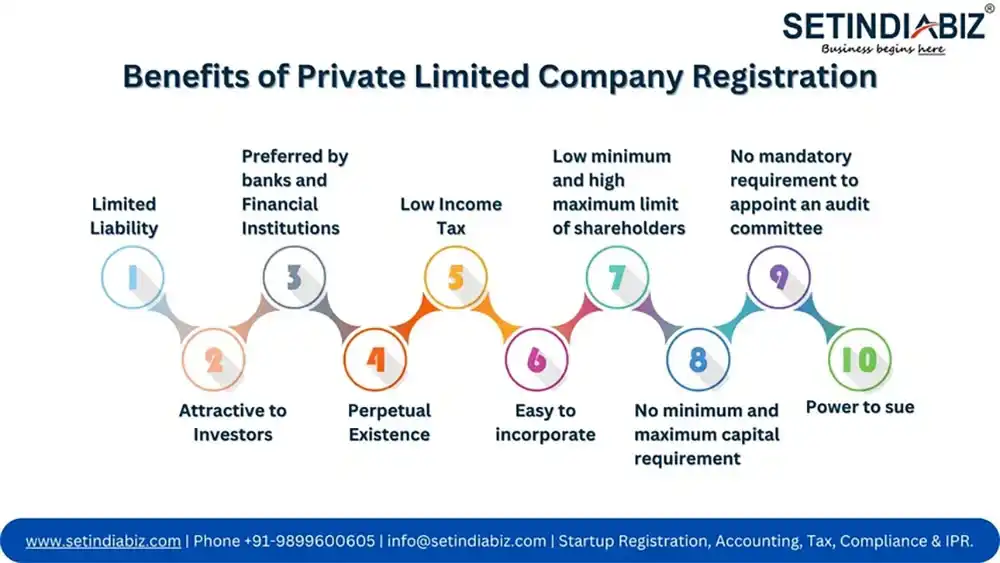
Here are the 6 major benefits of a Private Limited Company in India:
1. Separate Legal Entity
One of the most important benefits of a Private Limited Company is its separate legal identity.
Once incorporated, the company becomes a legal entity distinct from its members and directors. It can own property, maintain bank accounts, enter into contracts, incur liabilities, and sue or be sued in its own name.
This separation means that the company’s business activities are legally distinct from the personal affairs of its shareholders.
For example, if a company enters into a commercial agreement with a client, the contract is generally entered into by the company itself, rather than by the shareholders in their personal capacity.
The company also continues to exist independently even when its shareholders change, subject to applicable law and corporate procedures.
2. Limited Liability Protection
Limited liability is another significant advantage of a Private Limited Company. Generally, the liability of a shareholder is limited to the amount remaining unpaid on the shares held by that shareholder. Therefore, shareholders are ordinarily not personally liable for the company’s business debts merely because they are shareholders.
This creates a legal distinction between the company’s liabilities and the personal assets of its shareholders.
However, limited liability is not absolute. In certain circumstances, such as fraud or statutory violations, applicable law may permit personal liability to arise.
Therefore, limited liability should be understood as a legal protection subject to applicable law, rather than as an unconditional shield.
3. Equity Funding and Investor Participation
A major advantage of a Private Limited Company is its ability to structure ownership through shares.
This makes the structure useful for businesses planning to raise equity funding from eligible investors.
Depending on the company’s stage and funding requirements, it may raise capital from sources such as Angel Investors, Venture Capital Funds and Strategic Investors, subject to the applicable legal and regulatory requirements.
The issue or transfer of shares must comply with the applicable provisions of the Companies Act, 2013, including requirements relating to private placement, valuation, disclosures and other applicable conditions.
For a growing startup, this share-based structure allows the company to bring in new investors while maintaining a defined ownership pattern among existing shareholders.
The ability to issue shares can also be important when founders want to bring in co-founders, strategic partners or institutional investors as shareholders.
4. Employee Stock Options (ESOPs)
A Private Limited Company can also use Employee Stock Options (ESOPs) as a tool for attracting and retaining key talent, subject to applicable legal requirements.
Under Section 62(1)(b) of the Companies Act, 2013, read with the applicable rules, companies can grant stock options to eligible employees and directors through an ESOP scheme, subject to the prescribed conditions, approvals and other applicable requirements.
Instead of offering compensation only through salary and performance incentives, eligible employees may receive an opportunity to participate in the company’s future growth through an ownership-linked benefit.
This can be particularly useful for startups and growing companies looking to hire senior executives, technology professionals and other key employees.
For example, a startup may offer an eligible senior employee an ESOP package as part of the overall compensation structure. If the company grows in value, the employee may potentially benefit from the value associated with those shares, subject to the ESOP terms and applicable conditions.
5. Perpetual Succession
A Private Limited Company enjoys perpetual succession, meaning that its existence does not depend on the continued presence of any particular shareholder.
The company can continue to exist even if a shareholder:
- Dies
- Retires
- Becomes insolvent
- Transfers their shares
- Exits the business
The company’s legal existence remains separate from the individual shareholders.
This is particularly important for entrepreneurs who want to build a business that can continue beyond the involvement of its original founders.
For example, if one shareholder exits the company, the business does not automatically come to an end. The shares may be transferred in accordance with the Companies Act, Articles of Association and applicable restrictions, while the company itself continues its operations.
Perpetual succession therefore provides continuity for businesses with long-term growth and ownership-transition plans.
6. Access to Foreign Investment Opportunities
A Private Limited Company can also be a suitable structure for businesses that intend to receive Foreign Direct Investment (FDI).
However, it is important not to assume that every Private Limited Company can automatically receive 100% FDI.
India’s FDI framework is sector-specific. In sectors and activities where 100% foreign investment is permitted under the automatic route, foreign investment may generally be received without prior Government approval, subject to applicable sectoral conditions, pricing requirements, reporting obligations and other regulations.
Other sectors may be subject to:
- Sectoral caps
- Government approval requirements
- Additional conditions
- Sector-specific regulatory requirements
Therefore, whether a company can receive 100% FDI depends on the nature of its business and the applicable FDI policy.
Company Registration Cost
- Director DIN
- Company Name Approval
- Filing Incorporation Forms
- Company PAN & TAN
- Digital Signature
- Drafting MoA & AoA
- Certificate of Incorporation
- 100% Online Process


Conclusion
A Private Limited Company provides a structured foundation for businesses looking to grow, raise investment and build long-term operations. Benefits such as separate legal identity, limited liability, equity funding, ESOPs, perpetual succession and access to foreign investment, subject to applicable rules, make it a suitable structure for many growth-oriented businesses.
However, incorporation also comes with ongoing legal and compliance responsibilities. Entrepreneurs should therefore evaluate their business goals and choose the structure that best fits their requirements.
FAQ’s
The Private Limited Company main benefits in India include separate legal identity, limited liability protection, structured equity ownership, access to equity funding, ESOPs, perpetual succession and the ability to receive foreign investment subject to applicable rules.
A Private Limited Company and a partnership firm have different legal structures, liability frameworks, compliance requirements and ownership mechanisms. A Private Limited Company may be more suitable for businesses seeking equity investment, structured shareholding and long-term corporate continuity, depending on their specific requirements.
Yes. A Private Limited Company can raise equity capital from eligible investors through permitted methods, subject to the Companies Act, 2013 and applicable requirements relating to issue of shares, valuation, disclosures and other regulatory conditions.
Yes, a Private Limited Company can receive Foreign Direct Investment (FDI) where permitted under India’s FDI framework. The applicable sectoral cap, entry route, pricing requirements, reporting obligations and other conditions depend on the nature of the business and the applicable regulations.
Yes. A Private Limited Company has perpetual succession, so its legal existence generally continues even when shareholders change, transfer their shares, retire, or exit the business, subject to applicable legal and corporate requirements.
