
Overview : As we all know, changing directors in company is a kind of exercise that a company needs to perform so that no operations of the company are affected or boosting its operations. Changing director name in company is subject to MOA conditions and also provisions of the Companies Act 2013. Navigate the company director change process in this blog and gain insight into how to change director in a pvt ltd company.
In a company, directors are appointed to take complete charge of operations and management in a company. Simply put, directors of a company hold key managerial positions in an organization and are responsible for managing the execution of overall day-to-day operations and affairs that can help meet the company’s final goal along with making profit and enhancing its goodwill across the industry.
Changing a company director in a private limited company may include either removing a director, or appointing a new director to the Board of Directors (BD) of the company. If we talk about the governing law, the appointment and resignation of directors are governed as per the provisions mentioned under the Companies Act 2013 and rules made thereunder.
Gain knowledge about how to change directors in a pvt ltd company in a step-by-step process in this blog.
Directors: Definition & Meaning
Section 2 (13) of the Companies Act 1956 states that a director is any person exercising the operations/functions of the company. The Article of Association (AOA) outlines the provisions for their appointment, duties, retirement rights, and also remuneration.
Considerables before initiating Change in Directors
Before initiating change of a director (s) in a private limited company, several points should be kept in mind. The major ones are listed below;
- The minimum number of directors is two.
- A maximum of 15 directors are allowed.
- Every appointed Director must have a Director Identification Number (DIN).
- Foreign Directors appointment is also allowed.
- Any director removed formally from the board must secure an opportunity to be heard.
- Any director who is resigning from the company must submit his letter of resignation to the board of directors. Within 30 days of resignation, it is necessary to file Form DIR-11 to the ROC by the director.
Adhering to these checkpoints before changing directors in a private limited company ensures hassle-free and quick processing of change in directors.
Step-by-Step Process of Change of Director in a Company
To change directors in a private limited company, certain steps need to be followed. The step-by-step process to change director in a company is described below;
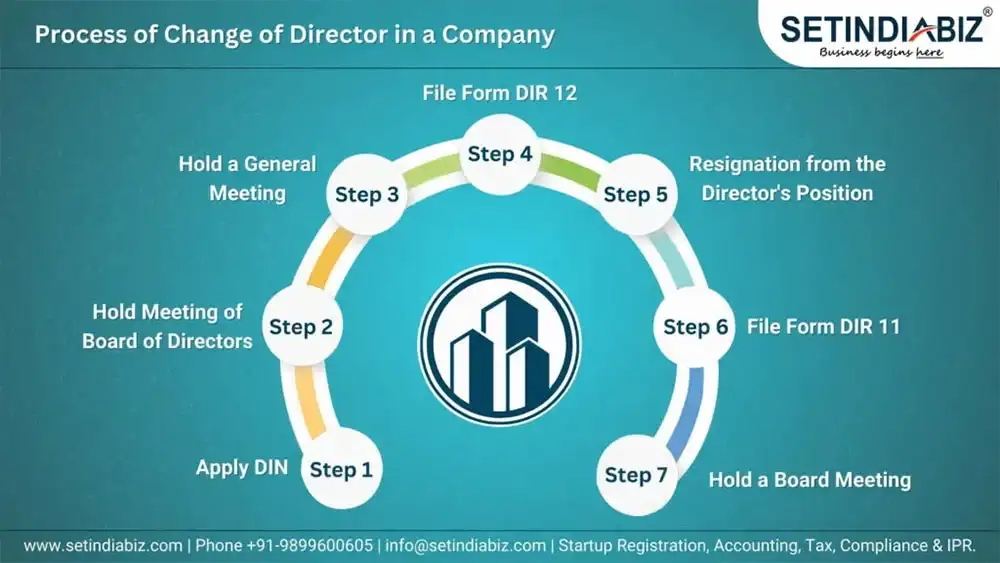
Step 1: Apply DIN
Director Identification Number (DIN) is necessary for the directors of a company if they are proposed to or appointed as a director in a company.
Step 2: Hold Meeting of Board of Directors
In case of a change of director in a company, a board meeting must be held. The board members must consent to the appointment, resignation or removal of a director in the company.
Step 3: Hold a General Meeting
A General Meeting must be held seeking consent of the majority of the board members for changing directors in the company.
Step 4: File Form DIR 12
Within 30 days of appointment of a new director, Form DIR-12 is required to be submitted as per Section 152 (5) of the Companies Act, 2013 with Rule 9 of the Companies (Appointment & Qualification of Directors) Rules, 2014.
Step 5: Resignation from the Director’s Position
A director of the company is free to resign from the company anytime after giving a notice of intimation to the company. The company is required to intimate to the Registrar of Companies within 30 days from the date of Resignation in Form DIR-12.
Step 6: File Form DIR 11
The next step is to file Form DIR-11 to the Registrar of Companies for intimating the resignation of the director.
Step 7: Hold a Board Meeting
Finally, a board meeting needs to be held to officially accept the resignation of the director from his directorship of the company.
This is how following the aforementioned step-by-step process can help fulfill the crucial task of company director change without any hassle and that too within a quicker time span.
Conclusion
Adding or removing director (s) in a private limited company can be done easily by adhering to the terms outlined in the company’s MOA (Memorandum of Association) as well as provisions specified for change of director in the Companies Act 2013. Hopefully, the above post would be helpful in gaining insights into how to change directors in a pvt ltd company.
FAQ’s
What documents are required for share transfer?
Is stamp duty required for share transfer in a private limited company?
Can shares be transferred freely to non-residents in a private limited company?
What is the process of share transfer to a non-resident in a private company?
How is the process of share transfer different for resident and non-resident?
Related Articles :
In This Article
Author Bio

Setindiabiz Editorial Team is a multidisciplinary collective of Chartered Accountants, Company Secretaries, and Advocates offering authoritative insights on India’s regulatory and business landscape. With decades of experience in compliance, taxation, and advisory, they empower entrepreneurs and enterprises to make informed decisions.
